Auld Lang Syne
Behind the song
Two old companions remember running over the hills, picking daisies and paddling in a burn. Years of separation lie between those shared days and the offered hand in the closing verses. Auld Lang Syne brings them together over a drink, with a chorus that invites everyone singing to join in the remembrance. [1]
In December 1788 Frances Dunlop told Burns about meeting an old schoolfriend. His reply dwelt on the pleasure of remembered friendship and the force of the words “Auld lang syne”. He recalled an old song and tune that had moved him deeply. Five years later, he sent the verses to George Thomson for his collection of Scottish songs. [2][5]
The words appeared in James Johnson’s Scots Musical Museum in 1796, set to an older air. George Thomson published them with the familiar melody in 1799. The two settings also give the words a different shape: in the Museum, a drink precedes the childhood memories; in Thomson, it rounds off the song. [7][8][12]
Read the fuller story
The opening question had a long history. In his notes on the song, James C. Dick traces earlier verses through James Watson’s collection of 1711 and Allan Ramsay’s song of 1720. Burns inherited a phrase and a subject that Scottish writers and singers had already made familiar: old friendships remembered across the years. [3]
Writing to Thomson in September 1793, Burns said he had taken the song down from an old man’s singing. He admired the words and called the air “but mediocre”. His account places the song in oral tradition. Later editors argued over how much of the verse Burns had reshaped, and the extent of his contribution remains uncertain. [3][5]
Johnson printed the song as number 413 in the fifth volume of the Museum. The chorus addresses “my jo”, meaning “my dear”, and the second stanza calls for a pint-stowp, a drinking vessel. Then come the hills, daisies and stream of childhood, followed by the offered hand. A small footnote gives singers another choice: “Kiss” in place of “Cup”. [7][9][13]
Thomson’s version addresses “my dear”. Its childhood memories lead to the offered hand, and the invitation to drink comes last. Morag Grant explains that this order follows the version Burns sent to Thomson. The printed heading describes the words as coming from an old manuscript in the editor’s possession. [12][15]
The two melodies also have separate histories. Dick traces the older air through eighteenth-century collections, including Playford’s Original Scotch Tunes of 1700. He connects the familiar melody with tunes called The Miller’s Wedding, The Miller’s Daughter and Sir Alexander Don, and compares it with O can ye labour lea. These connections lead into the dance and song collections from which later musicians drew their material. [3]
William Shield used a related air in his opera Rosina in 1783. Dick places that music beside a Cumming example dated 1780 and argues that Shield adapted an existing tune. The comparison helps explain how an air could pass through a dance collection, the theatre and a new song setting. [3]
The music gives each version its own character. The Museum prints the older melody with a bass line beneath it. Thomson’s 1799 setting adds a keyboard introduction and conclusion, a flowing accompaniment and a second voice in the chorus. Its direction, Allegretto, calls for a moderately lively pace. [9][12][13]
Koželuch simplified the Thomson arrangement in 1801, easing the running keyboard accompaniment. Thomson later published Beethoven’s arrangement in 1841. Singers could carry the same words into performances with different accompaniments and vocal parts. [6][11][12]
Story references
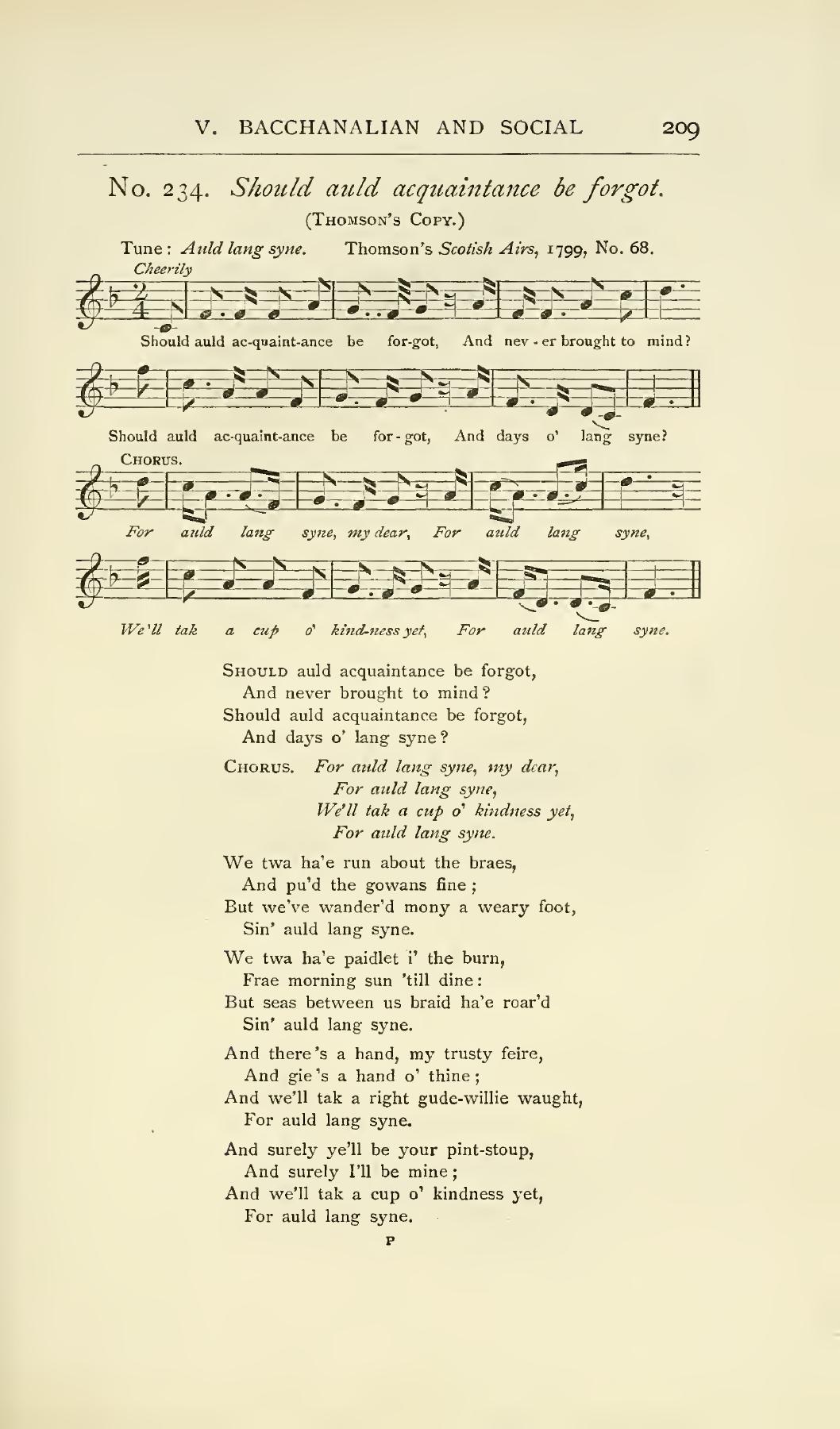
- James C. Dick, The Songs of Robert Burns (1903), nos 233–234, pp. 208–209: the two printed lyrics and tunes.
- Burns to Frances Dunlop, December 1788, in Allan Cunningham’s collected edition (1855), letter CXLII, pp. 394–395.
- James C. Dick, The Songs of Robert Burns (1903), notes 233–234, pp. 433–440: earlier songs, tunes and testimony.
- University of Glasgow, Editing Robert Burns for the 21st Century: Auld Lang Syne exhibition, especially the Johnson and Thomson sections.
- Burns to George Thomson, September 1793, Cunningham 1855, p. 470: account of the old man’s singing and judgement of the air.
- University of Glasgow, Auld lang syne — GT: Beethoven arrangement and period-performance recording.
- The Morgan Library & Museum, “First publication of the Burns verses”: Scots Musical Museum, vol. V (1796), no. 413, p. 426; exhibited original.
- The Morgan Library & Museum, “Words and melody, together at last”: Thomson, Select Collection (1799), third set, p. 68; exhibited lyric and score.
- Scots Musical Museum, no. 413, p. 426, photographed page reproduced by the University of Glasgow. The isolated image does not independently date this copy’s impression.
- Thomson, “Should auld acquaintance be forgot”, letterpress p. 68, photographed lyric reproduced by Glasgow under its 1799 heading. The specific issue of this leaf remains unverified.
- Thomson, engraved p. 68, photographed score reproduced by Glasgow; footer records Koželuch’s simplification in 1801.
- Thomson 1799, third set, letterpress and engraved p. 68: high-resolution reproduction of the Morgan James Fuld original via Wikimedia Commons; visually matched to reference 8.
- James Johnson, Scots Musical Museum, NLS Inglis collection, Ing. 43, no. 413, p. 426 (PDF 23); volume V title PDF 9; volume VI preface dated 4 June 1803 at PDF 137.
- Scotish Musical Museum, volume V (Blackwood and Cadell, 1839): dated title PDF 7; engraved title PDF 9; no. 413, p. 426, PDF 29.
- M. J. Grant, Auld Lang Syne: A Song and its Culture (Open Book Publishers, 2021), p. 44: stanza order in the version sent to Thomson.
- David Laing, preface to the Scotish Musical Museum, vol. I (1839), pp. ii, xviii–xxi; PDF 20, 36–39.
- Murray Pittock, Who Wrote the Scots Musical Museum? (2016), p. 16; PDF 14.
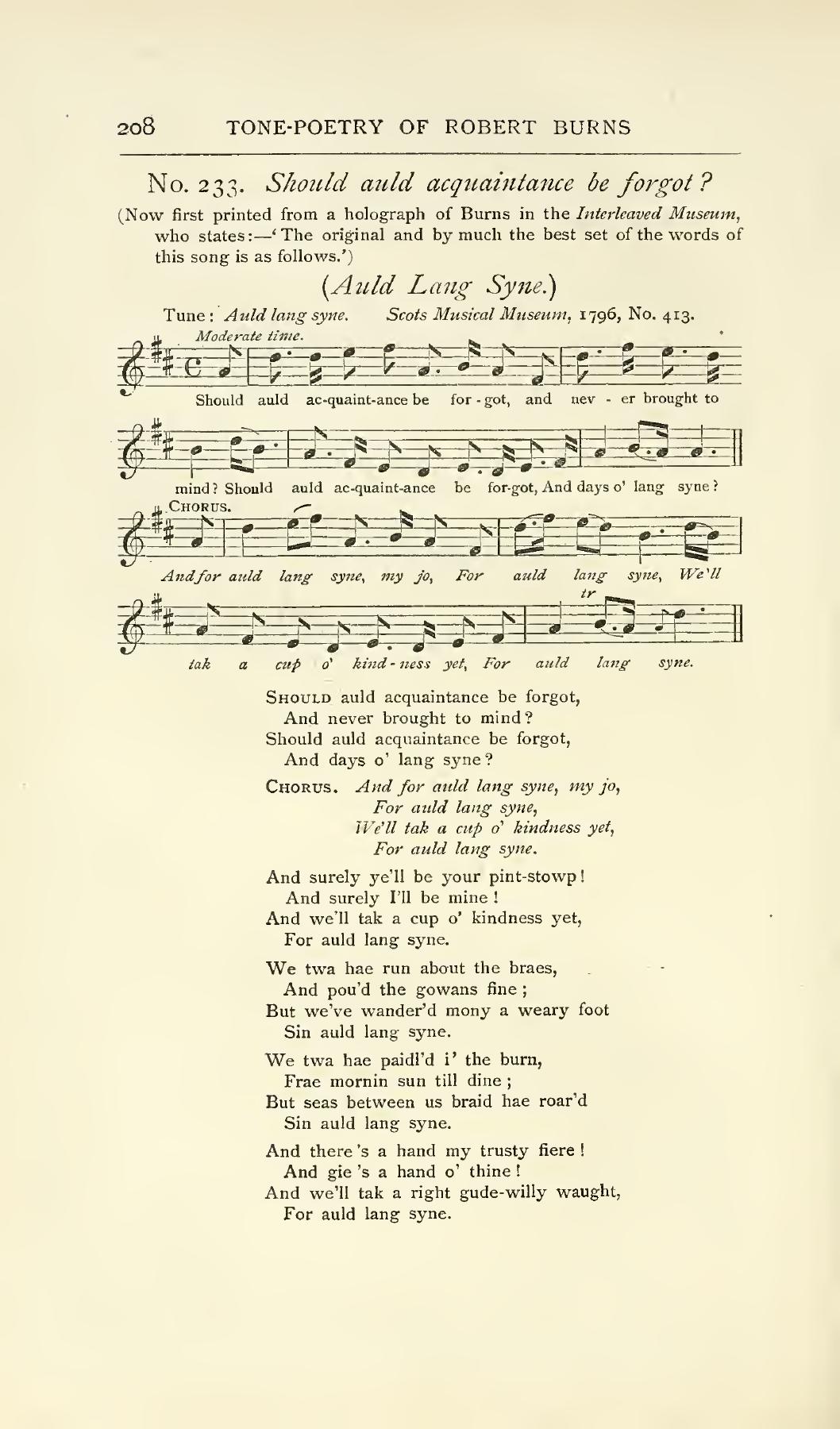 View score Dick’s Songs of Robert Burns (1903)
Lyrics
Choose an edition
- Dick (1903) · no. 233 · older tune
- Dick (1903) · no. 234 · familiar tune
- Scots Musical Museum, vol. V · no. 413 · NLS Inglis copy, catalogued 1796
- Scots Musical Museum, vol. V · no. 413 · 1839 edition
- Scots Musical Museum, vol. V · no. 413 · Glasgow copy
- Thomson’s Scottish Airs (1799) · no. 68
- Thomson’s Scottish Airs · no. 68 · Glasgow copy
- Cunningham (1855)
- Scots Musical Museum, vol. V (catalogued 1796) · no. 413
Version notes
The first stanza ends “And auld lang syne!” in the Glasgow copy of the Scots Musical Museum and “And days o’ lang syne?” in Thomson’s 1799 printing. The Museum places the pint stanza near the beginning. Thomson places it last. Scots Musical Museum, vol. V · no. 413 · Glasgow copy · Thomson’s Scottish Airs (1799) · no. 68
Dick (1903) · no. 233 · older tune
Should auld acquaintance be forgot,
  And never brought to mind?
Should auld acquaintance be forgot,
  And days o’ lang syne?

Chorus. And for auld lang syne, my jo,
          For auld lang syne,
        We’ll tak a cup o’ kindness yet,
          For auld lang syne.

And surely ye’ll be your pint-stowp!
  And surely I’ll be mine!
And we’ll tak a cup o’ kindness yet,
  For auld lang syne.

We twa hae run about the braes,
  And pou’d the gowans fine;
But we’ve wander’d mony a weary foot
  Sin auld lang syne.

We twa hae paidl’d i’ the burn,
  Frae mornin sun till dine;
But seas between us braid hae roar’d
  Sin auld lang syne.

And there’s a hand my trusty fiere!
  And gie’s a hand o’ thine!
And we’ll tak a right gude-willy waught,
  For auld lang syne.
Complete lyric checked against Dick 1903. Original Scots and stanza order retained; typography normalised.
View the source edition · no. 233; p. 208
About this edition
Dick says he takes the words from a handwritten copy in the Interleaved Museum. Here the chorus opens “And for auld lang syne, my jo”, and the pint-stowp stanza comes second. His text differs in small spellings and phrasing from the printed Museum versions, which have their own selections.
Dick (1903) · no. 234 · familiar tune
Should auld acquaintance be forgot,
  And never brought to mind?
Should auld acquaintance be forgot,
  And days o’ lang syne?

Chorus. For auld lang syne, my dear,
          For auld lang syne,
        We’ll tak a cup o’ kindness yet,
          For auld lang syne.

We twa ha’e run about the braes,
  And pu’d the gowans fine;
But we’ve wander’d mony a weary foot,
  Sin’ auld lang syne.

We twa ha’e paidlet i’ the burn,
  Frae morning sun ’till dine:
But seas between us braid ha’e roar’d
  Sin’ auld lang syne.

And there’s a hand, my trusty feire,
  And gie’s a hand o’ thine;
And we’ll tak a right gude-willie waught,
  For auld lang syne.

And surely ye’ll be your pint-stoup,
  And surely I’ll be mine;
And we’ll tak a cup o’ kindness yet,
  For auld lang syne.
Complete lyric checked against Dick 1903. Original Scots and stanza order retained; typography normalised.
View the source edition · no. 234; p. 209
About this edition
Dick calls this “Thomson’s Copy”. The chorus addresses “my dear”, and the pint-stoup stanza closes the song. The reading keeps Dick’s spellings, including “ha’e”, “paidlet”, “feire” and “gude-willie”. Select the original 1799 Thomson version to compare the earlier printed text.
Scots Musical Museum, vol. V · no. 413 · NLS Inglis copy, catalogued 1796
Should auld acquaintance be forgot
And never brought to mind?
Should auld acquaintance be forgot,
And auld lang syne!

Chorus. For auld lang syne my jo,
For auld lang syne,
We’ll tak a cup o’ kindness yet
for auld lang syne.

And surely ye’ll be your pint stowp!
And surely I’ll be mine!
And we’ll tak a cup o’ kindness yet,
For auld lang syne.
For auld &c.

We twa hae run about the braes,
And pou’d the gowans fine;
But we’ve wander’d mony a weary fitt,
Sin auld lang syne.
For auld &c.

We twa hae paidl’d in the burn,
Frae morning sun till dine;
But seas between us braid hae roar’d,
Sin auld lang syne.
For auld &c.

And there’s a hand, my trusty fiere!
And gie’s a hand o’ thine!
And we’ll tak a right gude-willie-waught,
For auld lang syne.
For auld &c.

Printed footnote to “cup”: Some Sing Kiss in place of Cup.
The library catalogues this copy as 1796. Its exact impression is uncertain.
View the source edition · no. 413; p. 426 by sequence
About this edition
The pint-stowp stanza comes second, and a footnote offers “Kiss” in place of “Cup”. The reading preserves the abbreviated refrain “For auld &c.”. Long-s and apostrophe shapes are normalised, and words split across the music are joined for reading. The volume has an undated title and is bound with material dated 1803; the precise date of this impression remains unresolved.
Scots Musical Museum, vol. V · no. 413 · 1839 edition
View the source edition · Volume V, p. 426, no. 413
About this edition
This edition has a title page dated 1839. Its score preserves a different bass phrase from the Inglis copy, giving a dated example of the lower accompaniment. The complete page can be enlarged under Music; a proofread reading text is still to be prepared.
Scots Musical Museum, vol. V · no. 413 · Glasgow copy
Should auld acquaintance be forgot
And never brought to mind?
Should auld acquaintance be forgot,
And auld lang syne!

Chorus. For auld lang syne my jo,
For auld lang syne,
We’ll tak a cup o’ kindness yet
for auld lang syne.

And surely ye’ll be your pint stowp!
And surely I’ll be mine!
And we’ll tak a cup o’ kindness yet,
For auld lang syne.
For auld, &c.

We twa hae run about the braes,
And pou’d the gowans fine;
But we’ve wander’d mony a weary fitt,
Sin auld lang syne.
For auld, &c.

We twa hae paidl’d in the burn,
Frae morning sun till dine;
But seas between us braid hae roar’d,
Sin auld lang syne.
For auld, &c.

And there’s a hand, my trusty fiere.
And gie’s a hand o’ thine!
And we’ll tak a right gude-willie-waught,
For auld lang syne.
For auld, &c.

Printed footnote to “cup”: Some Sing, Kiss, in place of Cup.
The words follow Glasgow’s photograph of the printed page. The issue it came from is uncertain.
View the source edition · no. 413; p. 426
About this edition
The chorus addresses “my jo”, the pint-stowp stanza comes second, and the footnote offers “Kiss” in place of “Cup”. The reading joins syllables printed beneath the music and normalises long-s. It retains this copy’s spelling and punctuation, including “fiere.” and “thine!”.
Thomson’s Scottish Airs (1799) · no. 68
Should auld acquaintance be forgot,
And never brought to mind?
Should auld acquaintance be forgot,
And days o’ lang syne?
Chorus. For auld lang syne, my dear,
For auld lang syne,
We’ll tak’ a cup o’ kindness yet,
For auld lang syne.

We twa ha’e run about the braes,
And pu’d the gowans fine;
But we’ve wander’d mony a weary foot,
Sin’ auld lang syne.
For auld lang syne, my dear, &c.

We twa ha’e paidlet i’ the burn,
Frae morning sun ’till dine:
But seas between us braid ha’e roar’d,
Sin’ auld lang syne.
For auld lang syne, my dear,
For auld lang syne,
We’ll tak’ a cup o’ kindness yet,
For auld lang syne.

And there’s a hand, my trusty feire,
And gi’es a hand o’ thine;
And we’ll tak’ a right gude-willie waught,
For auld lang syne.
For auld lang syne, my dear, &c.

And surely ye’ll be your pint-stoup,
And surely I’ll be mine;
And we’ll tak’ a cup o’ kindness yet,
For auld lang syne.
For auld lang syne, my dear,
For auld lang syne,
We’ll tak’ a cup o’ kindness yet,
For auld lang syne.
Complete lyric checked against a high-resolution reproduction of the Morgan original. Typography normalised; Scots spelling, punctuation and refrain instructions retained.
View the source edition · Third set; letterpress and engraved p. 68
About this edition
The pint stanza comes last. The text reads “paidlet i’ the burn”, “sun ’till dine:”, “trusty feire”, “gi’es” and “gude-willie waught”. These small differences distinguish it from the separately photographed Thomson lyric. The date follows the Morgan Library’s identification of its original.
Thomson’s Scottish Airs · no. 68 · Glasgow copy
Should auld acquaintance be forgot,
And never brought to mind?
Should auld acquaintance be forgot,
And days o’ lang syne?
Chorus. For auld lang syne, my dear,
For auld lang syne,
We’ll tak’ a cup o’ kindness yet,
For auld lang syne.

We twa ha’e run about the braes,
And pu’d the gowans fine;
But we’ve wander’d mony a weary foot,
Sin’ auld lang syne.
For auld lang syne, my dear, &c.

We twa ha’e paidlet in the burn,
Frae morning sun till dine;
But seas between us braid ha’e roar’d
Sin’ auld lang syne.
For auld lang syne, my dear,
For auld lang syne,
We’ll tak’ a cup o’ kindness yet,
For auld lang syne.

And there’s a hand, my trustie feire,
And gi’e’s a hand o’ thine;
And we’ll tak’ a right gude-willie-waught,
For auld lang syne.
For auld lang syne, my dear, &c.

And surely ye’ll be your pint-stoup,
And surely I’ll be mine;
And we’ll tak’ a cup o’ kindness yet,
For auld lang syne.
For auld lang syne, my dear,
For auld lang syne,
We’ll tak’ a cup o’ kindness yet,
For auld lang syne.
The words follow Glasgow’s photograph of the printed page. The issue it came from is uncertain.
View the source edition · Letterpress p. 68
About this edition
The heading describes the words as “From an old MS. in the editor’s possession”. This lyric has small differences from the original 1799 printing, including “in the burn” and “trustie feire”. Its precise issue is undated. The reading preserves Scots spelling, punctuation and refrain instructions, with typography normalised.
Cunningham (1855)
Should auld acquaintance be forgot,
  And never brought to min’?
Should auld acquaintance be forgot,
  And days o’ lang syne?
    For auld lang syne, my dear,
      For auld lang syne,
    We’ll tak a cup o’ kindness yet,
      For auld lang syne!

We twa hae run about the braes,
  And pu’t the gowans fine;
But we’ve wander’d mony a weary foot,
  Sin’ auld lang syne.

We twa hae paidl’t i’ the burn,
  Frae mornin’ sun till dine:
But seas between us braid hae roar’d,
  Sin’ auld lang syne.

And here’s a hand, my trusty fiere,
  And gie’s a hand o’ thine;
And we’ll take a right guid willie-waught,
  For auld lang syne.

And surely ye’ll be your pint-stowp,
  And surely I’ll be mine;
And we’ll tak a cup o’ kindness yet,
  For auld lang syne.
    For auld lang syne, my dear,
      For auld lang syne,
    We’ll tak a cup o’ kindness yet,
      For auld lang syne!
Digital text from Project Gutenberg.
View the source edition · p. 287
About this edition
This text is collected from Cunningham’s 1855 edition. Its spelling and wording can be compared with the checked earlier readings; proofreading against a printed copy remains outstanding.
Scots Musical Museum, vol. V (catalogued 1796) · no. 413
View the source edition · Volume 5, no. 413; p. 426
Music
View historical scores
Dick’s Songs of Robert Burns (1903)
no. 233; p. 208
View source · Download citation
Dick’s Songs of Robert Burns (1903)
no. 234; p. 209
Collected or transmitted by Burns
Burns said he took the song down from an old man’s singing. Dick discusses revision and competing accounts of the words. The amount attributable to Burns remains uncertain.
Words Traditional material with Burns’s contribution disputed
Burns’s role Collection, transmission and revision; extent uncertain