My Nanie, O
Behind the song
Which river flows behind Nanie’s hills? The 1787 Edinburgh edition names the Stinchar. Writing to George Thomson, Burns proposed the Lugar. He thought the Girvan best suited the idea of the stanza, but preferred Lugar for “the most agreeable modulation of syllables”. [1][2]
His wages are small, but the farmer is welcome to his thriving sheep and cattle. For the young man setting out across the moor, the best part of the day is the welcome he expects from Nanie. What first prompted Burns to write the song is uncertain. [1]
Read the fuller story
The 1787 Edinburgh edition opens with Stinchar and gives the tune as My Nanie, O. Across eight stanzas, the speaker moves from his intended journey to a declaration of how he wishes to live. He praises Nanie’s honesty, counts his modest wages, and contrasts his own happiness with the farmer’s pleasure in thriving sheep and cattle. [1]
In the letter to Thomson printed by Cunningham, Burns argues that Scots words and manners suit the pastoral character of Scottish airs. He offers his Nannie, O as one set of words for the tune, leaving Thomson free to accept or reject it. His objection to the river name in the printed song is its sound: he proposes Lugar and explains his preference. [2]
Nanie’s identity and the circumstances that first prompted the song remain uncertain. Its account of courtship centres on the farm worker’s modest wages, his welcome with Nanie and his determination to reach her.
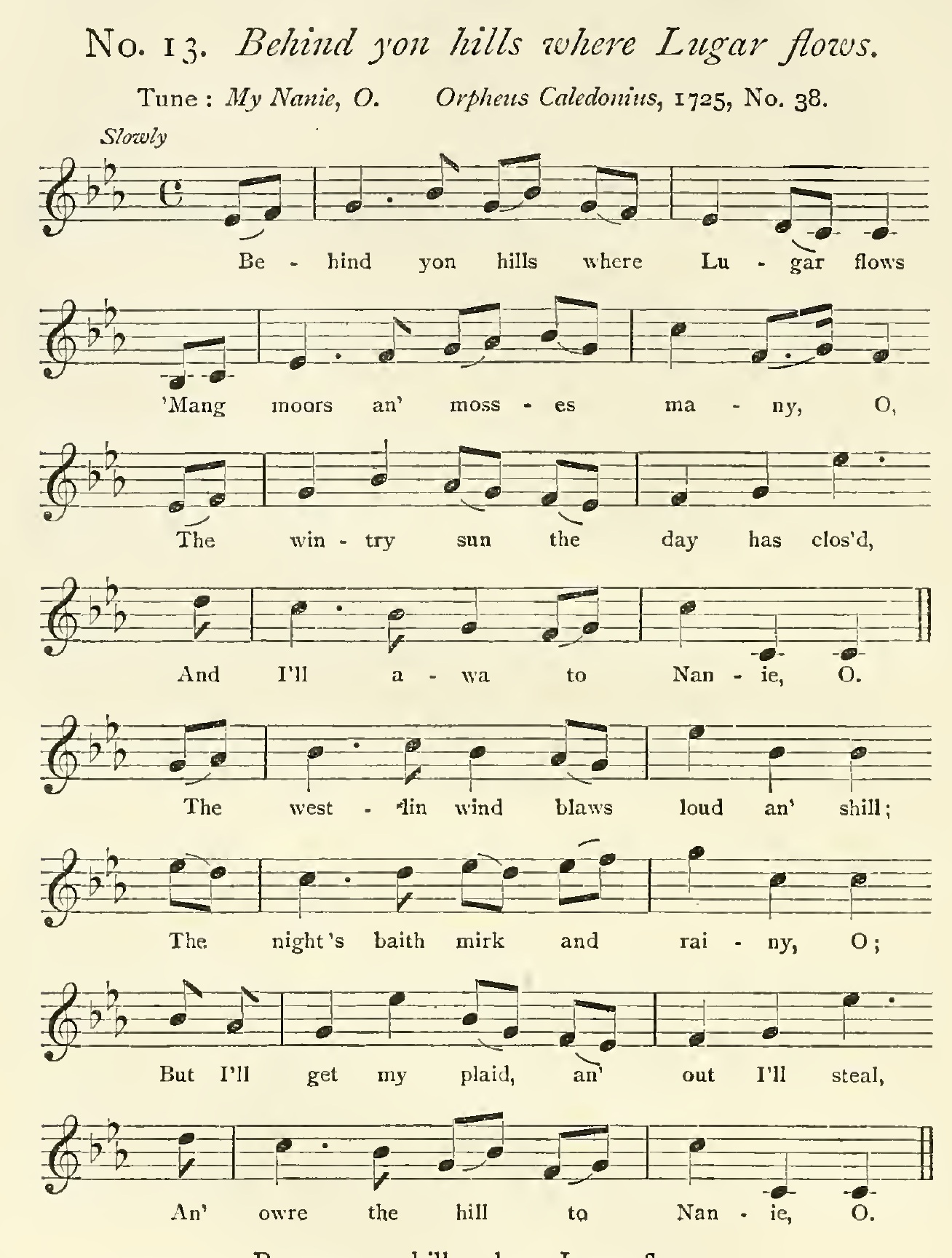 View score Dick’s Songs of Robert Burns (1903)
Lyrics
Choose an edition
Version notes
The opening names the Stinchar in the 1787 Edinburgh edition. In the Scots Musical Museum it runs “where riv’lets row”. The Cunningham transcription gives “where Lugar flows”. Edinburgh Poems (1787) · Scots Musical Museum, vol. VI (1839) · no. 580 · Cunningham · 1855
Dick’s separate lyric has “an’ rainy”. The words printed beneath the notes on the same page give “and rainy”. Dick (1903) · no. 13
| Edinburgh Poems (1787) | Scots Musical Museum, vol. VI (1839) · no. 580 |
|---|---|
| Behind yon hills where Stinchar flows, | Behind yon hills where riv’lets row, |
| ’Mang moors an’ mosses many, O, | Are moors an’ mosses many O; |
| The wintry sun the day has clos’d, | The wint’ry sun the day has clos’d |
| And I’ll awa to Nanie, O. | An’ I’ll away to Nannie O; |
More differences between these editions
| Edinburgh Poems (1787) | Scots Musical Museum, vol. VI (1839) · no. 580 |
|---|---|
| The westlin wind blaws loud an’ shill; | The westlin wind blaws loud an’ shrill, |
| The night’s baith mirk and rainy, O; | The night’s baith mirk an’ rainy O; |
| But I’ll get my plaid an’ out I’ll steal, | I’ll get my plaid an’ out I’ll steal, |
| An’ owre the hill to Nanie, O. | An’ o’er the hill to Nannie O, |
| My Nanie’s charming, sweet an’ young; | My Nannie’s charming, sweet, and young, |
| Nae artfu’ wiles to win ye, O: | Nae artfu’ wiles to win ye O; |
| May ill befa’ the flattering tongue | May ill befa’ the flattering tongue, |
| That wad beguile my Nanie, O. | That wad beguile my Nannie O: |
| As spotless as she’s bonie, O, | As spotless as she’s bonnie O; |
| The op’ning gowan, wat wi’ dew, | The op’ning gowan wat wi’ dew, |
| Nae purer is than Nanie, O. | Nae purer is than Nannie O. |
| An’ few there be that ken me, O; | And few there be that ken me O; |
| I’m welcome ay to Nanie, O. | I’m welcome ay to Nannie O: |
| My riches a’s my penny-fee, | My riches a’s my penny fee, |
| An’ I maun guide it cannie, O; | And I maun guide it cannie O; |
| But warl’s gear ne’er troubles me, | But warld’s gear ne’er troubles me, |
| My thoughts are a’, my Nanie, O. | My thoughts are a’ my Nannie O: |
| Our auld Guidman delights to view | Our auld guidman delights to view, |
| His sheep an’ kye thrive bonie, O; | His sheep an’ kye thrive bonnie O; |
| But I’m as blythe that hauds his pleugh, | But I’m as blythe that hauds his pleugh |
| An’ has nae care but Nanie, O. | An’ has nae care but Nannie O: |
| Come weel come woe, I care na by, | Come weel, come woe, I care na by, |
| I’ll tak what Heav’n will sen’ me, O; | I’ll tak’ what Heav’n will send me O; |
| But live, an’ love my Nanie, O. | But live, and love my Nannie O. |
| Edinburgh Poems (1787) | Dick (1903) · no. 13 |
|---|---|
| Behind yon hills where Stinchar flows, | Behind yon hills where Lugar flows |
| But I’ll get my plaid an’ out I’ll steal, | But I’ll get my plaid, an’ out I’ll steal, |
| Nae artfu’ wiles to win ye, O: | Nae artfu’ wiles to win ye, O; |
| Her face is fair, her heart is true, | Her face is fair, her heart is true; |
More differences between these editions
| Edinburgh Poems (1787) | Dick (1903) · no. 13 |
|---|---|
| As spotless as she’s bonie, O, | As spotless as she’s bonie, O; |
| Our auld Guidman delights to view | Our auld guidman delights to view |
| Come weel come woe, I care na by, | Come weel, come woe, I care na by, |
| But live, an’ love my Nanie, O. | But live, an’ love my Nanie, O! |
| The night’s baith mirk and rainy, O; | The night’s baith mirk an’ rainy, O; |
Edinburgh Poems (1787)
I.
Behind yon hills where Stinchar flows,
’Mang moors an’ mosses many, O,
The wintry sun the day has clos’d,
And I’ll awa to Nanie, O.

II.
The westlin wind blaws loud an’ shill;
The night’s baith mirk and rainy, O;
But I’ll get my plaid an’ out I’ll steal,
An’ owre the hill to Nanie, O.

III.
My Nanie’s charming, sweet an’ young;
Nae artfu’ wiles to win ye, O:
May ill befa’ the flattering tongue
That wad beguile my Nanie, O.

IV.
Her face is fair, her heart is true,
As spotless as she’s bonie, O,
The op’ning gowan, wat wi’ dew,
Nae purer is than Nanie, O.

V.
A country lad is my degree,
An’ few there be that ken me, O;
But what care I how few they be,
I’m welcome ay to Nanie, O.

VI.
My riches a’s my penny-fee,
An’ I maun guide it cannie, O;
But warl’s gear ne’er troubles me,
My thoughts are a’, my Nanie, O.

VII.
Our auld Guidman delights to view
His sheep an’ kye thrive bonie, O;
But I’m as blythe that hauds his pleugh,
An’ has nae care but Nanie, O.

VIII.
Come weel come woe, I care na by,
I’ll tak what Heav’n will sen’ me, O;
Nae ither care in life have I,
But live, an’ love my Nanie, O.
View the source edition · pp. 322–324
About this edition
Mosses are boggy ground; mirk means dark; gowan is a daisy; kye means cattle. The speaker’s penny-fee is his cash wage, which he must manage carefully. The auld Guidman is the farmer whose plough he holds.
In the collected letter to Thomson, Burns calls the printed river name ‘horribly prosaic’ and proposes ‘Behind yon hills where Lugar flows’. He says Girvan suits the stanza’s idea best, but Lugar has ‘the most agreeable modulation of syllables’. The editor’s footnote identifies Stinchar in the 1787 edition. [2]
Scots Musical Museum, vol. VI (1839) · no. 580
Behind yon hills where riv’lets row,
Are moors an’ mosses many O;
The wint’ry sun the day has clos’d
An’ I’ll away to Nannie O;
The westlin wind blaws loud an’ shrill,
The night’s baith mirk an’ rainy O;
I’ll get my plaid an’ out I’ll steal,
An’ o’er the hill to Nannie O,
To Nannie O to Nannie O;
I’ll get my plaid an’ out I’ll steal,
An’ o’er the hill to Nannie O.

My Nannie’s charming, sweet, and young,
Nae artfu’ wiles to win ye O;
May ill befa’ the flattering tongue,
That wad beguile my Nannie O:
Her face is fair, her heart is true,
As spotless as she’s bonnie O;
The op’ning gowan wat wi’ dew,
Nae purer is than Nannie O.

A country lad is my degree,
And few there be that ken me O;
But what care I how few they be,
I’m welcome ay to Nannie O:

My riches a’s my penny fee,
And I maun guide it cannie O;
But warld’s gear ne’er troubles me,
My thoughts are a’ my Nannie O:

Our auld guidman delights to view,
His sheep an’ kye thrive bonnie O;
But I’m as blythe that hauds his pleugh
An’ has nae care but Nannie O:
Come weel, come woe, I care na by,
I’ll tak’ what Heav’n will send me O;
Nae ither care in life have I,
But live, and love my Nannie O.
AI visual reading transcription of printed p.600. Long s and apostrophes normalised; musical syllables joined and underlay arranged into reading lines. The repeated musical passage is retained; spacing normalised.
View the source edition · Volume VI, no. 580, p. 600
About this edition
The opening removes the named river and continues “Are moors”. This setting repeats “To Nannie O” and the last two lines of the second verse. The reading text retains that passage. Later wording includes “warld’s gear” and “Heav’n will send me”. The edition alone does not establish who made these changes or when.
In the collected letter to Thomson, Burns calls the printed river name ‘horribly prosaic’ and proposes ‘Behind yon hills where Lugar flows’. He says Girvan suits the stanza’s idea best, but Lugar has ‘the most agreeable modulation of syllables’. The editor’s footnote identifies Stinchar in the 1787 edition. [2]
Cunningham (1855)
Behind yon hills, where Lugar flows,
  ‘Mang moors an’ mosses many, O,
The wintry sun the day has closed,
  And I’ll awa to Nannie, O.

The westlin wind blaws loud an’ shrill;
  The night’s baith mirk and rainy, O;
But I’ll get my plaid, an’ out I’ll steal,
  An’ owre the hills to Nannie, O.

My Nannie’s charming, sweet, an’ young;
  Nae artfu’ wiles to win ye, O:
May ill befa’ the flattering tongue
  That wad beguile my Nannie, O.

Her face is fair, her heart is true,
  As spotless as she’s bonnie, O:
The op’ning gowan, wat wi’ dew,
  Nae purer is than Nannie, O.

A country lad is my degree,
  An’ few there be that ken me, O;
But what care I how few they be?
  I’m welcome ay to Nannie, O.

My riches a’s my penny-fee,
  An’ I maun guide it cannie, O;
But warl’s gear ne’er troubles me,
  My thoughts are a’ my Nannie, O.

Our auld guidman delights to view
  His sheep an’ kye thrive bonnie, O;
But I’m as blythe that hauds his pleugh,
  An’ has nae care but Nannie, O.

Come weel, come woe, I care na by,
  I’ll tak what Heav’n will sen’ me, O:
Nae ither care in life have I,
  But live, an’ love my Nannie, O.
Digital text from Project Gutenberg.
View the source edition · p. 213; song XIV
About this edition
The Lugar opening agrees with the river name proposed in the collected letter to Thomson. Other differences in spelling and wording should be read as this edition’s text; a full comparison remains to be made.
In the collected letter to Thomson, Burns calls the printed river name ‘horribly prosaic’ and proposes ‘Behind yon hills where Lugar flows’. He says Girvan suits the stanza’s idea best, but Lugar has ‘the most agreeable modulation of syllables’. The editor’s footnote identifies Stinchar in the 1787 edition. [2]
Dick (1903) · no. 13
Behind yon hills where Lugar flows
’Mang moors an’ mosses many, O,
The wintry sun the day has clos’d,
And I’ll awa to Nanie, O.
The westlin wind blaws loud an’ shill;
The night’s baith mirk an’ rainy, O;
But I’ll get my plaid, an’ out I’ll steal,
An’ owre the hill to Nanie, O.

My Nanie’s charming, sweet an’ young;
Nae artfu’ wiles to win ye, O;
May ill befa’ the flattering tongue
That wad beguile my Nanie, O.
Her face is fair, her heart is true;
As spotless as she’s bonie, O;
The op’ning gowan, wat wi’ dew,
Nae purer is than Nanie, O.

A country lad is my degree,
An’ few there be that ken me, O;
But what care I how few they be,
I’m welcome ay to Nanie, O.
My riches a’s my penny-fee,
An’ I maun guide it cannie, O;
But warl’s gear ne’er troubles me,
My thoughts are a’, my Nanie, O.

Our auld guidman delights to view
His sheep an’ kye thrive bonie, O;
But I’m as blythe that hauds his pleugh,
An’ has nae care but Nanie, O.
Come weel, come woe, I care na by,
I’ll tak what Heav’n will sen’ me, O;
Nae ither care in life have I,
But live, an’ love my Nanie, O!
AI visual reading transcription of the separate lyric on printed pp.12–13. Apostrophes, display capitals and spacing normalised; verse grouping retained. Score underlay is not duplicated.
View the source edition · no. 13, pp. 12–13
About this edition
The separate printed lyric begins on p.12 and continues on p.13, ending before song no.14. All notation is on p.12. Its underlay has “and rainy” where the separate lyric prints “an’ rainy”; the reading panel follows the separate lyric. Dick’s historical commentary remains a separate catalogue witness.
In the collected letter to Thomson, Burns calls the printed river name ‘horribly prosaic’ and proposes ‘Behind yon hills where Lugar flows’. He says Girvan suits the stanza’s idea best, but Lugar has ‘the most agreeable modulation of syllables’. The editor’s footnote identifies Stinchar in the 1787 edition. [2]
Music
View historical scores
Dick’s Songs of Robert Burns (1903)
pp. 12–13; PDF68–69; no. 13
This version opens ‘Behind yon hills where Lugar flows’. The tune is headed ‘My Nanie, O’.