O’er the moor amang the heather
Behind the song
A traveller crossing the craigs of Kyle meets a young woman keeping her sheep among the heather. He asks where she lives; she answers by describing the flocks she tends. They lie together on a sunny bank, the sheep wander freely, and she sings. The meeting becomes a memory that the traveller says has left him unable to think of anyone else. [1]
The refrain makes the heather a place to return to after each stage of the encounter. Its last two lines change with the verses: first the woman keeps her sheep together, then she lets them roam, and finally the singer declares that she shall be his. The repeated music carries the story forward while holding its landscape in the ear. [1]
Read the fuller story
The woman’s singing is the turning point. Her voice sends an echo across the moor, and the burden of her song is the title of the song we are already hearing. This moment makes the refrain part of the lovers’ meeting as well as part of its retelling. “Yowes” are ewes, “tent” means tend, and “sinsyne” means since then. [1]
Burns identified Jean Glover as the song’s composer and said he took it down from her singing while she was travelling with a sleight-of-hand performer. Dick reproduces that note and records publication in the Scots Musical Museum in 1792, from a manuscript supplied by Burns. [2]
Dick placed the song in his appendix and emphasised Burns’s attribution to Glover. He also left open how much Burns might have contributed to the version he supplied. Burns’s note contains hostile accusations about the singer; those are uncorroborated allegations. Her biography follows the surviving account of her performance and the less certain traditions about her life. [2]
The melody had circulated before the song reached the Museum. Dick identifies a tune of this name in Bremner’s Reels of 1760, followed by other printed collections. This older musical history is compatible with Glover supplying words to an existing air. Dick’s discussion leaves the precise extent of her composition and Burns’s editing unresolved. [2]
The held Museum volume prints the piece as number 328 on page 338, with a bass part and the direction “Lively but Slow”. Dick’s later page gives a melody staff and a separate chorus. The Museum abbreviates repeated chorus lines, while Dick writes them out beneath successive verses. Its fourth verse has “echo rang” where Dick has “echo ran”. These are separate edition readings, available through the source references. [1][3]
Story references
- Dick (1903), no.356, printed pp.344–345; complete lyric and notation heading.
- Dick (1903), note356, printed p.501; Burns’s transmitted attribution and editorial discussion.
- Held Scots Musical Museum, volume IV, no.328, printed p.338, PDF40; copy appearance, not a newly verified first-edition impression.
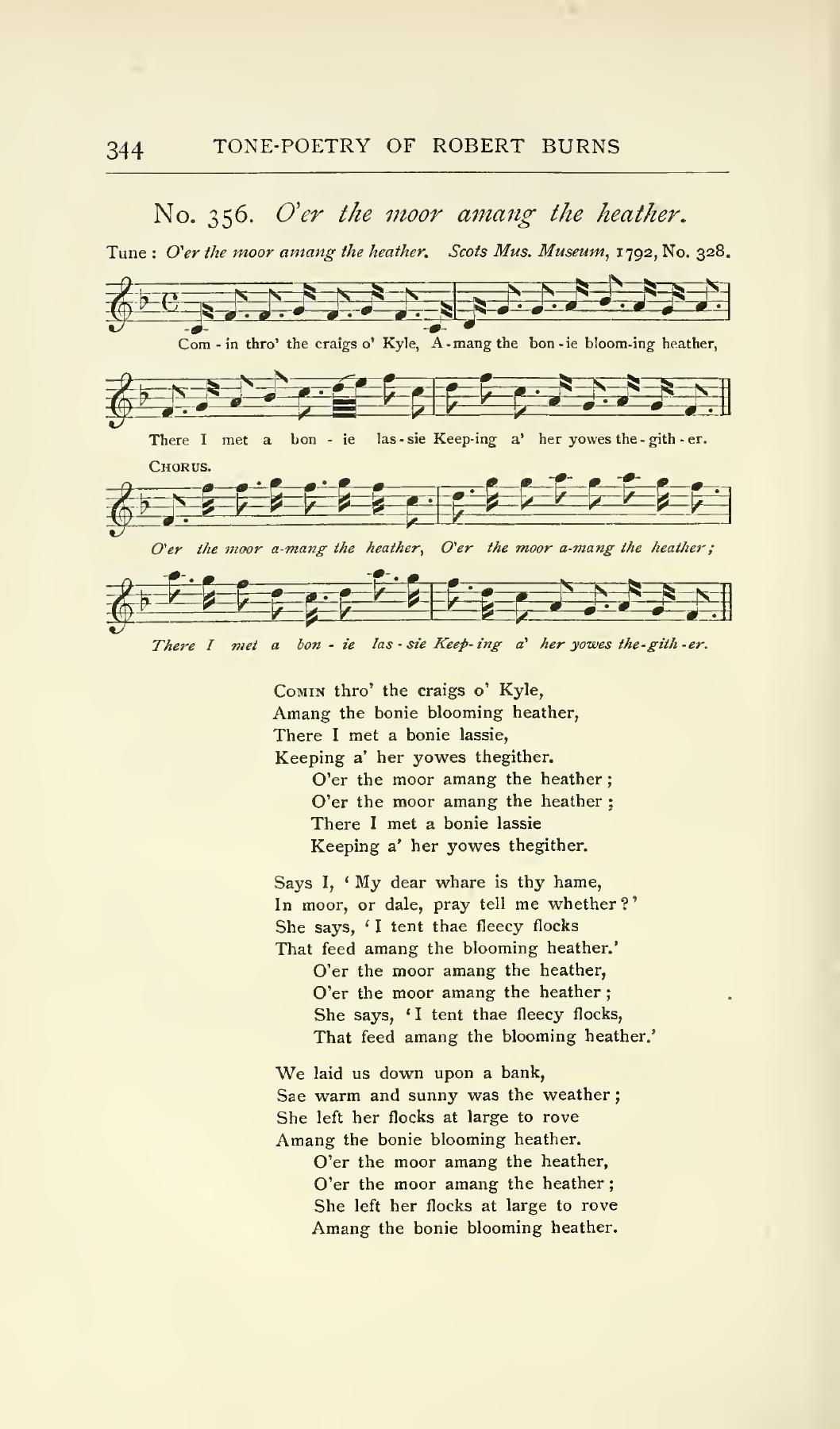 View score Dick’s Songs of Robert Burns (1903)
Lyrics
Choose an edition
Dick (1903) · no. 356
O'er the moor amang the heather.
Comin thro' the craigs o' Kyle,
Amang the bonie blooming heather,
There I met a bonie lassie,
Keeping a' her yowes thegither.
CHORUS
O'er the moor amang the heather;
O'er the moor amang the heather;
There I met a bonie lassie
Keeping a' her yowes thegither.

Says I, 'My dear whare is thy hame,
In moor, or dale, pray tell me whether?'
She says, 'I tent thae fleecy flocks
That feed amang the blooming heather.'
CHORUS
O'er the moor amang the heather,
O'er the moor amang the heather;
She says, 'I tent thae fleecy flocks,
That feed amang the blooming heather.'

We laid us down upon a bank,
Sae warm and sunny was the weather;
She left her flocks at large to rove
Amang the bonie blooming heather.
CHORUS
O'er the moor amang the heather,
O'er the moor amang the heather;
She left her flocks at large to rove
Amang the bonie blooming heather.

While thus we lay, she sang a sang,
Till echo ran a mile and farther;
And ay the burden o' the sang
Was, O'er the moor amang the heather.
CHORUS
O'er the moor amang the heather,
O'er the moor amang the heather;
And ay the burden o' the sang
Was, O'er the moor amang the heather.

She charm'd my heart, and ay sinsyne,
I could na think on ony ither:
By sea and sky she shall be mine!
The bonie lass amang the heather.
CHORUS
O'er the moor amang the heather,
O'er the moor amang the heather;
By sea and sky she shall be mine!
The bonie lass amang the heather.
View the source edition · O'er the moor amang the heather.
Scots Musical Museum, vol. IV (1792) · no. 328
View the source edition · Volume 4, no. 328; p. 338
About this edition
The Museum has “echo rang” where Dick prints “echo ran”; repeated chorus lines are abbreviated.
Music
View historical scores
Dick’s Songs of Robert Burns (1903)
O'er the moor amang the heather.
Collected or transmitted by Burns
Dick reproduces Burns’s attribution to Glover and his account of collecting the song. The extent of Burns’s editing remains uncertain.
Words Jean Glover, as attributed by Burns
Burns’s role Taken down from Glover’s singing and supplied for print