Hee Balou! my sweet wee Donald
Behind the song
The mother singing Donald to sleep already has plans for him. When he grows up, he can steal a horse and bring home a Carlisle cow. She calls him the picture of Clanronald and reckons the chief knows well enough who fathered him. [1]
She imagines Donald raiding through the Lowlands and over the Border before she calls him home. James C. Dick repeats William Stenhouse’s account that a Highland woman gave Burns the meaning and the air of a Gaelic nursery song. [1][2]
Read the fuller story
Dick quotes Stenhouse’s account that Burns versified a Gaelic nursery song whose meaning and air had been communicated by a Highland woman. Cunningham describes an older strain amended and extended by Burns, and says it was sent to the Museum in his handwriting. [2][3]
Dick prints the air The highland balou, marked Very slow, with a heading referring to Museum no472 of 1796. His note compares the song’s attitude to cattle lifting with a conversation in Walter Scott’s Waverley. The lyric’s own particulars—Donald, his chief and the hoped-for Carlisle cow—give the comic voice its shape. [1][2]
Story references
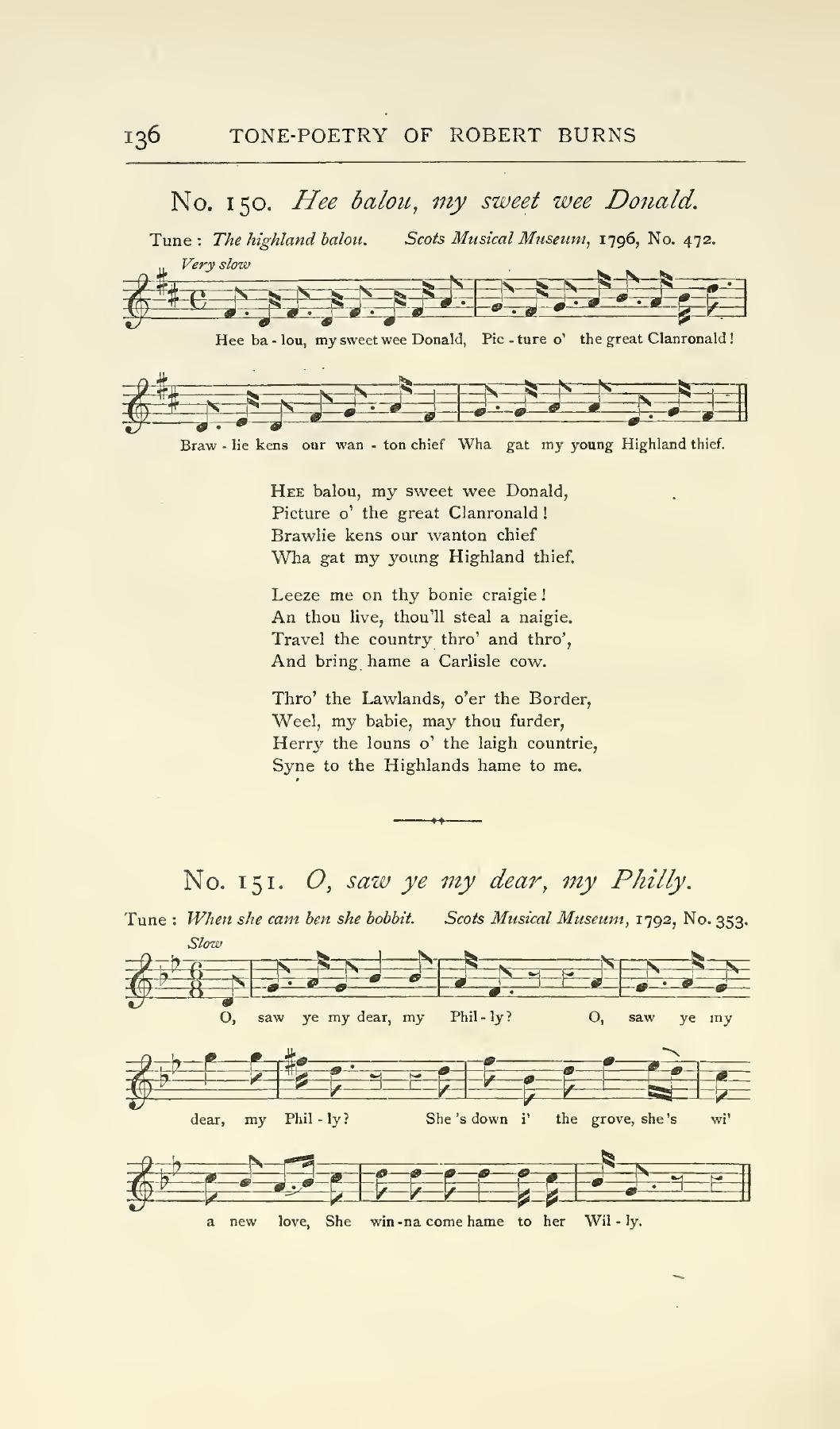 View score Dick’s Songs of Robert Burns (1903)
Lyrics
Choose an edition
Version notes
| Dick (1903) · no. 150 | Cunningham · 1855Ebook transcription |
|---|---|
| gat | got |
| bonie / An thou / countrie | bonnie / An’ thou / countree |
| Hee balou, / Clanronald! | Hee balou! / Clanronald; |
| craigie! / naigie. | craigie, / naigie: |
More differences between these editions
| Dick (1903) · no. 150 | Cunningham · 1855Ebook transcription |
|---|---|
| Border, / furder, | border, / furder: |
Dick (1903) · no. 150
Hee balou, my sweet wee Donald,
Picture o' the great Clanronald!
Brawlie kens our wanton chief
Wha gat my young Highland thief.

Leeze me on thy bonie craigie!
An thou live, thou'll steal a naigie.
Travel the country thro' and thro',
And bring hame a Carlisle cow.

Thro' the Lawlands, o'er the Border,
Weel, my babie, may thou furder,
Herry the louns o' the laigh countrie,
Syne to the Highlands hame to me.
View the source edition · no. 150; p. 136
About this edition
Both readings contain three quatrains. Dick has gat, bonie, An thou and countrie; Cunningham has got, bonnie, An’ thou and countree. Dick’s opening uses a comma after balou and an exclamation mark after Clanronald, where Cunningham has an exclamation mark and semicolon. Punctuation after craigie, naigie and furder also differs.
Cunningham (1855)
Hee balou! my sweet wee Donald,
Picture o’ the great Clanronald;
Brawlie kens our wanton chief
Wha got my young Highland thief.

Leeze me on thy bonnie craigie,
An’ thou live, thou’ll steal a naigie:
Travel the country thro’ and thro’,
And bring hame a Carlisle cow.

Thro’ the Lawlands, o’er the border,
Weel, my babie, may thou furder:
Herry the louns o’ the laigh countree,
Syne to the Highlands hame to me.
Digital text from Project Gutenberg.
View the source edition · p. 270
About this edition
Both readings contain three quatrains. Dick has gat, bonie, An thou and countrie; Cunningham has got, bonnie, An’ thou and countree. Dick’s opening uses a comma after balou and an exclamation mark after Clanronald, where Cunningham has an exclamation mark and semicolon. Punctuation after craigie, naigie and furder also differs.
Scots Musical Museum, vol. V (catalogued 1796) · no. 472
View the source edition · Volume 5, no. 472; p. 486
Music
View historical scores
Dick’s Songs of Robert Burns (1903)
no. 150; p. 136