The lovely Lass of Inverness
Behind the song
At Drumossie Moor the lass of Inverness lost her father, her three brothers and the man she loved. This is Culloden, fought on 16 April 1746. James C. Dick credits Burns with all but the first four lines, where someone watching describes a young woman in tears. Then she speaks for herself. [1][2]
Grass grows over the ground where they lie, with the bloody earth for their winding-sheet. She names her father again and turns on the lord who has wounded so many people who never harmed him. [1]
Read the fuller story
Dick identifies Drumossie Moor with Culloden, the battle fought on 16 April 1746. He assigns all except the opening four lines to Burns and records the song in the Museum in 1796. On that account, an inherited description of a weeping lass becomes the opening for her extended account of family loss and anger. [2]
Cunningham repeats a tradition that the lament arose as Burns crossed Culloden during a Highland tour, and calls the first four lines partly old. Dick points to the poet's visit in 1787 and his diary reflections on the defeat. The recorded visit and the later story of a song arising there remain different pieces of its history. [2][3]
Dick prints “sea” for “see” in the opening stanza and has “For e'en to morn”, where Cunningham reads “For e'en and morn”. Dick closes with “wrang”, Cunningham with “wrong”. Both preserve two eight-line stanzas and name the Inverness air. The words move from the observer's description into the woman's own address to the man she blames. [1][3]
Story references
- James C. Dick, The Songs of Robert Burns (1903), No. 299; printed pp. 281–281; PDF pp. 337–337
- James C. Dick, The Songs of Robert Burns (1903), Dick historical note 299; printed 471; PDF 527
- Allan Cunningham, The Complete Works of Robert Burns (1855), printed 263; HTML #songsCXLVIII. Project Gutenberg transcription.
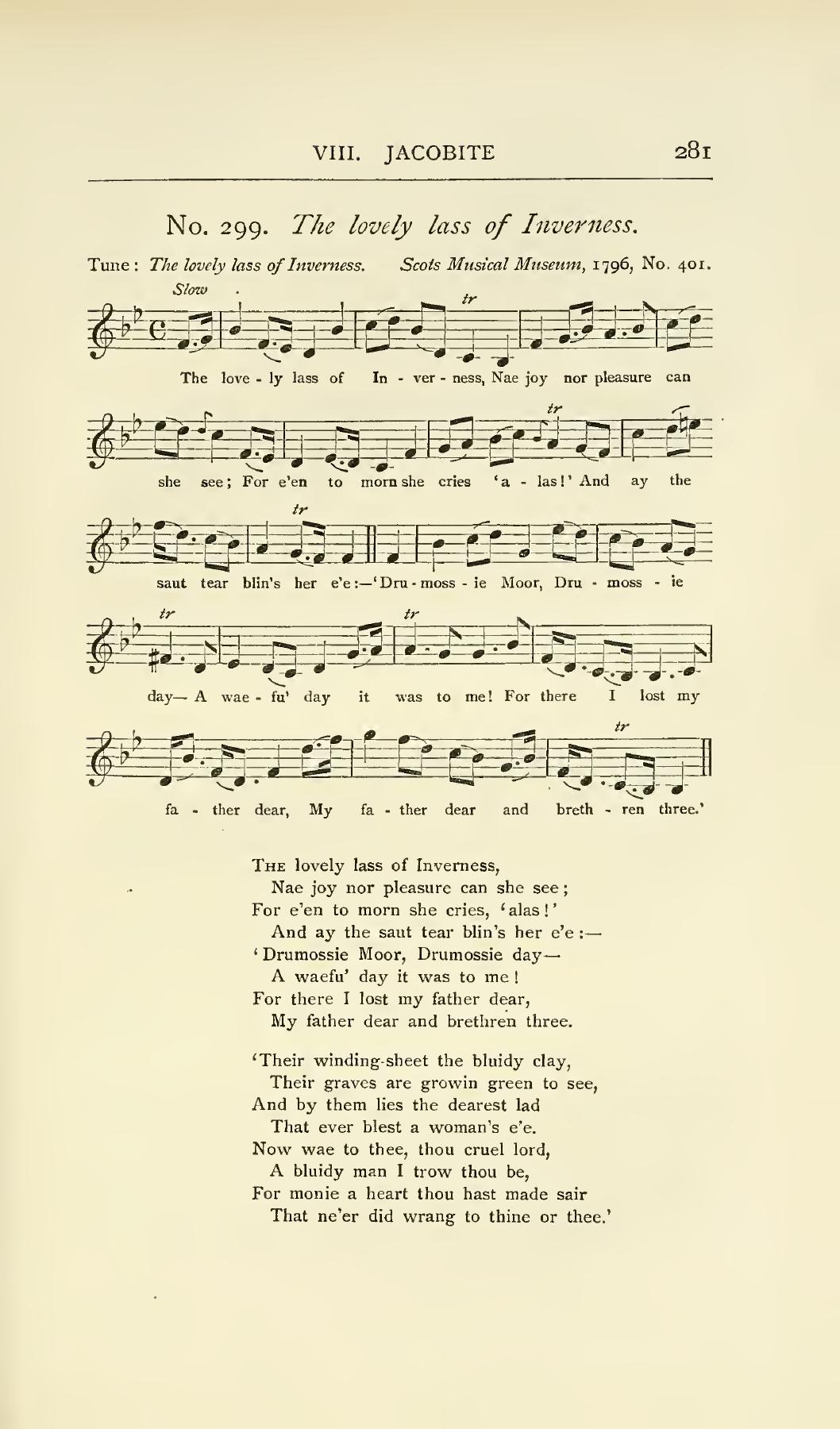 View score Dick’s Songs of Robert Burns (1903)
Lyrics
Choose an edition
Version notes
| Dick (1903) · no. 299 | Cunningham · 1855Ebook transcription |
|---|---|
| sea | see |
| e’en to morn | e’en and morn |
| wrang | wrong |
| hast | host |
Dick (1903) · no. 299
The lovely lass of Inverness,
Nae joy nor pleasure can she sea;
For e'en to morn she cries, 'alas!'
And ay the saut tear blin's her e'e:—
'Drumossie Moor, Drumossie day—
A waefu' day it was to me!
For there I lost my father dear,
My father dear and brethren three.

'Their winding-sheet the bluidy clay,
Their graves are growing green to see,
And by them lies the dearest lad
That ever blest a woman's e'e.
Now wae to thee, thou cruel lord,
A bluidy man I trow thou be,
For monie a heart thou hast made sair
That ne'er did wrang to thine or thee.'
These are the words printed below the score.
View the source edition · no. 299; p. 281
About this edition
Two eight-line stanzas in both editions. Dick has “can she sea”, “For e’en to morn” and “wrang”, against Cunningham’s “can she see”, “For e’en and morn” and “wrong”. Dick’s contribution claim reserves the first four lines as older material. Cunningham’s printed “host” for “hast” is retained as an ebook reading, not facsimile-proofed.
Cunningham (1855)
The lovely lass o’ Inverness,
  Nae joy nor pleasure can she see;
For e’en and morn, she cries, alas!
  And ay the saut tear blin’s her e’e:
Drumossie moor—Drumossie day—
  A waefu’ day it was to me!
For there I lost my father dear,
  My father dear, and brethren three.

Their winding sheet the bluidy clay,
  Their graves are growing green to see:
And by them lies the dearest lad
  That ever blest a woman’s e’e!
Now wae to thee, thou cruel lord,
  A bluidy man I trow thou be;
For mony a heart thou host made sair,
  That ne’er did wrong to thine or thee.
Digital text from Project Gutenberg.
View the source edition · p. 263
About this edition
Two eight-line stanzas in both editions. Dick has “can she sea”, “For e’en to morn” and “wrang”, against Cunningham’s “can she see”, “For e’en and morn” and “wrong”. Dick’s contribution claim reserves the first four lines as older material. Cunningham’s printed “host” for “hast” is retained as an ebook reading, not facsimile-proofed.
Scots Musical Museum, vol. V (catalogued 1796) · no. 401
View the source edition · Volume 5, no. 401; p. 414
Music
View historical scores
Dick’s Songs of Robert Burns (1903)
no. 299; p. 281