← Back to the work and its versions
The lovely Lass of Inverness
Dick (1903) · no. 299
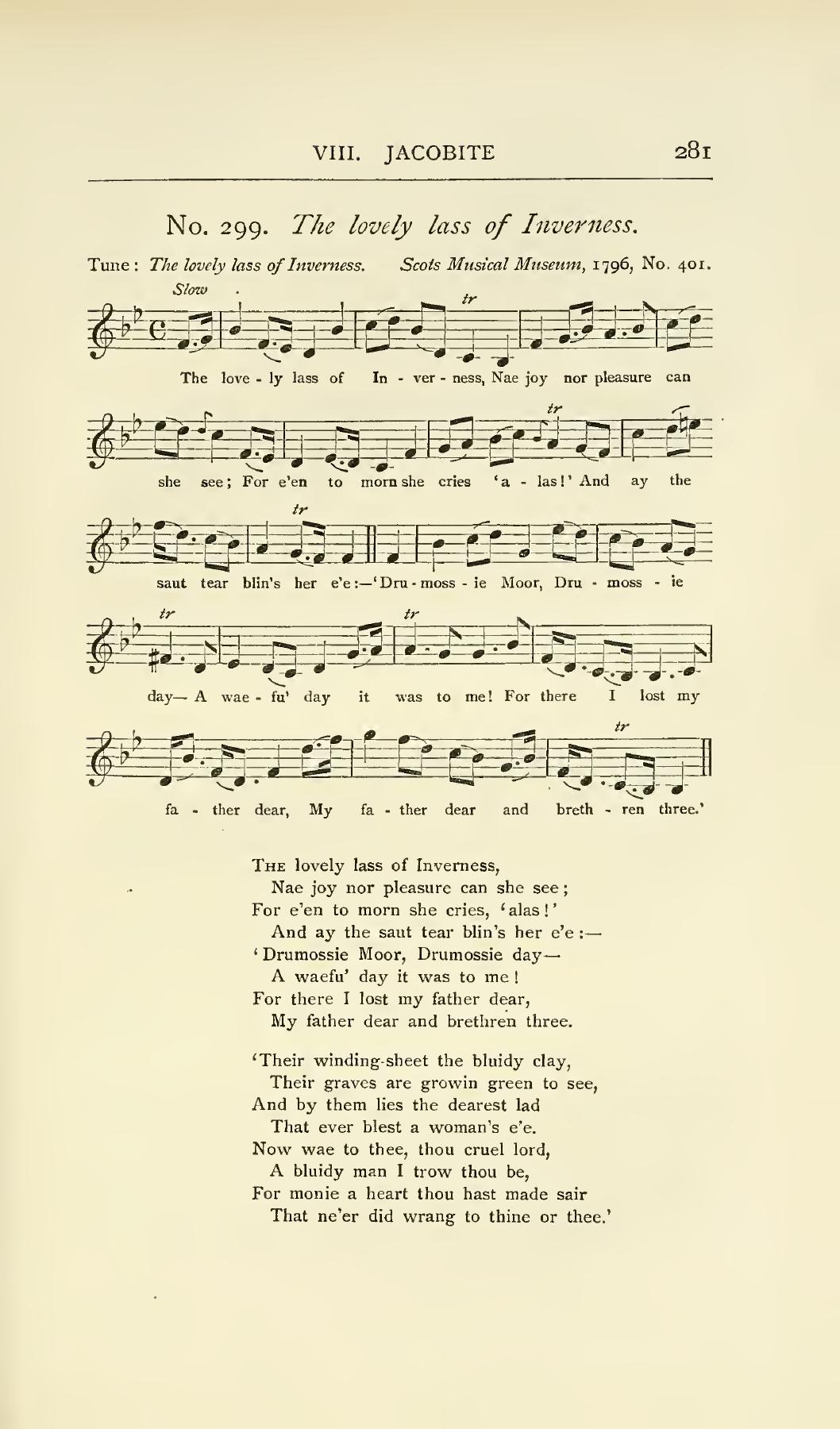
The lovely lass of Inverness,
Nae joy nor pleasure can she sea;
For e'en to morn she cries, 'alas!'
And ay the saut tear blin's her e'e:—
'Drumossie Moor, Drumossie day—
A waefu' day it was to me!
For there I lost my father dear,
My father dear and brethren three.

'Their winding-sheet the bluidy clay,
Their graves are growing green to see,
And by them lies the dearest lad
That ever blest a woman's e'e.
Now wae to thee, thou cruel lord,
A bluidy man I trow thou be,
For monie a heart thou hast made sair
That ne'er did wrang to thine or thee.'
These are the words printed below the score.
View the source edition · no. 299; p. 281
About this edition
Two eight-line stanzas in both editions. Dick has “can she sea”, “For e’en to morn” and “wrang”, against Cunningham’s “can she see”, “For e’en and morn” and “wrong”. Dick’s contribution claim reserves the first four lines as older material. Cunningham’s printed “host” for “hast” is retained as an ebook reading, not facsimile-proofed.
View historical scores
Dick’s Songs of Robert Burns (1903)
no. 299; p. 281