Awa, Whigs, awa
Behind the song
The Whigs come like a frost in June, and the thistles and roses wither. The singer calls them traitor louns, or rogues, and sends them away with the same angry command at every return of the refrain. [1]
Next the crown falls in the dust, and the singer curses those who gave the Whigs power. The complaint widens to Church and State and becomes a call for vengeance, with royal heads hunted like a hare. [1]
Read the fuller story
Cunningham describes Burns as revising an older Jacobite song and assigns the second and fourth stanzas wholly to him. Dick quotes a different eight-line passage from the Herd manuscripts, including a refrain that calls the Whigs lazy louns. The contrast between lazy in that quotation and traitor in the printed reading sharpens the political charge. [2][3][1]
Dick gives the song a wider political reading in his note, linking it with his view of Burns’s Jacobite sympathies. His edition brackets the chorus and the first and third stanzas, while the second and fourth are unbracketed. The score is headed Awa, Whigs, awa! and marked Moderate. [3][1]
Story references
- James C. Dick, The Songs of Robert Burns (1903), No. 278; printed pp. 260–260; PDF pp. 316–316
- Allan Cunningham, The Complete Works of Robert Burns (1855), printed 238; HTML #songsLXXXI. Project Gutenberg transcription.
- James C. Dick, The Songs of Robert Burns (1903), Dick note 278; printed 461; PDF 517
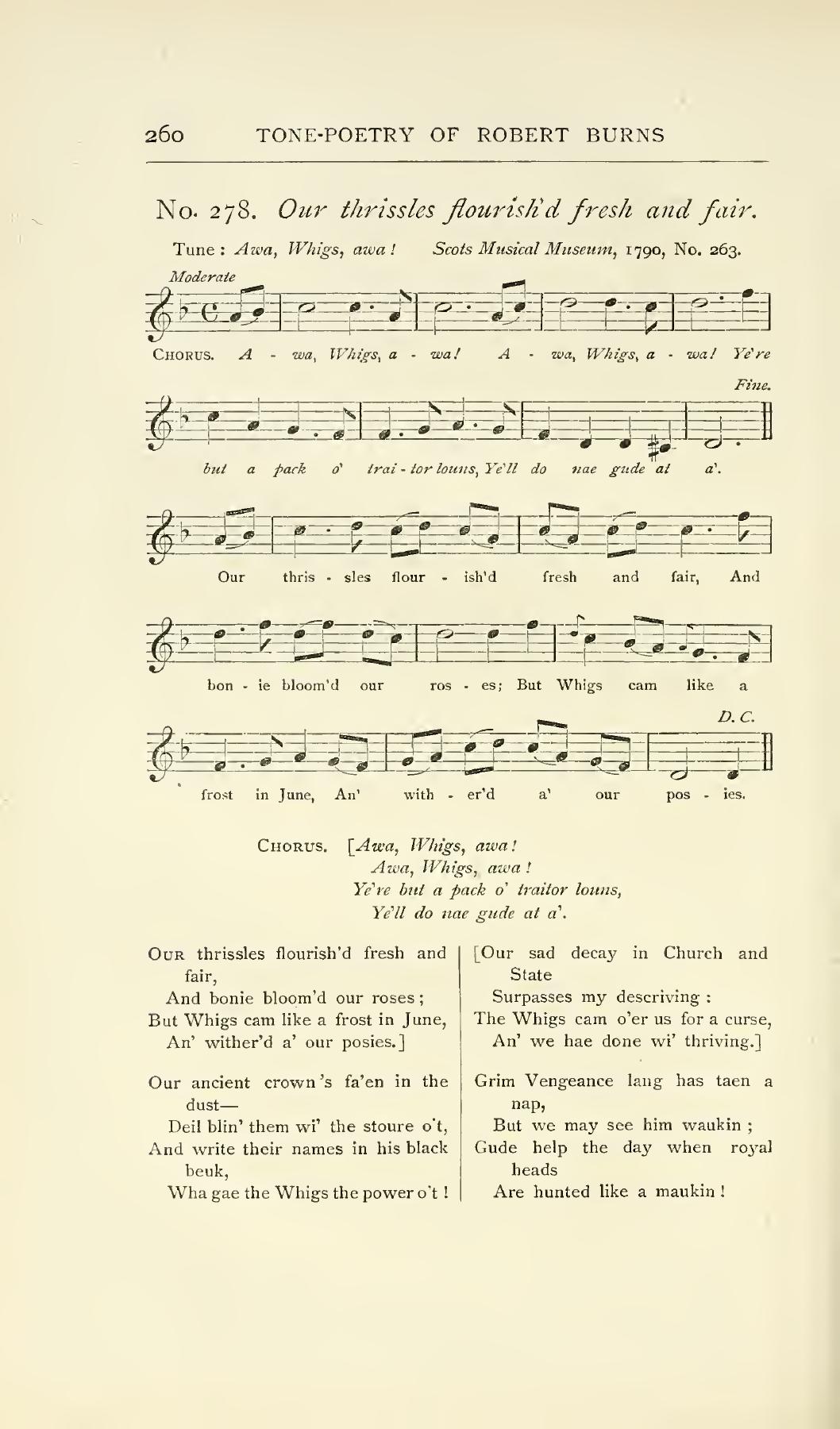 View score Dick’s Songs of Robert Burns (1903)
Lyrics
Choose an edition
Version notes
| Dick (1903) · no. 278 | Cunningham · 1855Ebook transcription |
|---|---|
| one opening refrain; brackets around chorus+stanza1 and stanza3 | opening and closing refrains; no lyric brackets |
| gude | good in opening chorus; gude in final chorus |
| bonie / cam / An’ / fa’en / has / waukin | bonnie / came / And / fa’n / ha’s / wauken |
| stoure o’t, / power o’t! | stoure o’t; / power o’t. |
Dick (1903) · no. 278
Chorus. [Awa, Whigs, awa!
Awa, Whigs, awa!
Ye're but a pack o' traitor louns,
Ye'll do nae gude at a'.

Our thrissles flourish'd fresh and fair,
And bonie bloom'd our roses;
But Whigs cam like a frost in June,
An' wither'd a' our posies.]

Our ancient crown's fa'en in the dust—
Deil blin' them wi' the stoure o't,
And write their names in his black beuk,
Wha gae the Whigs the power o't!

[Our sad decay in Church and State
Surpasses my descriving:
The Whigs cam o'er us for a curse,
An' we hae done wi' thriving.]

Grim Vengeance lang has taen a nap,
But we may see him waukin;
Gude help the day when royal heads
Are hunted like a maukin!
View the source edition · no. 278; p. 260
About this edition
Dick brackets the opening chorus and first stanza together and brackets the third stanza separately. Cunningham prints unbracketed numbered verses and repeats the chorus at the end. His opening chorus has good, his final chorus gude; Dick has gude. Dick’s bonie, cam, fa’en, has and waukin appear as bonnie, came, fa’n, ha’s and wauken in Cunningham. The dust-curse punctuation differs.
Cunningham (1855)
Awa Whigs, awa!
  Awa Whigs, awa!
Ye’re but a pack o’ traitor louns,
  Ye’ll do nae good at a’.

Our thrissles flourish’d fresh and fair,
  And bonnie bloom’d our roses;
But Whigs came like a frost in June,
  And wither’d a’ our posies.

Our ancient crown’s fa’n in the dust—
  Deil blin’ them wi’ the stoure o’t;
And write their names in his black beuk,
  Wha gae the Whigs the power o’t.

Our sad decay in Church and State
  Surpasses my descriving:
The Whigs came o’er us for a curse,
  And we hae done wi’ thriving.

Grim vengeance lang ha’s taen a nap,
  But we may see him wauken;
Gude help the day when royal heads
  Are hunted like a maukin.
    Awa Whigs, awa!
      Awa Whigs, awa!
    Ye’re but a pack o’ traitor louns,
      Ye’ll do nae gude at a’.
Digital text from Project Gutenberg.
View the source edition · p. 238
About this edition
Dick brackets the opening chorus and first stanza together and brackets the third stanza separately. Cunningham prints unbracketed numbered verses and repeats the chorus at the end. His opening chorus has good, his final chorus gude; Dick has gude. Dick’s bonie, cam, fa’en, has and waukin appear as bonnie, came, fa’n, ha’s and wauken in Cunningham. The dust-curse punctuation differs.
Scots Musical Museum, vol. III (1790) · no. 263
View the source edition · Volume 3, no. 263; p. 272
Music
View historical scores
Dick’s Songs of Robert Burns (1903)
no. 278; p. 260