Whistle o’er the lave o’t
Behind the song
When he was courting Maggie, the singer could see heaven in her manner. Now he tells anyone inclined to ask about the marriage to “whistle o’er the lave o’t”, or whistle over the rest of it. [1]
He is willing to say how few people ought to see how they live and how dearly he would like to see somebody ready for burial. He stops before writing a name, because Meg will read it. [1]
Read the fuller story
Cunningham calls the words bitter and connects them with an older strain. His version describes Meg as “nature’s child”, where Dick has “Sweet and harmless as a child”. The change gives the remembered innocence a different shape while leaving the speaker’s disillusionment in place. Cunningham’s title, First when Maggy was my care, foregrounds that opening memory; both editions name Whistle o’er the lave o’t as the air. [2][1]
Dick quotes two older stanzas from Herd in which a young woman hints at sexual encounters and whistles over what she will leave unsaid. He also repeats a traditional tale of the Devil fiddling the tune in a Glasgow churchyard. The refrain could support both a bawdy confidence and a married man’s grievance. Dick reports a Bruce composition claim alongside an earlier manuscript lead, leaving a musical history that needs its source distinctions preserved. [3]
Story references
- James C. Dick, The Songs of Robert Burns (1903), No. 209; printed pp. 187–187; PDF pp. 243–243
- Allan Cunningham, The Complete Works of Robert Burns (1855), printed 236; HTML #songsLXXVI. Project Gutenberg transcription.
- James C. Dick, The Songs of Robert Burns (1903), Dick note 209; printed 421,422; PDF 477,478
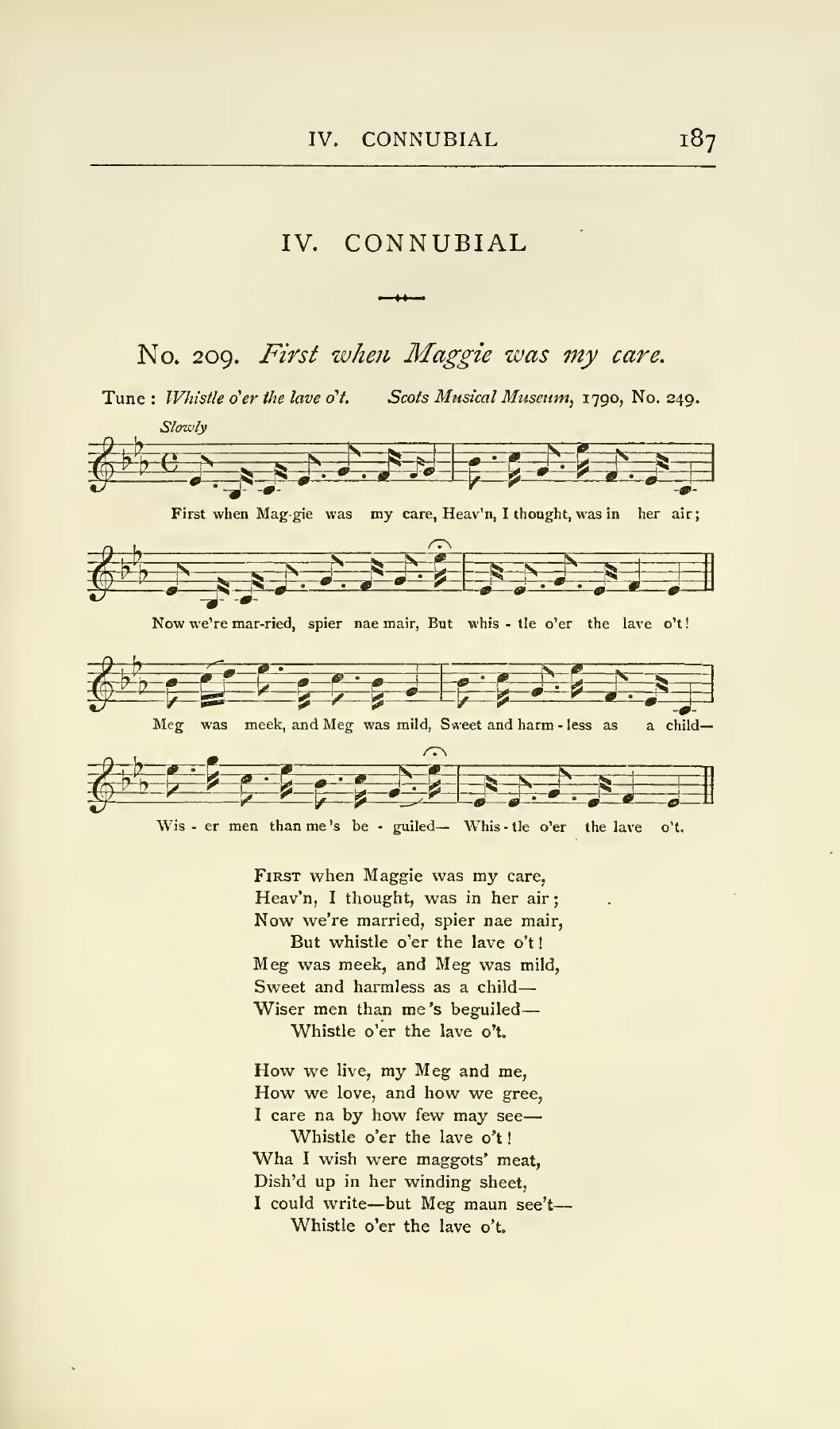 View score Dick’s Songs of Robert Burns (1903)
Lyrics
Choose an edition
Version notes
| Dick (1903) · no. 209 | Cunningham · 1855Ebook transcription |
|---|---|
| Maggie / Heav’n | Maggy / Heaven |
| But whistle o’er the lave o’t | Whistle o’er the lave o’t |
| Sweet and harmless as a child | Bonnie Meg was nature’s child |
| gree | ’gree |
More differences between these editions
| Dick (1903) · no. 209 | Cunningham · 1855Ebook transcription |
|---|---|
| maggots’ meat | maggot’s meat |
Dick (1903) · no. 209
First when Maggie was my care,
Heav'n, I thought, was in her air;
Now we're married, spier nae mair,
But whistle o'er the lave o't!
Meg was meek, and Meg was mild,
Sweet and harmless as a child—
Wiser men than me's beguiled—
Whistle o'er the lave o't.

How we live, my Meg and me,
How we love, and how we gree,
I care na by how few may see—
Whistle o'er the lave o't!
Wha I wish were maggots' meat,
Dish'd up in her winding sheet,
I could write—but Meg maun see't—
Whistle o'er the lave o't.
These are the words printed below the score.
View the source edition · no. 209; p. 187
About this edition
Both readings have two octaves. Dick has “Maggie”, “Heav’n”, “But whistle” and “Sweet and harmless as a child”; Cunningham has “Maggy”, “Heaven”, “Whistle” and “Bonnie Meg was nature’s child”. Dick prints “How we love, and how we gree”; Cunningham has “how we ’gree”. Dick’s “maggots’ meat” differs from Cunningham’s “maggot’s meat”. Both leave the subject of the burial wish implied.
Cunningham (1855)
First when Maggy was my care,
Heaven, I thought, was in her air;
Now we’re married—spier nae mair—
  Whistle o’er the lave o’t.—
Meg was meek, and Meg was mild,
Bonnie Meg was nature’s child;
Wiser men than me’s beguil’d—
  Whistle o’er the lave o’t.

How we live, my Meg and me,
How we love, and how we ‘gree,
I care na by how few may see;
  Whistle o’er the lave o’t.—
Wha I wish were maggot’s meat,
Dish’d up in her winding sheet,
I could write—but Meg maun see’t—
  Whistle o’er the lave o’t.
Digital text from Project Gutenberg.
View the source edition · p. 236
About this edition
Both readings have two octaves. Dick has “Maggie”, “Heav’n”, “But whistle” and “Sweet and harmless as a child”; Cunningham has “Maggy”, “Heaven”, “Whistle” and “Bonnie Meg was nature’s child”. Dick prints “How we love, and how we gree”; Cunningham has “how we ’gree”. Dick’s “maggots’ meat” differs from Cunningham’s “maggot’s meat”. Both leave the subject of the burial wish implied.
Scots Musical Museum, vol. III (1790) · no. 249
View the source edition · Volume 3, no. 249; p. 258
Music
View historical scores
Dick’s Songs of Robert Burns (1903)
no. 209; p. 187