When we gaed to the braes o’ Mar
Behind the song
At Sherramuir, says the soldier telling Willie the story, both sides fought, both sides won and both sides ran away. He remembers lords and lairds gathering confidently on the braes of Mar before the battle. James C. Dick places the satire in the rising of 1715. He quotes Burns naming the man who gave him this version, the Edinburgh humourist Tom Niel. [1][2]
Read the fuller story
The first warning comes before the fighting. When the standard is raised, a fierce wind knocks its royal ornament to the ground. Second-sighted Sandie predicts that the expedition will do no good. The army’s arrival at Perth briefly restores confidence: the men expect to rout their opponents and restore their king, while pipers play them on. By returning to Sandie’s warning at the end, the song makes this early mishap a frame for everything that follows.[1]
The battle is told in partisan bursts. Huntly and other commanders are accused of giving way; Glengary receives praise for his attack, while Whittam is mocked with a bodily humiliation. By calling the opposing forces ‘rebels’, the speaker claims legitimate authority for his own side. Yet the ending cuts across those insults and boasts. His claim to report what he saw produces an admission that the two armies shared the same contradictory experience.[1]
In his 1903 note, James C. Dick places the song in the rebellion of 1715 and describes it as one of the Sherriffmuir satires. He quotes Burns’s account in the Interleaved Museum that he obtained this version from Tom Niel, known for his humour in Edinburgh. Dick also prints a stanza from an earlier seven-stanza song in The Charmer of 1752 and notes many differences. He expressly leaves Burns’s alterations or amendments undetermined. Burns’s role here is therefore that of a transmitter whose precise editorial contribution remains uncertain.[2]
The repeated call ‘Up, and warn a’, Willie’ is central to that transmission. Dick quotes Burns explaining it as a summons to a Highland clan to take up arms, which some Lowlanders misunderstood as ‘waur’ — overcome — them all. Within the song, the summons becomes an invitation to listen to the speaker’s ‘canty’, or lively, Highland song. Dick’s setting is marked ‘Quickly’; the opening chorus and the recurring two-line call keep the long narrative moving. His note traces the air through eighteenth-century collections, while the printed D.C. and Fine signs show the return built into this setting.[1][2]
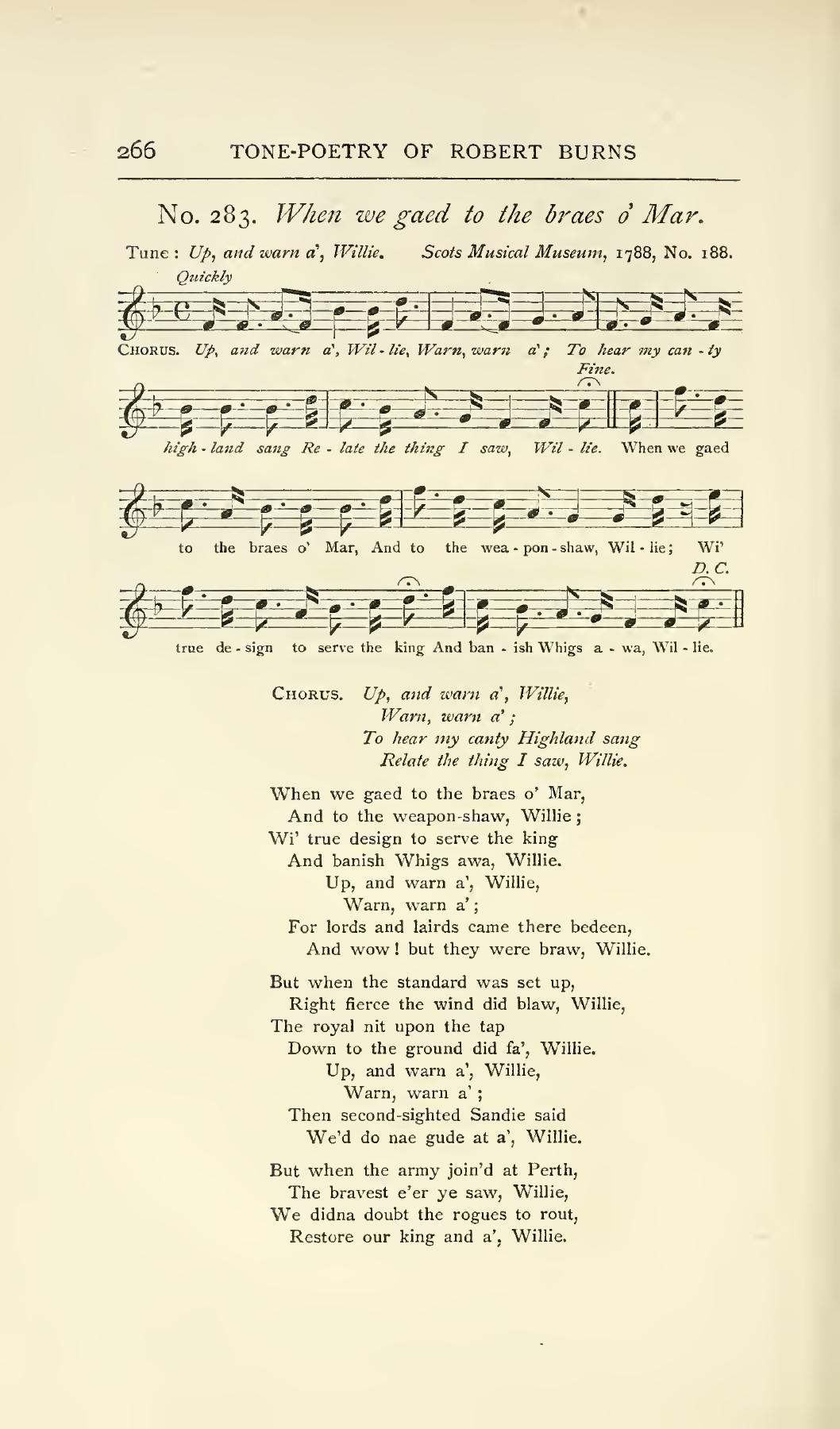 View score Dick’s Songs of Robert Burns (1903)
Lyrics
Dick (1903) · no. 283
When we gaed to the braes o' Mar.
CHORUS
Up, and warn a', Willie,
Warn, warn a';
To hear my canty Highland sang
Relate the thing I saw, Willie.

When we gaed to the braes o' Mar,
And to the weapon-shaw, Willie;
Wi' true design to serve the king
And banish Whigs awa, Willie.
Up, and warn a', Willie,
Warn, warn a';
For lords and lairds came there bedeen,
And wow! but they were braw, Willie.

But when the standard was set up,
Right fierce the wind did blaw, Willie,
The royal nit upon the tap
Down to the ground did fa', Willie.
Up, and warn a', Willie,
Warn, warn a';
Then second-sighted Sandie said
We'd do nae gude at a', Willie.

But when the army join'd at Perth,
The bravest e'er ye saw, Willie,
We didna doubt the rogues to rout,
Restore our king and a', Willie.
Up, and warn a', Willie,
Warn, warn a';
The pipers play'd frae right to left
O whirry Whigs awa, Willie.

But when we march'd to Sherramuir
And there the rebels saw, Willie;
Brave Argyle attack'd our right,
Our flank, and front and a', Willie;
Up, and warn a', Willie,
Warn, warn a';
Traitor Huntly soon gave way,
Seaforth, St. Clair and a', Willie.

But brave Glengary on our right
The rebels' left did claw, Willie;
He there the greatest slaughter made
That ever Donald saw, Willie;
Up, and warn a', Willie,
Warn, warn a';
And Whittam fyled his breeks for fear,
And fast did rin awa, Willie.

For he ca'd us a Highland mob,
And soon he'd slay us a', Willie;
But we chas'd him back to Stirling brig—
Dragoons, and foot, and a', Willie.
Up, and warn a', Willie,
Warn, warn a';
At length we rallied on a hill,
And briskly up did draw, Willie.

But when Argyle did view our line
And them in order saw, Willie,
He straight gaed to Dumblane again,
And back his left did draw, Willie.
Up, and warn a', Willie,
Warn, warn a';
Then we to Auchterairder march'd
To wait a better fa', Willie.

Now if ye spier wha wan the day,
I've tell'd you what I saw, Willie,
We baith did fight, and baith did beat,
And baith did rin awa, Willie.
Up, and warn a', Willie,
Warn, warn a';
For second-sighted Sandie said
We'd do nae gude at a', Willie.
View the source edition · When we gaed to the braes o' Mar.
Music
View historical scores
Dick’s Songs of Robert Burns (1903)
When we gaed to the braes o' Mar.