Whare are you gaun, my bonie lass
Behind the song
A flirtatious conversation leads to a night visit, but the mother wakes before dawn. ‘Whare are you gaun, my bonie lass’ is told by the young man, who begins with affectionate questions and ends by blaming the girl’s watchful mother for spoiling the encounter. The comedy follows his changing fortunes; its harshest consequence falls on the daughter.[1]
Read the fuller story
At first she answers him saucily. She is running an errand for her ‘minnie’, her mother, and reluctantly tells him where she lives beside the burn. His endearment ‘hiney’ makes the questioning playful. By evening he has gone up the glen to see her, and he boasts that she is less saucy before morning. The narrator presents that change as his success.[1]
A wakeful cock reverses it. The man curses the bird and wishes a foumart, or polecat, would take it for crowing. Its noise has roused the mother, who pulls her daughter over the bed and beats her with a large hazel stick. ‘Waukrife’ means wakeful or watchful. The final farewell praises the girl but treats her mother’s vigilance as the decisive obstacle. The speaker’s light dismissal leaves the unequal cost of the episode visible.[1]
James C. Dick identifies the song in the Scots Musical Museum of 1790, no. 288, under ‘A waukrife minnie’. He quotes Burns saying that he obtained the old song and tune from a country girl in Nithsdale and had not encountered it elsewhere in Scotland. Dick adds that Burns was thought to have amended some verses and written others, while acknowledging that he could find no earlier original. The extent of Burns’s alteration therefore remains uncertain.[2]
The tune heading retains the watchful mother’s name. The notation carries the opening four-line exchange, allowing the following stanzas to continue the story on the same air. Dialogue gives way to nocturnal adventure, interruption and farewell, so that a simple repeated setting can support a complete comic narrative with a sharp ending.[1]
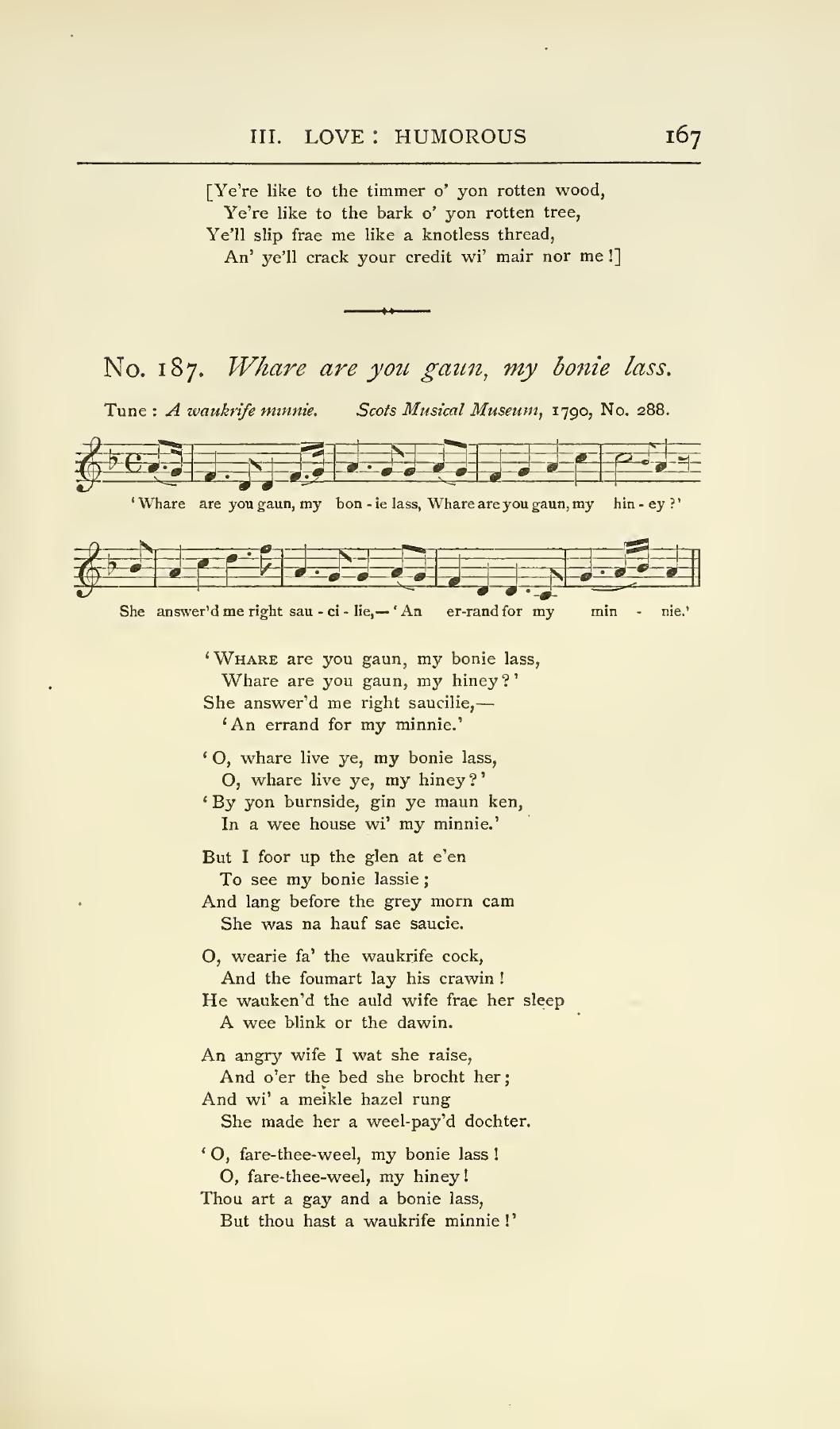 View score Dick’s Songs of Robert Burns (1903)
Lyrics
Choose an edition
Dick (1903) · no. 187
'Whare are you gaun, my bonie lass,
Whare are you gaun, my hiney?'
She answer'd me right saucilie,—
'An errand for my minnie.'

'O, whare live ye, my bonie lass,
O, whare live ye, my hiney?'
'By yon burnside, gin ye maun ken,
In a wee house wi' my minnie.'

But I foor up the glen at e'en
To see my bonie lassie;
And lang before the grey morn cam
She was na hauf sae saucie.

O, wearie fa' the waukrife cock,
And the foumart lay his crawin!
He wauken'd the auld wife frae her sleep
A wee blink or the dawin.

An angry wife I wat she raise,
And o'er the bed she brocht her;
And wi' a meikle hazel rung
She made her a weel-pay'd dochter.

'O, fare-thee-weel, my bonie lass!
O, fare-thee-weel, my hiney!
Thou art a gay and a bonie lass,
But thou hast a waukrife minnie!'
Six stanzas from Dick’s 1903 edition.
View the source edition · no. 187; p. 167
About this edition
Syllables separated by the musical notation are joined into words in this reading.
Dick reports that Burns collected an older song and tune, and suggests that he amended some verses.
Scots Musical Museum, vol. III (1790) · no. 288
View the source edition · Volume 3, no. 288; p. 298
Music
View historical scores
Dick’s Songs of Robert Burns (1903)
no. 187; p. 167