As late by a sodger I chanced to pass
Behind the song
A passing narrator overhears a soldier courting a young woman. He promises to make her glad to follow him; she answers that her companions would think her mad to go with a poor soldier, and that she has no wish to see battles. The song gives each of them a clear position before he tries again, turning the prospect of life on the road into an invitation to share his supper and bed. [1]
Read the fuller story
The soldier begins with endearments: she is his honey, his life and his dearest. Her reply brings the offer down to practical terms. Poverty, the opinion of her companions and the prospect of battle all count against it. “Sodger” means soldier, “gin” means if and “cummers” here means female companions. Her refusal has the same musical shape as his promise, changing his assurance that she will be glad into her insistence that she will never want to follow. [1]
His second speech offers companionship in tangible portions: some of his supper and some of his bed, wherever it happens to be. He then asks her to try his knapsack on her back and travel along the king’s highway between Saint Johnston and Dundee. The route and the pack give his invitation a physical form. They also show how much movement and uncertainty are contained in his apparently simple offer of a shared life. [1]
The lyric closes with the soldier repeating his confidence. The young woman has no further reply in the printed song, so the courtship ends with persuasion still under way. A performance can bring out the difference between his cheerful persistence and the objections she has already made. The words leave that tension active at the finish. [1]
Dick identifies the song in the Museum of 1790, no. 268, and cites Law’s manuscript list as evidence of Burns’s involvement. His note says that the first twelve lines are substantially those of a Herd manuscript and treats the remaining four as original additions completing the second stanza for the tune. On that account, Burns’s contribution is the closing invitation involving the knapsack and the journey. He traces the larger dialogue to the inherited song. [2]
The printed tune is “I’ll mak you be fain to follow me”, and the setting is marked “Cheerily”. “Fain” means glad or willing, the very feeling the soldier hopes to produce. That phrase serves as tune title, promise and repeated point of return. Its cheerfulness gives the invitation momentum, while the woman’s refusal keeps another view of the soldier’s life within the song. [1]
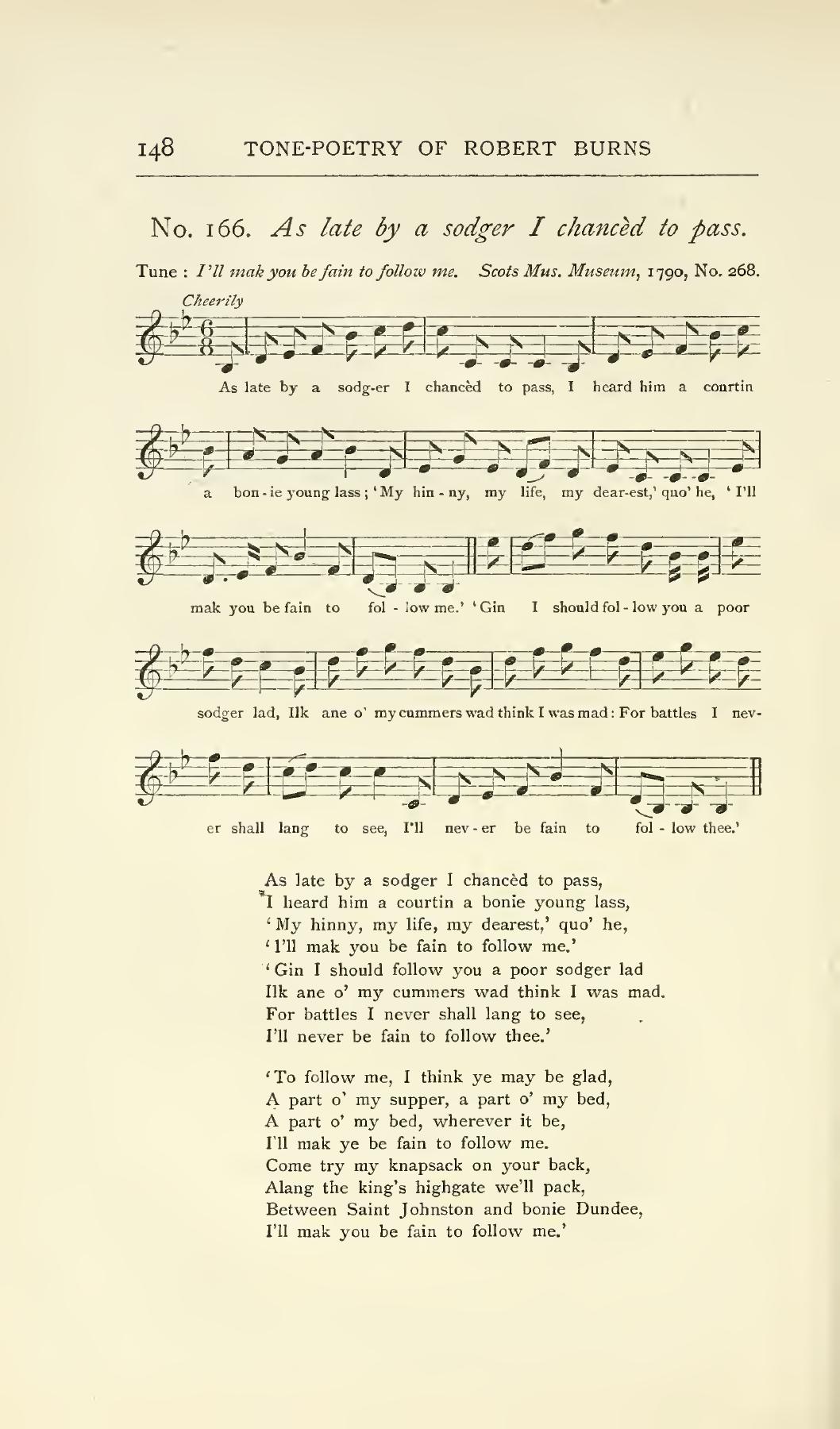 View score Dick’s Songs of Robert Burns (1903)
Lyrics
Choose an edition
Dick (1903) · no. 166
As late by a sodger I chancèd to pass,
I heard him a courtin a bonie young lass,
'My hinny, my life, my dearest,' quo' he,
'I'll mak you be fain to follow me.'
'Gin I should follow you a poor sodger lad
Ilk ane o' my cummers wad think I was mad.
For battles I never shall lang to see,
I'll never be fain to follow thee.'

'To follow me, I think ye may be glad,
A part o' my supper, a part o' my bed,
A part o' my bed, wherever it be,
I'll mak ye be fain to follow me.
Come try my knapsack on your back,
Alang the king's highgate we'll pack,
Between Saint Johnston and bonie Dundee,
I'll mak you be fain to follow me.'
View the source edition · Dick1903 no. 166; p. 148
About this edition
Syllables separated by the musical notation are joined into words in this reading.
Dick reports that the first twelve lines occur substantially in Herd’s manuscript and attributes the final four to Burns.
Scots Musical Museum, vol. III (1790) · no. 268
View the source edition · Volume 3, no. 268; p. 277
Music
View historical scores
Dick’s Songs of Robert Burns (1903)
Dick1903 no. 166; p. 148