It was a’ for our rightfu’ king
Behind the song
A soldier who fought for the king he calls rightful has come from Scotland to Ireland. Now the cause has failed and another crossing will take him away from the person he calls “my dear”. [1]
From the Irish shore we see him turn and shake his bridle reins. Then we hear the one left behind. Soldiers and sailors come home every day, yet the speaker lies awake thinking of a man she fears has gone for good. [1]
Read the fuller story
Cunningham prints the song as The Farewell and quotes Sir Harris Nicolas’s doubt about how much Burns wrote. He suggests pruning and beautifying an older lyric, while saying Johnson received it in Burns’s handwriting. Dick takes a firmer view of authorship and cites a facsimile published by Scott-Douglas. The later editions therefore preserve both the song and a dispute over the extent of Burns’s contribution. [2][3]
Dick identifies Mally Stuart as the older street ballad and prints the trooper’s farewell stanza as the portion borrowed. He brackets the corresponding stanza in his lyric, making that editorial distinction visible in the reading. The tune heading is Mally Stuart; Cunningham instead uses It was a’ for our rightfu’ king as its name. [3][1][2]
Story references
- James C. Dick, The Songs of Robert Burns (1903), No. 296; printed pp. 278–279; PDF pp. 334–335
- Allan Cunningham, The Complete Works of Robert Burns (1855), printed 291; HTML #CCXIX. Project Gutenberg transcription.
- James C. Dick, The Songs of Robert Burns (1903), Dick note 296; printed 469,470; PDF 525,526
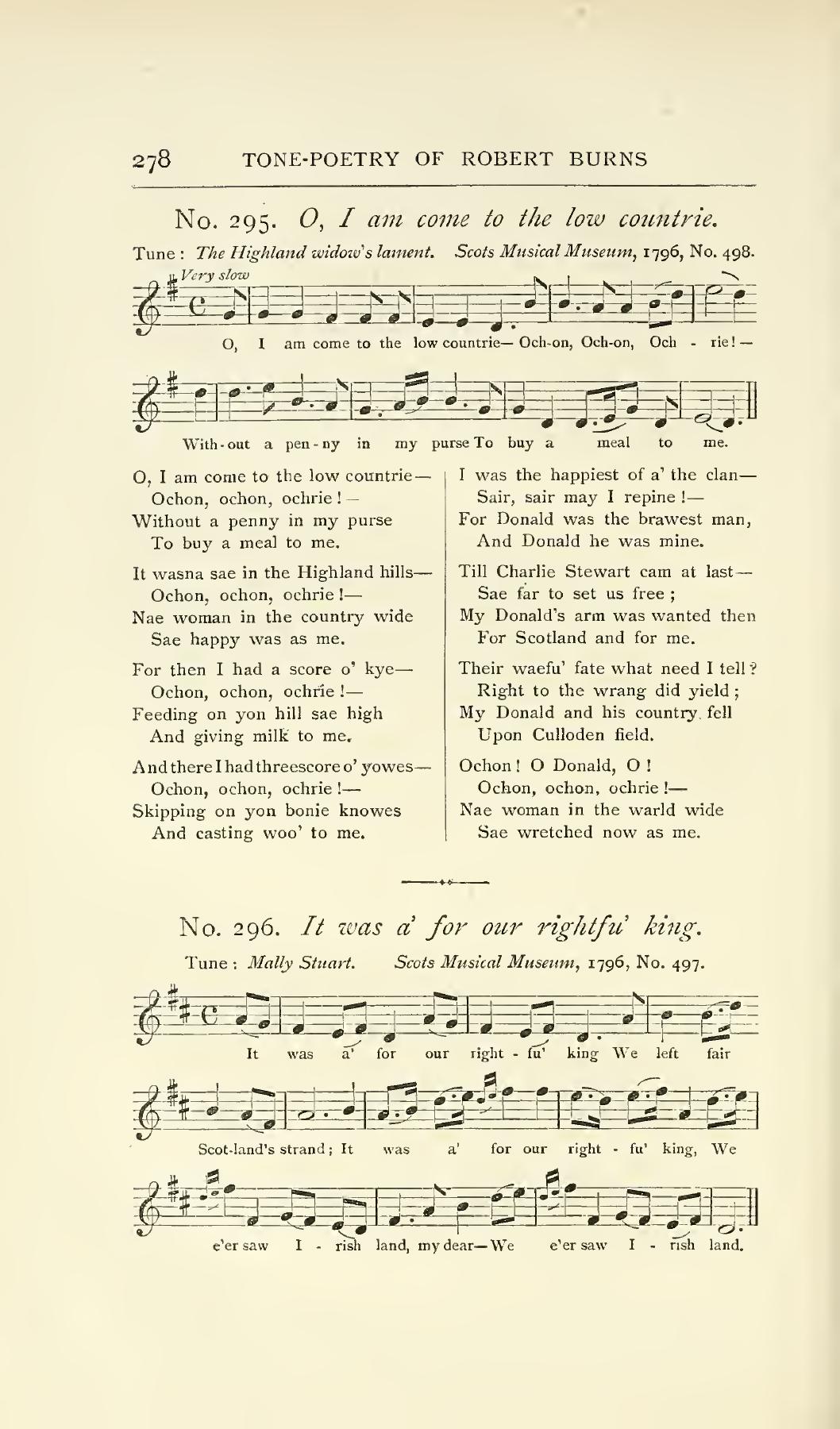 View score Dick’s Songs of Robert Burns (1903)
Lyrics
Choose an edition
Version notes
| Dick (1903) · no. 296 | Cunningham · 1855Ebook transcription |
|---|---|
| It was a’ for our rightfu’ king | The Farewell |
| five lines, my dear joined to line4 | six lines, my dear separate |
| soger frae | sodger from |
| awa | awa’ |
More differences between these editions
| Dick (1903) · no. 296 | Cunningham · 1855Ebook transcription |
|---|---|
| Mally Stuart | It was a’ for our rightfu’ king |
Dick (1903) · no. 296
It was a' for our rightfu' king
We left fair Scotland's strand;
It was a' for our rightfu' king,
We e'er saw Irish land, my dear—
We e'er saw Irish land.

Now a' is done that men can do,
And a' is done in vain,
My Love and native land farewell,
For I maun cross the main, my dear—
For I maun cross the main.

[He turn'd him right and round about
Upon the Irish shore,
And gae his bridle reins a shake,
With Adieu for evermore, my dear,
And adieu for evermore!]

The soger frae the wars returns,
The sailor frae the main,
But I hae parted frae my love
Never to meet again, my dear—
Never to meet again.

When day is gane, and night is come,
And a' folk bound to sleep,
I think on him that's far awa
The lee-lang night and weep, my dear—
The lee-lang night and weep.
These are the words printed below the score.
View the source edition · no. 296; pp. 278–279
About this edition
Dick prints five five-line stanzas with my dear joined to line 4; Cunningham sets my dear separately, making each stanza six lines. Dick brackets stanza 3 and ends it “With Adieu ... And adieu”; Cunningham leaves it unbracketed and repeats “With adieu”. Dick has “soger frae”, “awa” and “Love”; Cunningham has “sodger from”, “awa’” and “love”. Cunningham’s attribution caveat differs from Dick’s reported manuscript/facsimile argument.
Cunningham (1855)
It was a’ for our rightfu’ king,
  We left fair Scotland’s strand;
It was a’ for our rightfu’ king
  We e’er saw Irish land,
          My dear;
  We e’er saw Irish land.

Now a’ is done that men can do,
  And a’ is done in vain;
My love and native land farewell,
  For I maun cross the main,
          My dear;
  For I maun cross the main.

He turn’d him right, and round about
  Upon the Irish shore;
And gae his bridle-reins a shake,
  With adieu for evermore,
          My dear;
  With adieu for evermore.

The sodger from the wars returns,
  The sailor frae the main;
But I hae parted frae my love,
  Never to meet again,
          My dear;
  Never to meet again

When day is gane, and night is come,
  And a’ folk bound to sleep;
I think on him that’s far awa’,
  The lee-lang night, and weep,
          My dear;
  The lee-lang night, and weep.
Digital text from Project Gutenberg.
View the source edition · p. 291
About this edition
Dick prints five five-line stanzas with my dear joined to line 4; Cunningham sets my dear separately, making each stanza six lines. Dick brackets stanza 3 and ends it “With Adieu ... And adieu”; Cunningham leaves it unbracketed and repeats “With adieu”. Dick has “soger frae”, “awa” and “Love”; Cunningham has “sodger from”, “awa’” and “love”. Cunningham’s attribution caveat differs from Dick’s reported manuscript/facsimile argument.
Scots Musical Museum, vol. V (catalogued 1796) · no. 497
View the source edition · Volume 5, no. 497; p. 513
Music
View historical scores
Dick’s Songs of Robert Burns (1903)
no. 296; pp. 278–279