Logan Water
Behind the song
Willie has gone to war, leaving his wife with the children beside the Logan, the stream that ran past on their wedding day. A thrush has a mate to help feed the young. The woman has no one, and the men who sent Willie away have earned her curse. [1]
Writing to George Thomson in June 1793, Burns described his anger at rulers who laid waste to whole countries. The tune Logan Water came to mind. He reckoned he had spent three-quarters of an hour in his chair making the song. [2]
Read the fuller story
Cunningham prints a letter to Thomson dated 25 June 1793 in which Burns describes his indignation at rulers who devastate provinces and nations through ambition. Recalling the air Logan Water, he says he composed the song during three-quarters of an hour's meditation in his chair. That reported account gives the lyric's attack on statecraft an explicit context in Burns's correspondence. [2]
The tune carried other songs before this lament. Dick prints fragments of older words and says Burns incorporated two lines from John Mayne's By Logan's Streams, believing it old. Cunningham also connects the song with Mayne's Logan-braes. The borrowed river setting becomes the ground for Burns's account of war felt through marriage and children. [3][2]
Dick's last stanza tells the statesmen that they disregard the widow's tears and orphan's cries. Cunningham's main text asks how their flinty hearts can enjoy them, then gives Dick's wording in a footnote labelled “Originally”. The two couplets preserve different forms of the accusation at the song's sharpest point. [1][2]
Story references
- James C. Dick, The Songs of Robert Burns (1903), No. 271; printed pp. 252–253; PDF pp. 308–309
- Allan Cunningham, The Complete Works of Robert Burns (1855), printed 281; HTML #CXCVI. Project Gutenberg transcription.
- James C. Dick, The Songs of Robert Burns (1903), Dick historical note 271; printed 458; PDF 514
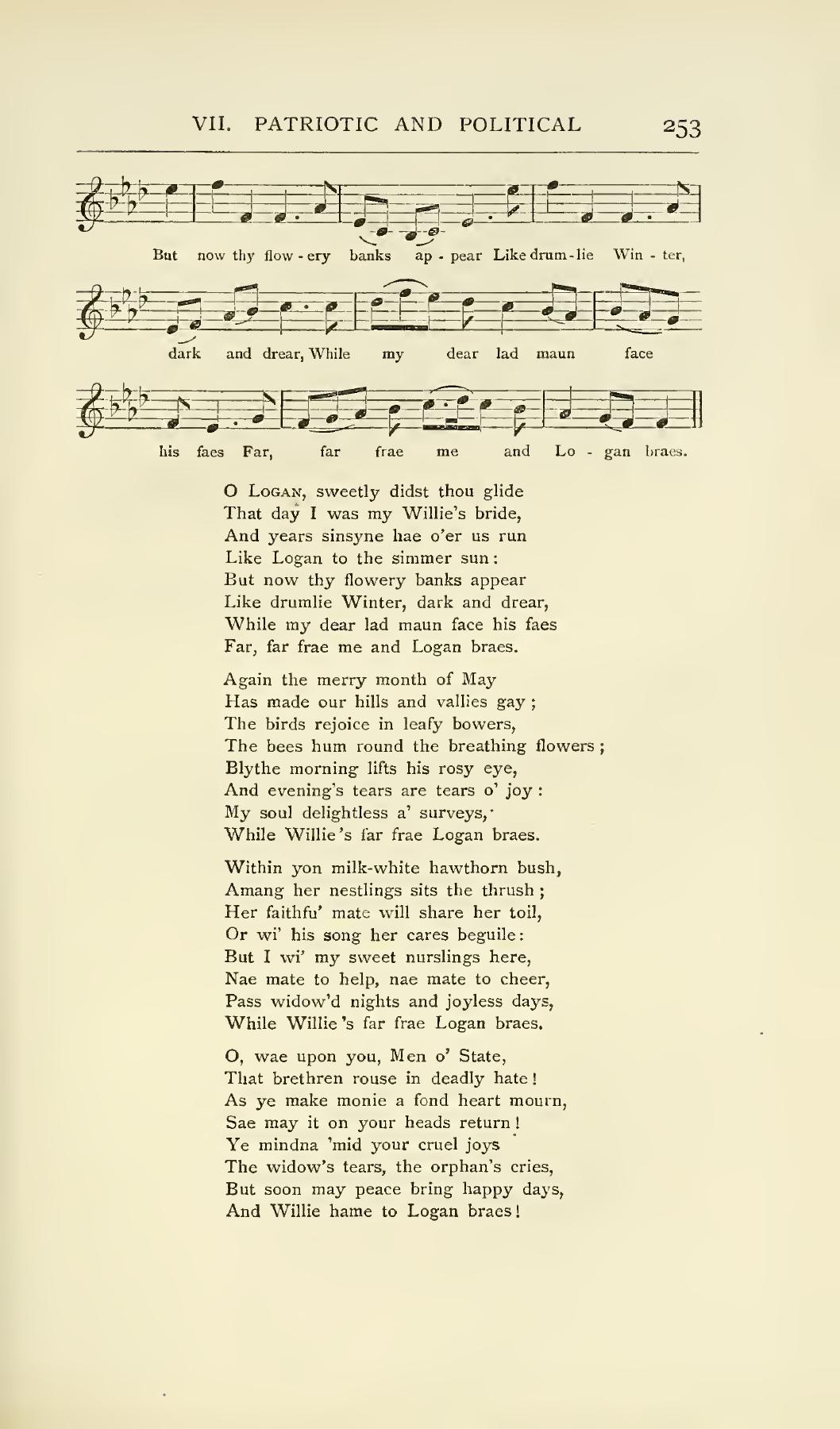
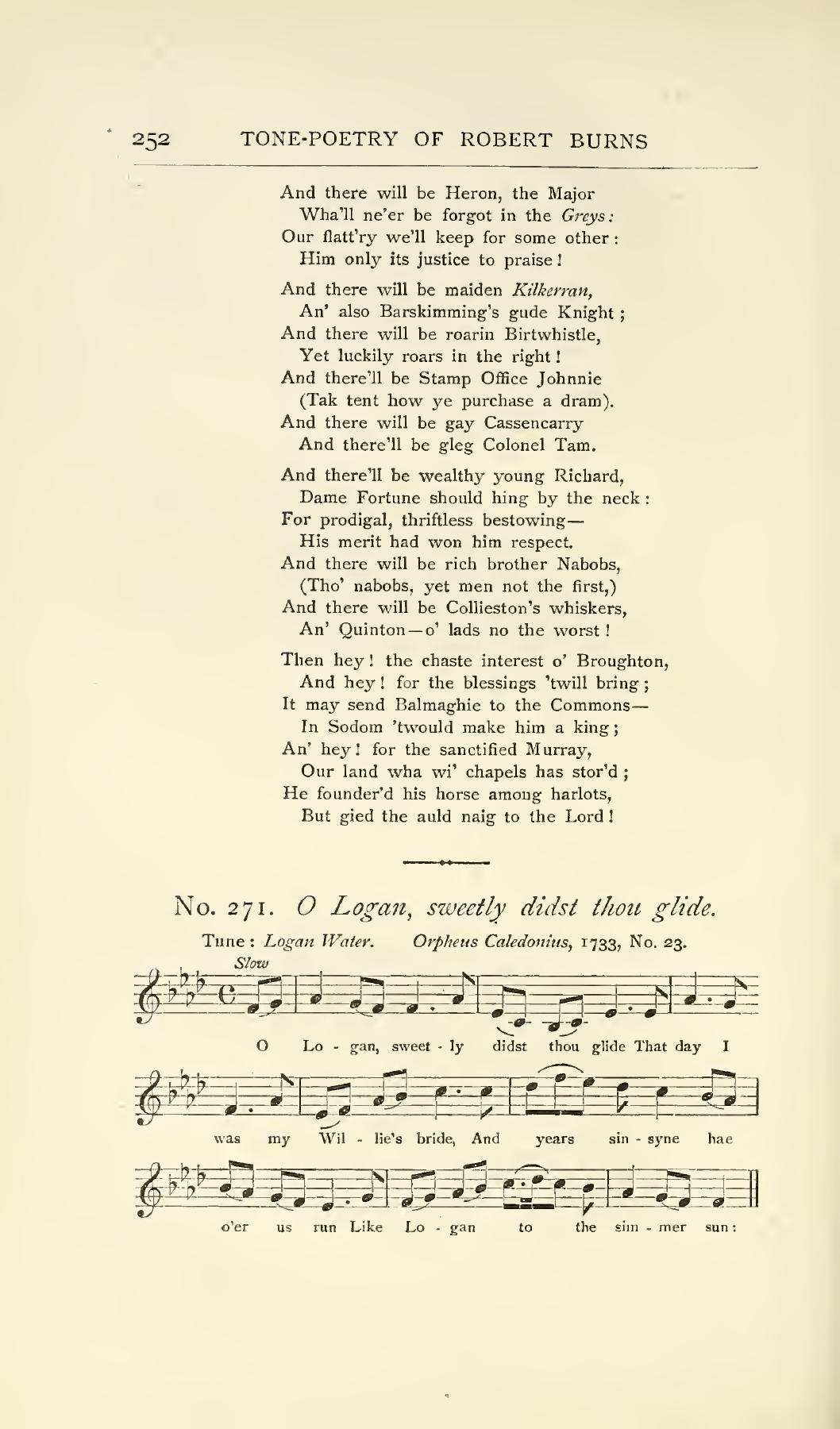 View score Dick’s Songs of Robert Burns (1903)
Lyrics
Choose an edition
Version notes
| Dick (1903) · no. 271 | Cunningham · 1855Ebook transcription |
|---|---|
| Ye mindna ’mid your cruel joys / The widow’s tears, the orphan’s cries | How can your flinty hearts enjoy / The widow’s tears, the orphan’s cry? |
| in deadly hate | to deadly hate |
| sinsyne | synsyne |
Dick (1903) · no. 271
O Logan, sweetly didst thou glide
That day I was my Willie's bride,
And years sinsyne hae o'er us run
Like Logan to the simmer sun:
But now thy flowery banks appear
Like drumlie Winter, dark and drear,
While my dear lad maun face his faes
Far, far frae me and Logan braes.

Again the merry month of May
Has made our hills and vallies gay;
The birds rejoice in leafy bowers,
The bees hum round the breathing flowers;
Blythe morning lifts his rosy eye,
And evening's tears are tears o' joy:
My soul delightless a' surveys,
While Willie's far frae Logan braes.

Within yon milk-white hawthorn bush,
Amang her nestlings sits the thrush;
Her faithfu' mate will share her toil,
Or wi' his song her cares beguile:
But I, wi' my sweet nurslings here,
Nae mate to help, nae mate to cheer,
Pass widow'd nights and joyless days,
While Willie's far frae Logan braes.

O, wae upon you, Men o' State,
That brethren rouse in deadly hate!
As ye make monie a fond heart mourn,
Sae may it on your heads return!
Ye mindna 'mid your cruel joys
The widow's tears, the orphan's cries,
But soon may peace bring happy days,
And Willie hame to Logan braes!
These are the words printed below the score.
View the source edition · no. 271; pp. 252–253
About this edition
Four eight-line stanzas in both texts. Dick has “Ye mindna ’mid your cruel joys / The widow’s tears, the orphan’s cries”; Cunningham’s main text has “How can your flinty hearts enjoy / The widow’s tears, the orphan’s cry?” and footnote140 records the earlier wording matching Dick. Dick’s “in deadly hate” is Cunningham’s “to deadly hate”.
Cunningham (1855)
O Logan, sweetly didst thou glide,
That day I was my Willie’s bride!
And years synsyne hae o’er us run
Like Logan to the simmer sun.
But now thy flow’ry banks appear
Like drumlie winter, dark and drear,
While my dear lad maun face his faes,
Far, far frae me and Logan braes!

Again the merry month o’ May
Has made our hills and valleys gay;
The birds rejoice in leafy bowers,
The bees hum round the breathing flowers;
Blythe Morning lifts his rosy eye,
And Evening’s tears are tears of joy:
My soul, delightless, a’ surveys,
While Willie’s far frae Logan braes.

Within yon milk-white hawthorn bush,
Amang her nestlings sits the thrush;
Her faithfu’ mate will share her toil,
Or wi’ his song her cares beguile:
But I, wi’ my sweet nurslings here,
Nae mate to help, nae mate to cheer,
Pass widow’d nights and joyless days,
While Willie’s far frae Logan braes.

O wae upon you, men o’ state,
That brethren rouse to deadly hate!
As ye make mony a fond heart mourn,
Sae may it on your heads return!
How can your flinty hearts enjoy
The widow’s tears, the orphan’s cry?
But soon may peace bring happy days
And Willie hame to Logan braes!

“Ye mind na, ‘mid your cruel joys,
The widow’s tears, the orphan’s cries.”
Digital text from Project Gutenberg.
View the source edition · p. 281
About this edition
Four eight-line stanzas in both texts. Dick has “Ye mindna ’mid your cruel joys / The widow’s tears, the orphan’s cries”; Cunningham’s main text has “How can your flinty hearts enjoy / The widow’s tears, the orphan’s cry?” and footnote140 records the earlier wording matching Dick. Dick’s “in deadly hate” is Cunningham’s “to deadly hate”.
Music
View historical scores
Dick’s Songs of Robert Burns (1903)
no. 271; pp. 252–253
View source · Download citation