Amang the trees, where humming bees
Behind the song
Scotland plays her pipes among the humming bees until a swarm of foreign voices knocks her “tapsalteerie”, head over heels. She has pibrochs, songs, strathspeys and reels in her fingers. James C. Dick heard in the crowing that interrupts her a dig at the stars of Italian opera. [1][2]
A royal ghost inspires a northern fiddler and this time it is the intruders who land tapsalteerie. Dick identifies the two rescuers as James I of Scotland and the fiddler Niel Gow. [1][2]
Read the fuller story
Dick identifies the northern fiddler as Niel Gow and the royal ghost as James I of Scotland. He reads the capon crows as a jibe at the castrato singers associated with Italian opera, naming Farinelli. Cunningham likewise presents the fragment as an attack on those who preferred imported operatic voices to Scottish airs. [2][3]
Both editions name The King of France, he rade a race as the air. Dick connects it with Lady Doll Sinclair’s Reel in an earlier collection and quotes a different Jacobite stanza from Hogg under The King of France title. The fragment’s contest is carried by a busy dance of sounds: bees and pipes give way to squawks, then to the imagined answer of a fiddle. [1][3][2]
Story references
- James C. Dick, The Songs of Robert Burns (1903), No. 254; printed pp. 230–230; PDF pp. 286–286
- James C. Dick, The Songs of Robert Burns (1903), Dick note 254; printed 447,448; PDF 503,504
- Allan Cunningham, The Complete Works of Robert Burns (1855), printed 272; HTML #CLXXVI. Project Gutenberg transcription.
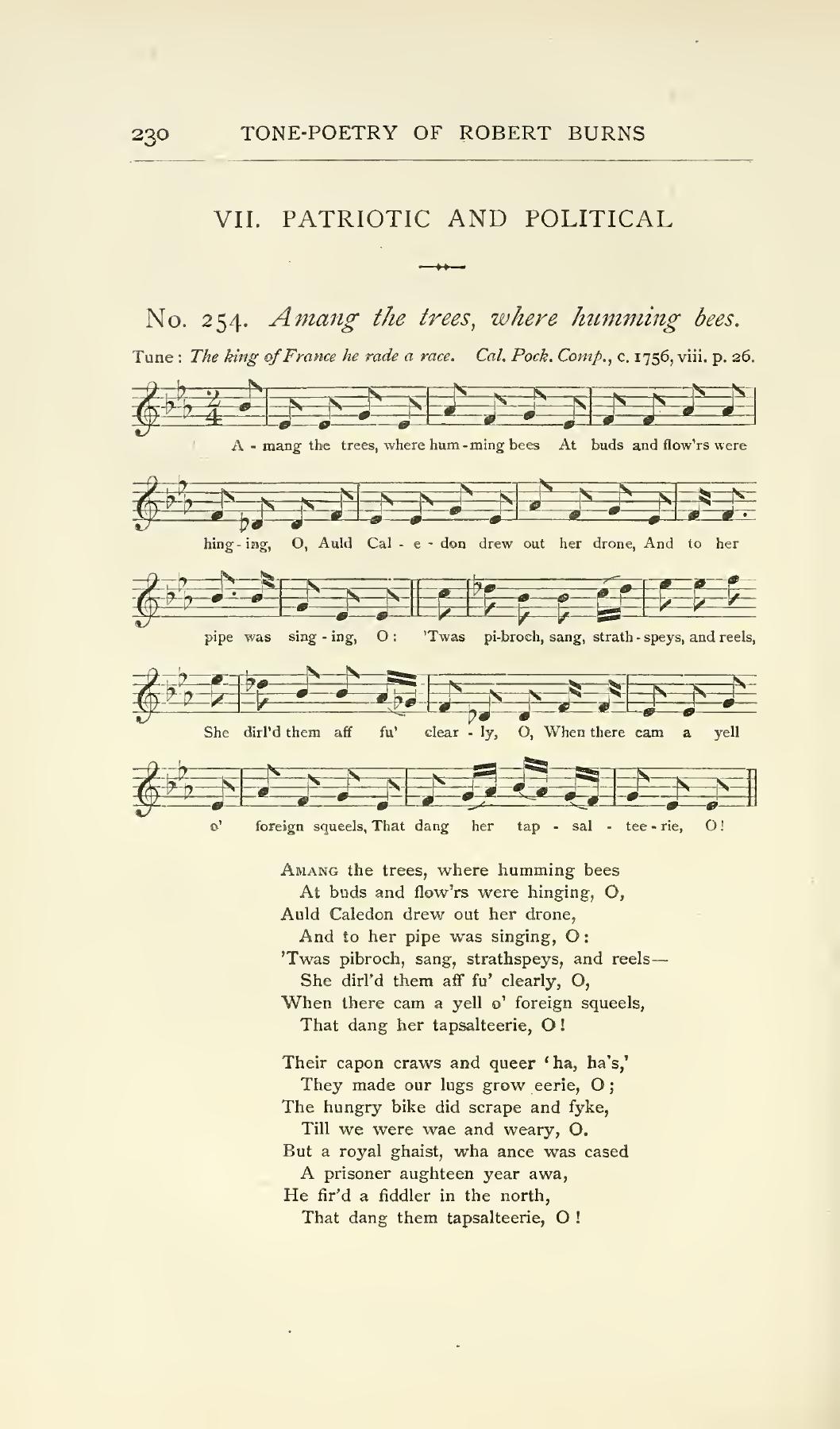 View score Dick’s Songs of Robert Burns (1903)
Lyrics
Choose an edition
Version notes
| Dick (1903) · no. 254 | Cunningham · 1855Ebook transcription |
|---|---|
| flow’rs / strathspeys, and reels | flowers / strathspey, or reels |
| scrape and fyke | scrape and pike |
| cased | cas’d |
| singing, O: / reels— / tapsalteerie, O! / weary, O. | singing, O; / reels, / tapsalteerie, O. / weary, O; |
Dick (1903) · no. 254
Amang the trees, where humming bees
At buds and flow'rs were hinging, O,
Auld Caledon drew out her drone,
And to her pipe was singing, O:
'Twas pibroch, sang, strathspeys, and reels—
She dirl'd them aff fu' clearly, O,
When there cam a yell o' foreign squeels,
That dang her tapsalteerie, O!

Their capon craws and queer 'ha, ha's,'
They made our lugs grow eerie, O;
The hungry bike did scrape and fyke,
Till we were wae and weary, O.
But a royal ghaist, wha ance was cased
A prisoner aughteen year awa,
He fir'd a fiddler in the north,
That dang them tapsalteerie, O!
View the source edition · no. 254; p. 230
About this edition
Both editions contain two eight-line stanzas. Dick has flow’rs, strathspeys and reels, fyke and cased; Cunningham has flowers, strathspey or reels, pike and cas’d. Dick gives an exclamation mark to both tapsalteerie endings, where Cunningham uses full stops; the punctuation around the quoted ha ha’s also differs.
Cunningham (1855)
Amang the trees, where humming bees
  At buds and flowers were hinging, O,
Auld Caledon drew out her drone,
  And to her pipe was singing, O;
’Twas pibroch, sang, strathspey, or reels,
  She dirl’d them aff fu’ clearly, O,
When there cam a yell o’ foreign squeels,
  That dang her tapsalteerie, O.

Their capon craws and queer ha ha’s,
  They made our lugs grow eerie, O;
The hungry bike did scrape and pike,
  ’Till we were wae and weary, O;
But a royal ghaist wha ance was cas’d
  A prisoner aughteen year awa,
He fir’d a fiddler in the north
  That dang them tapsalteerie, O.
Digital text from Project Gutenberg.
View the source edition · p. 272
About this edition
Both editions contain two eight-line stanzas. Dick has flow’rs, strathspeys and reels, fyke and cased; Cunningham has flowers, strathspey or reels, pike and cas’d. Dick gives an exclamation mark to both tapsalteerie endings, where Cunningham uses full stops; the punctuation around the quoted ha ha’s also differs.
Music
View historical scores
Dick’s Songs of Robert Burns (1903)
no. 254; p. 230