The Collier Laddie
Behind the song
A suitor offers Mistress Jean his land, fine clothes and a servant at each hand. All the hills and dales she can see will be hers if she leaves her collier laddie. [1]
Jean can earn five pennies a day and spend them as she pleases at night. She will make her bed in the collier’s corner. Her bargain is “Luve for luve”, with a cottage to live in and the world before her to earn her bread. [1]
Read the fuller story
Dick identifies the Museum's 1792 printing as My collier laddie. He reports Stenhouse's account that Burns supplied both words and tune to the editor, where they appeared together for the first time. Dick also notes a manuscript among the British Museum's Burns material. His note follows the song from manuscript to the printed collection. [2]
Cunningham describes the song as chiefly Burns's composition, coloured by an older strain, and says that it reached the Museum in Burns's handwriting. His introduction presents composition and inherited song together. Jean's self-sufficient speech remains the centre of the text: her work and affection supply the terms on which she will live. [3]
Dick prints six four-line stanzas with a bis instruction for the last two lines of each. Cunningham writes those repetitions out, making each stanza six lines. Dick has “five pennies in a day”, Cunningham “five pennies a day”; Dick's third stanza begins “An' ye shall”, Cunningham's “Ye shall”. Both preserve the repeated return to the Collier Laddie. [1][3]
Story references
- James C. Dick, The Songs of Robert Burns (1903), No. 133; printed pp. 121–121; PDF pp. 177–177
- James C. Dick, The Songs of Robert Burns (1903), Dick historical note 133; printed 396; PDF 452
- Allan Cunningham, The Complete Works of Robert Burns (1855), printed 253; HTML #songsCXXIII. Project Gutenberg transcription.
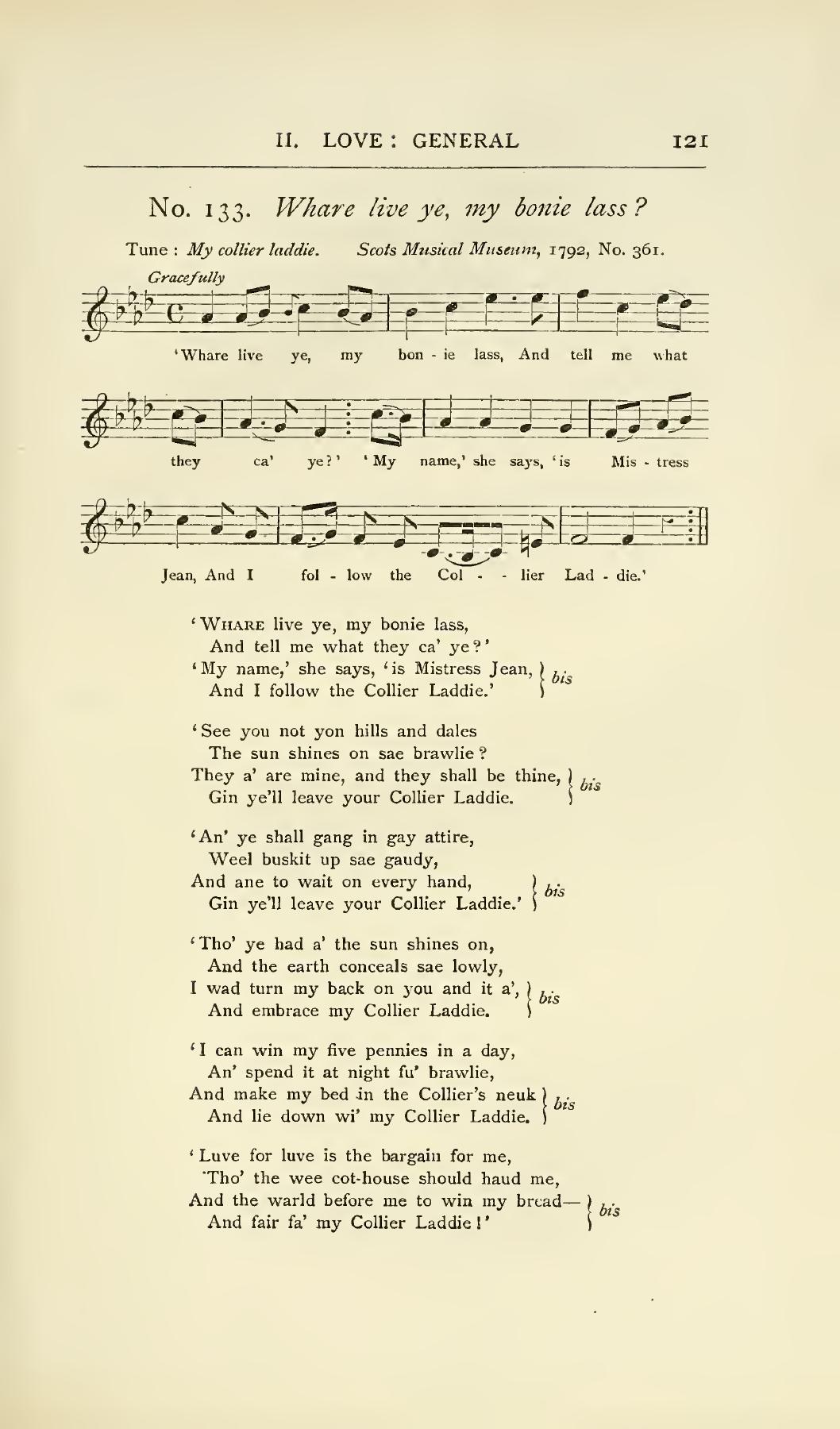 View score Dick’s Songs of Robert Burns (1903)
Lyrics
Choose an edition
Version notes
Dick marks the last two lines of each quatrain “bis”, an instruction to repeat them. The Cunningham transcription gives the repeated lines in full. Dick (1903) · no. 133 · Cunningham · 1855
| Dick (1903) · no. 133 | Cunningham · 1855Ebook transcription |
|---|---|
| last two lines marked bis | last two lines written twice |
| in a day | a day |
| An’ ye shall | Ye shall |
| Whare | Where |
Dick (1903) · no. 133
'Whare live ye, my bonie lass,
And tell me what they ca' ye?'
'My name,' she says, 'is Mistress Jean,
And I follow the Collier Laddie.' (bis)

'See you not yon hills and dales
The sun shines on sae brawlie?
They a' are mine, and they shall be thine,
Gin ye'll leave your Collier Laddie.' (bis)

'An' ye shall gang in gay attire,
Weel buskit up sae gaudy,
And ane to wait on every hand,
Gin ye'll leave your Collier Laddie.' (bis)

'Tho' ye had a' the sun shines on,
And the earth conceals sae lowly,
I wad turn my back on you and it a',
And embrace my Collier Laddie.' (bis)

'I can win my five pennies in a day,
An' spend it at night fu' brawlie,
And make my bed in the Collier's neuk
And lie down wi' my Collier Laddie.' (bis)

'Luve for luve is the bargain for me,
Tho' the wee cott-house should haud me,
And the world before me to win my bread—
And fair fa' my Collier Laddie!' (bis)
These are the words printed below the score.
View the source edition · no. 133; p. 121
About this edition
Six quatrains in Dick, with “bis” applying to each last pair of lines; the reading retains that instruction rather than writing out a performance repeat. Cunningham writes the pair out. Dick has “Whare”, “in a day” and “An’ ye shall”, against Cunningham’s “Where”, “a day” and “Ye shall”.
Cunningham (1855)
Where live ye, my bonnie lass?
  An’ tell me what they ca’ ye;
My name, she says, is Mistress Jean,
  And I follow the Collier Laddie.
My name she says, is Mistress Jean,
  And I follow the Collier Laddie.

See you not yon hills and dales,
  The sun shines on sae brawlie!
They a’ are mine, and they shall be thine,
  Gin ye’ll leave your Collier Laddie.
They a’ are mine, and they shall be thine,
  Gin ye’ll leave your Collier Laddie.

Ye shall gang in gay attire,
  Weel buskit up sae gaudy;
And ane to wait on every hand,
  Gin ye’ll leave your Collier Laddie.
And ane to wait on every hand,
  Gin ye’ll leave your Collier Laddie.

Tho’ ye had a’ the sun shines on,
  And the earth conceals sae lowly;
I wad turn my back on you and it a’,
  And embrace my Collier Laddie.
I wad turn my back on you and it a’,
  And embrace my Collier Laddie.

I can win my five pennies a day,
  And spen’t at night fu’ brawlie;
And make my bed in the Collier’s neuk,
  And lie down wi’ my Collier Laddie.
And make my bed in the Collier’s neuk,
  And lie down wi’ my Collier Laddie.

Luve for luve is the bargain for me,
  Tho’ the wee cot-house should haud me;
And the world before me to win my bread,
  And fair fa’ my Collier Laddie.
And the world before me to win my bread,
  And fair fa’ my Collier Laddie.
Digital text from Project Gutenberg.
View the source edition · p. 253
About this edition
Six quatrains in Dick, with “bis” applying to each last pair of lines; the reading retains that instruction rather than writing out a performance repeat. Cunningham writes the pair out. Dick has “Whare”, “in a day” and “An’ ye shall”, against Cunningham’s “Where”, “a day” and “Ye shall”.
Scots Musical Museum, vol. IV (1792) · no. 361
View the source edition · Volume 4, no. 361; p. 372
Music
View historical scores
Dick’s Songs of Robert Burns (1903)
no. 133; p. 121