O Kenmure’s on and awa, Willie
Behind the song
Willie is called on to raise his glass as Kenmure sets off. The company drinks to his courage, his family and his band. Kenmure led Jacobite forces in south-west Scotland. James C. Dick recounts his surrender and execution. The singers still have his victory and homecoming to drink to. [1][3]
Their last toast is to someone far away and to a rose as white as snow. A company that has spent five stanzas naming its leader can leave this last allegiance unspoken. [1]
Read the fuller story
Burns’s contribution is uncertain. Cunningham assigns him the second, third and concluding stanzas and says he sent the whole to the Museum in his handwriting. Dick says the association rests on Stenhouse, seeks confirmation and cannot locate the manuscript. He also describes additional stanzas printed by Cromek. [2][3]
Dick places Kenmure’s story in the Jacobite rising and follows his account from command in south-west Scotland to surrender and execution. The song itself stays with the band’s confidence and its hope for return. Dick’s sprightly setting bears Kenmure’s name, and both selected editions print six quatrains. [3]
Story references
- James C. Dick, The Songs of Robert Burns (1903), No. 282; printed pp. 265–265; PDF pp. 321–321
- Allan Cunningham, The Complete Works of Robert Burns (1855), printed 253; HTML #songsCXXII. Project Gutenberg transcription.
- James C. Dick, The Songs of Robert Burns (1903), Dick note 282; printed 464,465; PDF 520,521
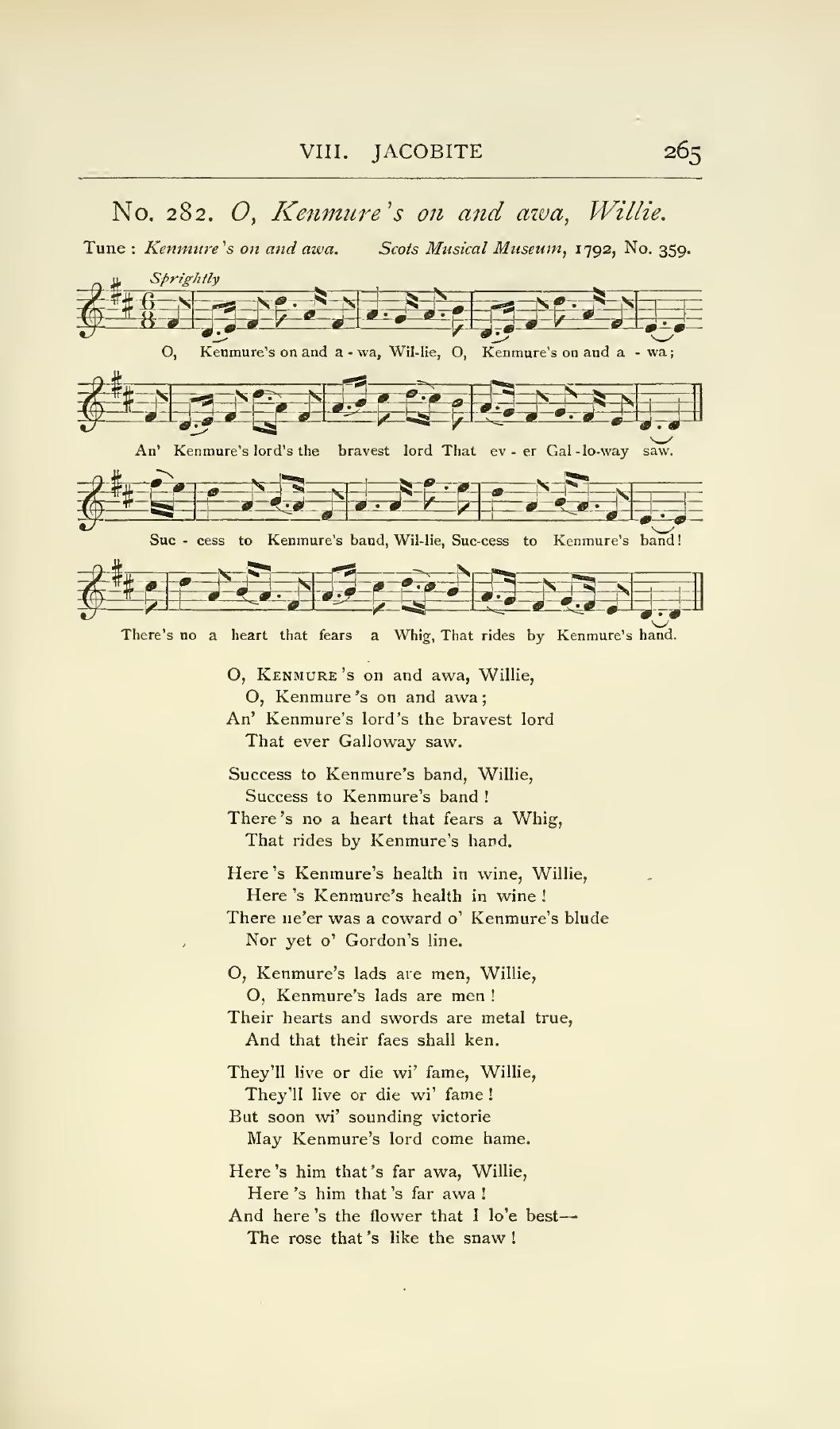 View score Dick’s Songs of Robert Burns (1903)
Lyrics
Choose an edition
Version notes
| Dick (1903) · no. 282 | Cunningham · 1855Ebook transcription |
|---|---|
| the flower that I lo’e best | the flower that I love best |
| An’ Kenmure’s lord’s | And Kenmure’s lord’s |
Dick (1903) · no. 282
O, Kenmure's on and awa, Willie,
O, Kenmure's on and awa;
An' Kenmure's lord's the bravest lord
That ever Galloway saw.

Success to Kenmure's band, Willie,
Success to Kenmure's band!
There's no a heart that fears a Whig,
That rides by Kenmure's hand.

Here's Kenmure's health in wine, Willie,
Here's Kenmure's health in wine!
There ne'er was a coward o' Kenmure's blude
Nor yet o' Gordon's line.

O, Kenmure's lads are men, Willie,
O, Kenmure's lads are men!
Their hearts and swords are metal true,
And that their faes shall ken.

They'll live or die wi' fame, Willie,
They'll live or die wi' fame!
But soon wi' sounding victorie
May Kenmure's lord come hame.

Here's him that's far awa, Willie,
Here's him that's far awa!
And here's the flower that I lo'e best—
The rose that's like the snaw!
View the source edition · no. 282; p. 265
About this edition
Both selected texts have six quatrains. Dick’s last toast has lo’e, Cunningham love; Dick’s opening An’ differs from Cunningham’s And. Stops differ, especially the repeated acclamations. Cunningham allocates particular stanzas to Burns; Dick asks for confirmation of the association.
Cunningham (1855)
O Kenmure’s on and awa, Willie!
  O Kenmure’s on and awa!
And Kenmure’s lord’s the bravest lord,
  That ever Galloway saw.

Success to Kenmure’s band, Willie!
  Success to Kenmure’s band;
There’s no a heart that fears a Whig,
  That rides by Kenmure’s hand.

Here’s Kenmure’s health in wine, Willie!
  Here’s Kenmure’s health in wine;
There ne’er was a coward o’ Kenmure’s blude,
  Nor yet o’ Gordon’s line.

O Kenmure’s lads are men, Willie!
  O Kenmure’s lads are men;
Their hearts and swords are metal true—
  And that their faes shall ken.

They’ll live or die wi’ fame, Willie!
  They’ll live or die wi’ fame;
But soon wi’ sounding victorie,
  May Kenmure’s lord come hame.

Here’s him that’s far awa, Willie,
  Here’s him that’s far awa;
And here’s the flower that I love best—
  The rose that’s like the snaw!
Digital text from Project Gutenberg.
View the source edition · p. 253
About this edition
Both selected texts have six quatrains. Dick’s last toast has lo’e, Cunningham love; Dick’s opening An’ differs from Cunningham’s And. Stops differ, especially the repeated acclamations. Cunningham allocates particular stanzas to Burns; Dick asks for confirmation of the association.
Scots Musical Museum, vol. IV (1792) · no. 359
View the source edition · Volume 4, no. 359; p. 370
Music
View historical scores
Dick’s Songs of Robert Burns (1903)
no. 282; p. 265