An O for ane and twenty, Tam
Behind the song
An aunt has left her land and goods, yet her family wants her to marry a wealthy fool. In three years she will be twenty-one and free to choose for herself. She offers her hand to Tam and promises her relatives a lively reckoning on her birthday. [1]
Burns had a particular dance step in mind for this defiant song. He wanted George Thomson to hear an old Scots fiddler play The moudiewart in strathspey time. James C. Dick says Thomson published it to Cold and raw. [2]
Read the fuller story
Dick records the song in the Museum in 1792 and says Burns acknowledged it in a letter of 19 October 1794. He describes it as an original song. Cunningham quotes Burns's brief annotation, “This song is mine”, in his own introduction. Both editors present a clear claim to the song, through later transmissions of Burns's words. [2][3]
Dick also preserves a pointed musical request. Burns wanted Thomson to hear an old Scots fiddler play The moudiewart in strathspey time. Dick says Thomson instead published the song to Cold and raw. The request shows how closely the words could be tied to a particular movement in performance, even when a publisher chose a different air. [2]
Dick prints The moudiewart above a brisk score. Cunningham uses The Moudiewort and prints the chorus again after the third stanza, where Dick leaves the initial chorus to stand. Both versions end on the offered hand and the promise to Tam, keeping the approaching birthday at the centre of the song. [1][3]
Story references
- James C. Dick, The Songs of Robert Burns (1903), No. 189; printed pp. 169–169; PDF pp. 225–225
- James C. Dick, The Songs of Robert Burns (1903), Dick historical note 189; printed 415; PDF 471
- Allan Cunningham, The Complete Works of Robert Burns (1855), printed 252; HTML #songsCXXI. Project Gutenberg transcription.
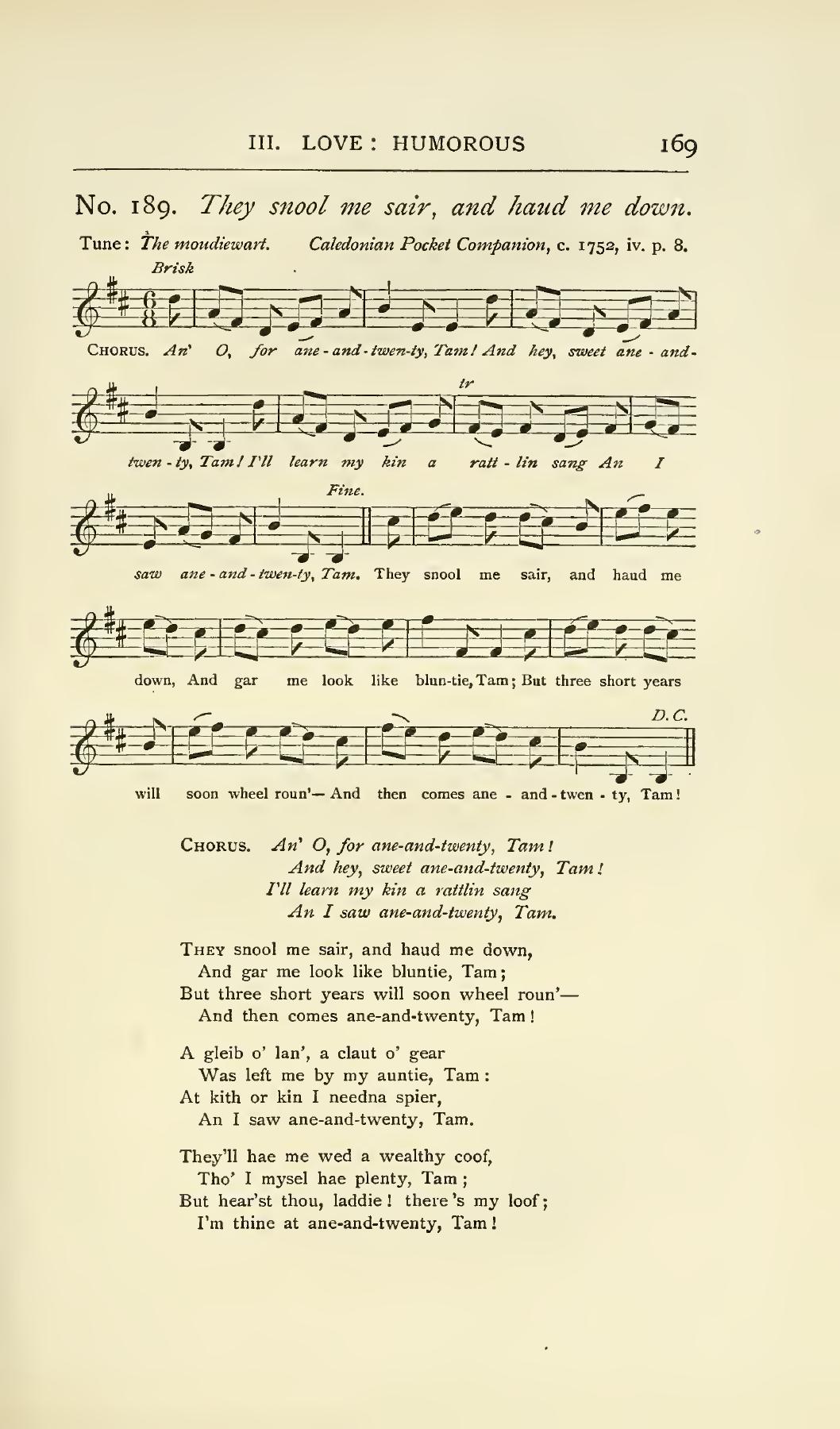 View score Dick’s Songs of Robert Burns (1903)
Lyrics
Choose an edition
Version notes
| Dick (1903) · no. 189 | Cunningham · 1855Ebook transcription |
|---|---|
| initial chorus only printed | chorus reprinted at end |
| Moudiewart | Moudiewort |
| needna | need na |
Dick (1903) · no. 189
Chorus. An' O, for ane-and-twenty, Tam!
And hey, sweet ane-and-twenty, Tam!
I'll learn my kin a rattlin sang
An I saw ane-and-twenty, Tam.

They snool me sair, and haud me down,
And gar me look like bluntie, Tam;
But three short years will soon wheel roun'—
And then comes ane-and-twenty, Tam!

A gleib o' lan', a claut o' gear
Was left me by my auntie, Tam:
At kith or kin I needna spier,
An I saw ane-and-twenty, Tam.

They'll hae me wed a wealthy coof,
Tho' I mysel hae plenty, Tam;
But hear'st thou, laddie! there's my loof;
I'm thine at ane-and-twenty, Tam!
These are the words printed below the score.
View the source edition · no. 189; p. 169
About this edition
Both editions have an initial chorus and three quatrains. Cunningham reprints the chorus after the final verse; Dick does not. Dick’s “needna” is Cunningham’s “need na”; the tune title is Moudiewart in Dick and Moudiewort in Cunningham. The older moudiewart stanza quoted in Dick’s note remains a separate dependent text.
Cunningham (1855)
An O, for ane-and-twenty, Tam,
  An’ hey, sweet ane-and-twenty, Tam,
I’ll learn my kin a rattlin’ sang,
  An I saw ane-and-twenty, Tam.

They snool me sair, and haud me down,
  And gar me look like bluntie, Tam!
But three short years will soon wheel roun’—
  And then comes ane-and-twenty, Tam.

A gleib o’ lan’, a claut o’ gear,
  Was left me by my auntie, Tam,
At kith or kin I need na spier,
  An I saw ane-and-twenty, Tam.

They’ll hae me wed a wealthy coof,
  Tho’ I mysel’ hae plenty, Tam;
But hear’st thou, laddie—there’s my loof—
  I’m thine at ane-and-twenty, Tam.
    An O, for ane-and-twenty, Tam!
      An hey, sweet ane-and-twenty, Tam!
    I’ll learn my kin a rattlin’ song,
      An I saw ane-and-twenty, Tam.
Digital text from Project Gutenberg.
View the source edition · p. 252
About this edition
Both editions have an initial chorus and three quatrains. Cunningham reprints the chorus after the final verse; Dick does not. Dick’s “needna” is Cunningham’s “need na”; the tune title is Moudiewart in Dick and Moudiewort in Cunningham. The older moudiewart stanza quoted in Dick’s note remains a separate dependent text.
Scots Musical Museum, vol. IV (1792) · no. 355
View the source edition · Volume 4, no. 355; p. 366
Music
View historical scores
Dick’s Songs of Robert Burns (1903)
no. 189; p. 169