The weary pund o’ tow
Behind the song
He bought his wife a stone of good flax. All she has spun, he complains, is a pound of tow, the coarse fibres. He reckons she will die before the job is done. When he finally orders her to spin, she takes the implement in her hand and cracks him over the head. [1]
Read the fuller story
The work is spinning. “Lint” means flax, and “pund o’ tow” refers to a pound of its coarser fibres. The bottle placed near the hearth supplies the next explanation for the delay: his wife keeps taking a drink, supposedly to wet the dusty tow. Her excuse turns a step in the work into an opportunity to interrupt it. The husband’s account makes the bottle as important an object as the flax. [1][2]
Then his complaint becomes an order. He calls her a “dirty dame” and tells her to spin; she answers by striking him on the head with the “rock”, the spinning implement in her hand. The movement is sudden and economical. A household argument that begins with the weight of material ends with the husband’s “pow”, or head, receiving the blow. The song’s comedy depends on the failure of his attempt to command the scene he is describing. [1][2]
The last stanza takes his grievance into death. He rejoices when her feet go foremost over the hill, the image of her being carried away dead, and declares that he would hang himself before marrying another such woman. There is grim wordplay in “tow”: the labour of spinning tow gives way to the rope with which he threatens to hang. The wife’s conduct, the violence and the final celebration all come through his complaining voice. The song invites a performance of extravagant resentment; that voice also makes the husband’s cruelty audible. [1][2]
Dick’s 1903 edition identifies the song with no. 350 of the Scots Musical Museum, which he dates to 1792, and reports a manuscript in the British Museum. He places it beside older songs about aggrieved husbands, including The pound of tow in The Charmer of 1782. His quotation from that song imagines wives in a bottomless boat and ends with the same unfinished pound of tow. This is the older comic territory in which he presents Burns’s song: domestic work, drink and a husband imagining release from marriage. [3]
The refrain is printed first, followed by four narrative stanzas. Dick’s setting is marked “Slow”, with directions to return to the beginning and finish at the end of the chorus. Repeated performance can make the complaint sound laborious in its own right: each incident leads back to the same weary pound. The pacing gives the singer room for the husband’s mounting exasperation and for the sharp reversal when his command brings him a blow. [1]
Story references
- James C. Dick, The Songs of Robert Burns (1903), no. 215, “I bought my wife a stane o’ lint”, p. 192, words and setting.
- Allan Cunningham, ed., The Complete Works of Robert Burns (1855), glossary, “Lint”, “Pund, pund o’ tow”, “Pow”, “Stowre” and “Tow”; Project Gutenberg transcription.
- James C. Dick, The Songs of Robert Burns (1903), note 215, pp. 426–427.
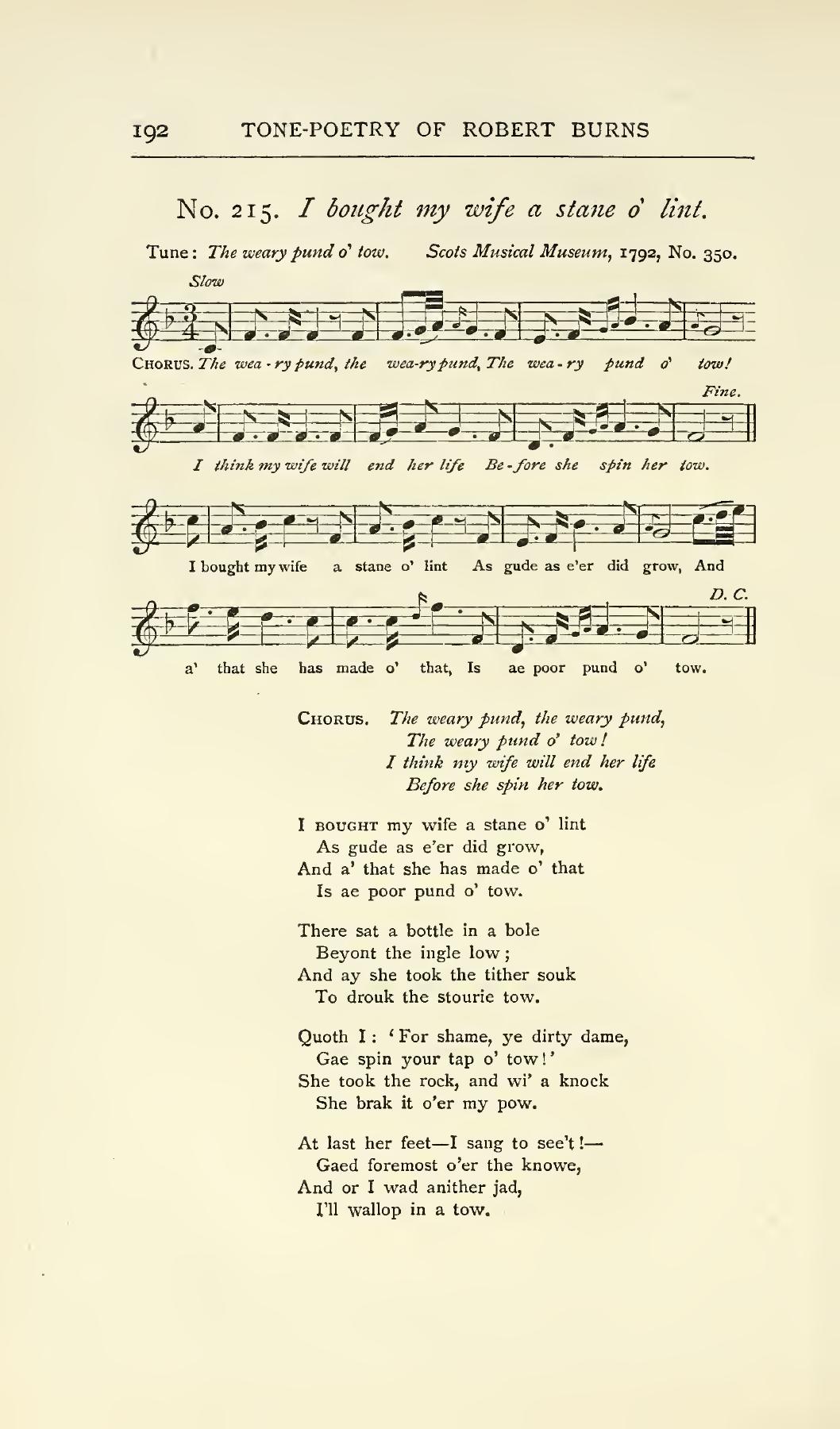 View score Dick’s Songs of Robert Burns (1903)
Lyrics
Choose an edition
Version notes
| Dick (1903) · no. 215 | Cunningham · 1855Ebook transcription |
|---|---|
| stourie | stowrie |
| Dick prints opening chorus once | Cunningham ebook repeats the chorus at the close |
Dick (1903) · no. 215
CHORUS
The weary pund, the weary pund,
The weary pund o' tow!
I think my wife will end her life
Before she spin her tow.

I bought my wife a stane o' lint
As gude as e'er did grow,
And a' that she has made o' that
Is ae poor pund o' tow.

There sat a bottle in a bole
Beyont the ingle low;
And ay she took the tither souk
To drouk the stourie tow.

Quoth I: 'For shame, ye dirty dame,
Gae spin your tap o' tow!'
She took the rock, and wi' a knock
She brak it o'er my pow.

At last her feet—I sang to see't!—
Gaed foremost o'er the knowe,
And or I wad anither jad,
I'll wallop in a tow.
Chorus and four stanzas from Dick’s 1903 edition.
View the source edition · no. 215; p. 192
About this edition
Syllables separated by the musical notation are joined into words in this reading.
Dick prints a chorus and four stanzas. Cunningham’s 1855 ebook repeats the chorus at the close and has stowrie where Dick prints stourie.
Cunningham (1855)
The weary pund, the weary pund,
  The weary pund o’ tow:
I think my wife will end her life
  Before she spin her tow.
I bought my wife a stane o’ lint
  As gude as e’er did grow;
And a’ that she has made o’ that,
  Is ae poor pund o’ tow.

There sat a bottle in a bole,
  Beyont the ingle low,
And ay she took the tither souk,
  To drouk the stowrie tow.

Quoth I, for shame, ye dirty dame,
  Gae spin your tap o’ tow!
She took the rock, and wi’ a knock
  She brak it o’er my pow.

At last her feet—I sang to see’t—
  Gaed foremost o’er the knowe;
And or I wad anither jad,
  I’ll wallop in a tow.
    The weary pund, the weary pund,
      The weary pund o’ tow!
    I think my wife will end her life
      Before she spin her tow.
Digital text from Project Gutenberg.
View the source edition · p. 252
Scots Musical Museum, vol. IV (1792) · no. 350
View the source edition · Volume 4, no. 350; p. 362
Music
View historical scores
Dick’s Songs of Robert Burns (1903)
no. 215; p. 192