Wha is that at my bower-door
Behind the song
Who is at the bower door? Findlay, of course. He looks like a thief, says the voice inside. Let him in and see, says he. He agrees just as readily that he will make mischief before morning. Every answer ends with the same two words, “quo’ Findlay”. [1]
Suppose he wakes the house, stays till daybreak or learns the way back? Each warning sounds more like an invitation. By the last verse the question is what he will tell afterwards. Findlay promises a lifetime of silence. [1]
Read the fuller story
Cunningham reports Gilbert Burns’s suggestion that Ramsay’s Auld man and the Widow prompted the song. Dick instead points to a broadside called Who but I, quoth Findlay, citing the Centenary Burns, and says that it supplied nearly all the incidents. He also challenges Cromek’s presentation of the supposed authorial statement “The words are mine”. [2][3]
Dick sets the song to Lass, an I come near thee, marked Lively, with a Scots Musical Museum reference dated 1792. His note quotes an older refrain associated with that tune and another fragment from the Herd manuscript in which a wife answers her husband. He also records a later original melody by Schumann. In the selected lyric, its three eight-line stanzas keep the two voices alternating without interruption. [1][3]
Story references
- James C. Dick, The Songs of Robert Burns (1903), No. 184; printed pp. 164–164; PDF pp. 220–220
- Allan Cunningham, The Complete Works of Robert Burns (1855), printed 249; HTML #songsCXIII. Project Gutenberg transcription.
- James C. Dick, The Songs of Robert Burns (1903), Dick note 184; printed 413,414; PDF 469,470
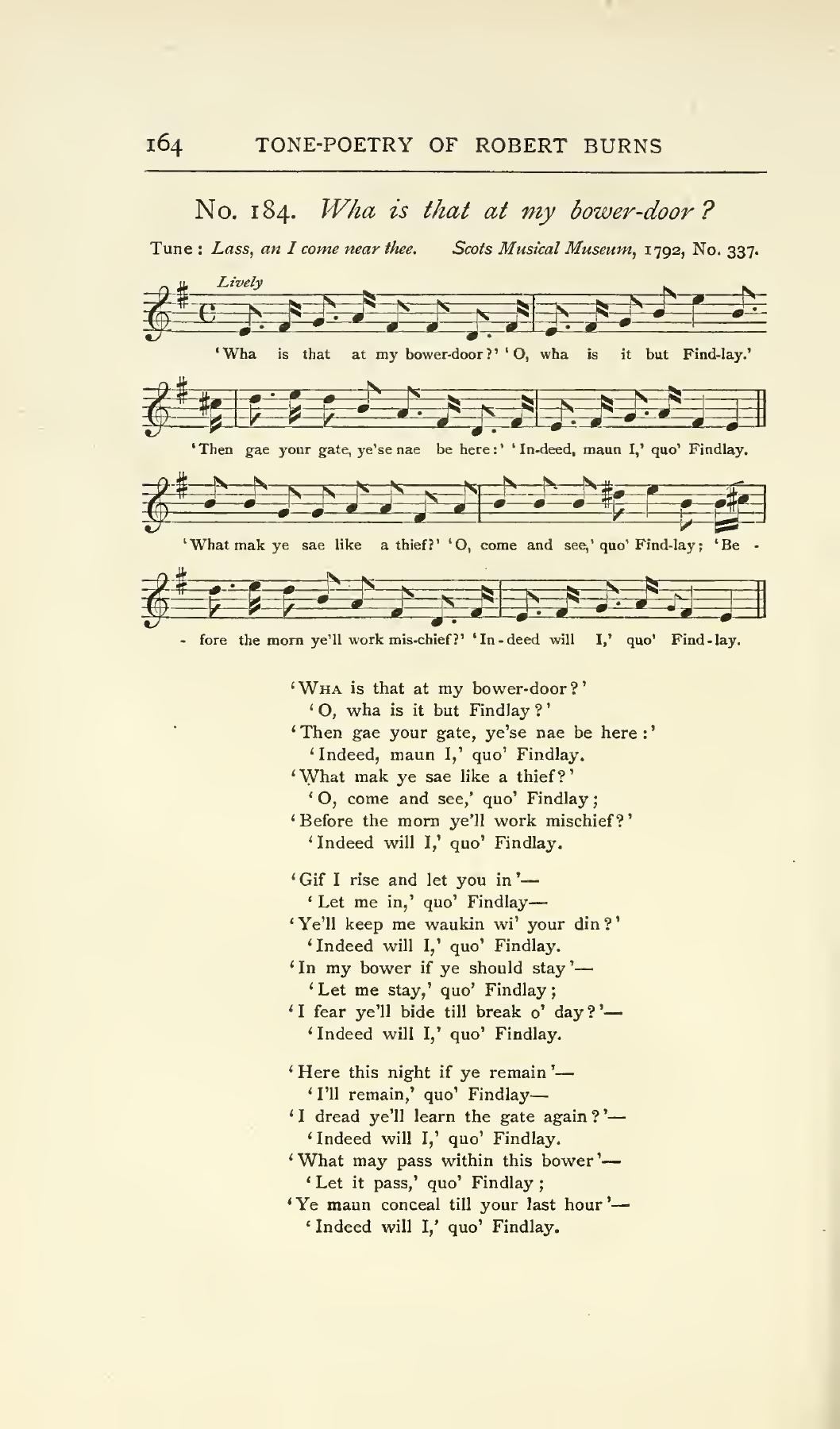 View score Dick’s Songs of Robert Burns (1903)
Lyrics
Choose an edition
Version notes
| Dick (1903) · no. 184 | Cunningham · 1855Ebook transcription |
|---|---|
| every turn separately quoted with questions, colons and trailing dashes | no speech quotes; differing questions/semicolons and exclamations |
| In my bower if ye should stay | In my bower if you should stay |
Dick (1903) · no. 184
'Wha is that at my bower-door?'
'O, wha is it but Findlay?'
'Then gae your gate, ye'se nae be here:'
'Indeed, maun I,' quo' Findlay.
'What mak ye sae like a thief?'
'O, come and see,' quo' Findlay;
'Before the morn ye'll work mischief?'
'Indeed will I,' quo' Findlay.

'Gif I rise and let you in'—
'Let me in,' quo' Findlay—
'Ye'll keep me waukin wi' your din?'
'Indeed will I,' quo' Findlay.
'In my bower if ye should stay'—
'Let me stay,' quo' Findlay;
'I fear ye'll bide till break o' day?'—
'Indeed will I,' quo' Findlay.

'Here this night if ye remain'—
'I'll remain,' quo' Findlay—
'I dread ye'll learn the gate again?'—
'Indeed will I,' quo' Findlay.
'What may pass within this bower'—
'Let it pass,' quo' Findlay;
'Ye maun conceal till your last hour'—
'Indeed will I,' quo' Findlay.
View the source edition · no. 184; p. 164
About this edition
Both editions retain three eight-line stanzas. Dick puts quotation marks around each speech turn and uses several trailing dashes; Cunningham leaves the speeches unquoted and punctuates a number of the challenges differently. Dick reads if ye should stay against Cunningham’s if you should stay.
Cunningham (1855)
Wha is that at my bower door?
  O, wha is it but Findlay?
Then gae your gate, ye’se nae be here!—
  Indeed, maun I, quo’ Findlay.
What mak ye sae like a thief?
  O come and see, quo’ Findlay;
Before the morn ye’ll work mischief;
  Indeed will I, quo’ Findlay.

Gif I rise and let you in?
  Let me in, quo’ Findlay;
Ye’ll keep me waukin wi’ your din;
  Indeed will I, quo’ Findlay.
In my bower if you should stay?
  Let me stay, quo’ Findlay;
I fear ye’ll bide till break o’ day;
  Indeed will I, quo’ Findlay.

Here this night if ye remain;—
  I’ll remain, quo’ Findlay;
I dread ye’ll learn the gate again;
  Indeed will I, quo’ Findlay.
What may pass within this bower,—
  Let it pass, quo’ Findlay;
Ye maun conceal till your last hour;
  Indeed will I, quo’ Findlay!
Digital text from Project Gutenberg.
View the source edition · p. 249
About this edition
Both editions retain three eight-line stanzas. Dick puts quotation marks around each speech turn and uses several trailing dashes; Cunningham leaves the speeches unquoted and punctuates a number of the challenges differently. Dick reads if ye should stay against Cunningham’s if you should stay.
Scots Musical Museum, vol. IV (1792) · no. 337
View the source edition · Volume 4, no. 337; p. 347
Music
View historical scores
Dick’s Songs of Robert Burns (1903)
no. 184; p. 164