Eppie M’Nab
Behind the song
Jock Rab asks after Eppie M’Nab. She is out in the yard kissing the laird, comes the answer. Jock calls for her to come home anyway. [1]
Then he asks what Eppie has to say for herself. She has forgotten him, he hears, and disowns him for ever. He keeps calling her by name, though now he wishes they had never met. [1]
Read the fuller story
Both editors describe Burns working on an older song. Cunningham says he corrected and added lines before sending the result to Johnson; Dick quotes the older song’s reputation for having more wit than decency. Dick also gives a Herd fragment in which Eppie kisses the laird, then appears in conspicuous shoes and stockings. That reported fragment supplies a different surviving glimpse of the woman. [2][3]
Dick’s complete reading crosses from the enquiry and offer of forgiveness on one page to rejection and lament on the next. He prints four quatrains; Cunningham groups the same exchange in two eight-line stanzas. The tune bears Eppie’s name. The compressed question-and-answer form lets the singer carry both the news about her and Jock’s changing response, with each repeated opening delaying the next blow. [1][2]
Story references
- James C. Dick, The Songs of Robert Burns (1903), No. 125; printed pp. 114–115; PDF pp. 170–171
- Allan Cunningham, The Complete Works of Robert Burns (1855), printed 249; HTML #songsCXII. Project Gutenberg transcription.
- James C. Dick, The Songs of Robert Burns (1903), Dick note 125; printed 394; PDF 450
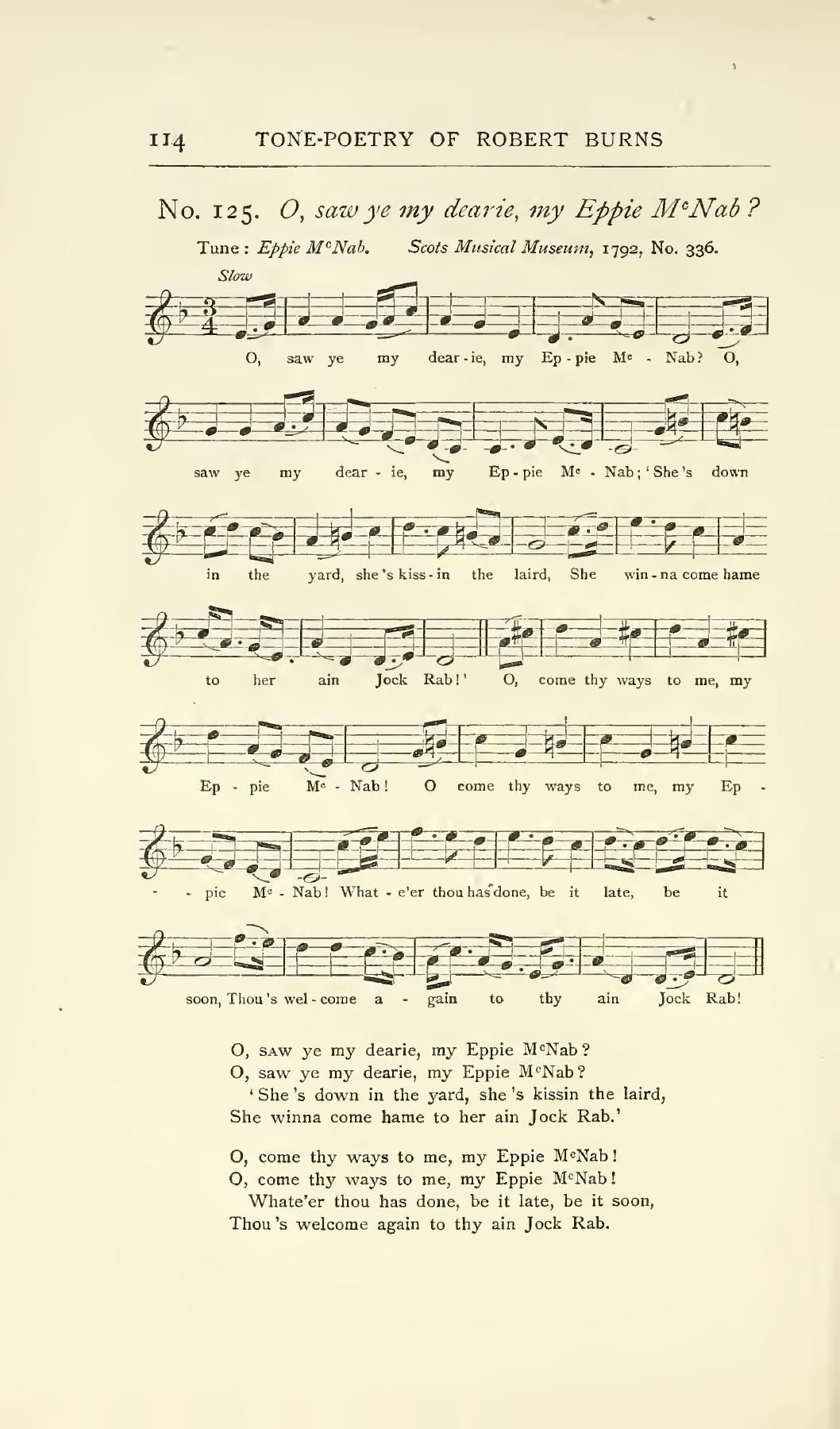 View score Dick’s Songs of Robert Burns (1903)
Lyrics
Choose an edition
Version notes
| Dick (1903) · no. 125 | Cunningham · 1855Ebook transcription |
|---|---|
| Whate’er thou has done | Whate’er thou hast done |
| and as fause as thou’s fair | and fause as thou’s fair |
Dick (1903) · no. 125
O, saw ye my dearie, my Eppie MᶜNab?
O, saw ye my dearie, my Eppie MᶜNab?
'She's down in the yard, she's kissin the laird,
She winna come hame to her ain Jock Rab.'

O, come thy ways to me, my Eppie MᶜNab!
O, come thy ways to me, my Eppie MᶜNab!
Whate'er thou has done, be it late, be it soon,
Thou's welcome again to thy ain Jock Rab.

What says she, my dearie, my Eppie MᶜNab?
What says she, my dearie, my Eppie MᶜNab?
'She lets thee to wit that she has thee forgot,
And for ever disowns thee, her ain Jock Rab.'

O, had I ne'er seen thee, my Eppie MᶜNab!
O, had I ne'er seen thee, my Eppie MᶜNab!
As light as the air and as fause as thou's fair,
Thou's broken the heart o' thy ain Jock Rab.
View the source edition · no. 125; pp. 114–115
About this edition
Dick’s four quatrains are grouped as two eight-line stanzas by Cunningham. Dick prints Whate’er thou has done against Cunningham’s Whate’er thou hast done; Dick’s closing comparison adds a second as. Quotation marks identify the replies in Dick. Superscript c in Dick’s surname is represented as Mᶜ.
Cunningham (1855)
O saw ye my dearie, my Eppie M’Nab?
O saw ye my dearie, my Eppie M’Nab?
She’s down in the yard, she’s kissin’ the laird,
She winna come hame to her ain Jock Rab.
O come thy ways to me, my Eppie M’Nab!
O come thy ways to me, my Eppie M’Nab!
Whate’er thou hast done, be it late, be it soon,
Thou’s welcome again to thy ain Jock Rab.

What says she, my dearie, my Eppie M’Nab?
What says she, my dearie, my Eppie M’Nab?
She lets thee to wit, that she has thee forgot,
And for ever disowns thee, her ain Jock Rab.
O had I ne’er seen thee, my Eppie M’Nab!
O had I ne’er seen thee, my Eppie M’Nab!
As light as the air, and fause as thou’s fair,
Thou’s broken the heart o’ thy ain Jock Rab.
Digital text from Project Gutenberg.
View the source edition · p. 249
About this edition
Dick’s four quatrains are grouped as two eight-line stanzas by Cunningham. Dick prints Whate’er thou has done against Cunningham’s Whate’er thou hast done; Dick’s closing comparison adds a second as. Quotation marks identify the replies in Dick. Superscript c in Dick’s surname is represented as Mᶜ.
Scots Musical Museum, vol. IV (1792) · no. 336
View the source edition · Volume 4, no. 336; p. 346
Music
View historical scores
Dick’s Songs of Robert Burns (1903)
no. 125; pp. 114–115