Merry hae I been teethin’ a heckle
Behind the song
The singer sets teeth into a heckle for combing flax, makes a spoon and patches a kettle. He whistles and sings to the beat of his hammer all day, then spends the evening with Katie. [1]
He remembers his first marriage to Bess as grief and servitude and blesses the hour she died. The toast to marrying again is as affectionate towards Katie as it is cruel to Bess. [1]
Read the fuller story
Cunningham says part of the song is old. Dick quotes the description Mr B’s old words from Law’s manuscript list and says it is in Burns’s handwriting. He discusses a resemblance to the tinker’s song in The Jolly Beggars while declining to treat that resemblance as an established variant relationship. [2][3]
Dick gives the tune as Lord Breadalbine’s March and marks it Brisk; Cunningham spells the title Lord Breadalbone’s March. Dick distinguishes the air from The bob o’ Dumblane and supplies Bodidich na’mbrigs as another name for it. The lively direction suits the repeated catalogue of work and pleasure, while the sudden turn to Bess changes the meaning of the singer’s good cheer. [1][2][3]
Story references
- James C. Dick, The Songs of Robert Burns (1903), No. 170; printed pp. 152–152; PDF pp. 208–208
- Allan Cunningham, The Complete Works of Robert Burns (1855), printed 239; HTML #songsLXXXIII. Project Gutenberg transcription.
- James C. Dick, The Songs of Robert Burns (1903), Dick note 170; printed 409; PDF 465
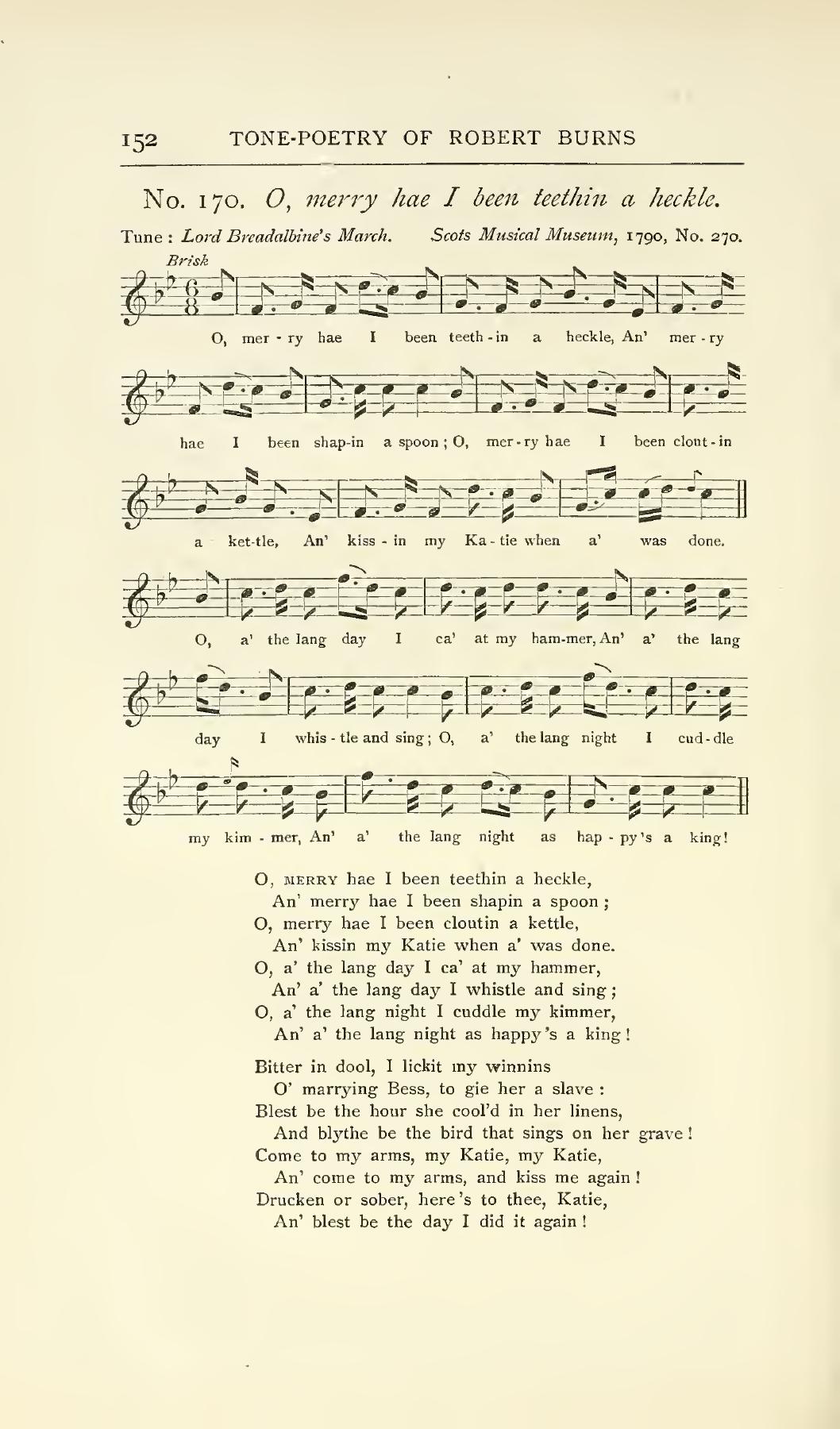 View score Dick’s Songs of Robert Burns (1903)
Lyrics
Choose an edition
Version notes
| Dick (1903) · no. 170 | Cunningham · 1855Ebook transcription |
|---|---|
| An’ merry hae I been shapin | And merry hae I been shapin’ |
| teethin / shapin / kissin | teethin’ / shapin’ / kissin’ |
| O, a’ the lang night | A’ the lang night |
| Drunken |
More differences between these editions
| Dick (1903) · no. 170 | Cunningham · 1855Ebook transcription |
|---|---|
| An’ blest | And blest |
| Bitter in dool, I lickit my winnins / marrying Bess, | Bitter in dool I lickit my winnins, / marrying Bess |
| grave! / arms, and / Katie, | grave. / arms and / Katie! |
| Lord Breadalbine’s March | Lord Breadalbone’s March |
Dick (1903) · no. 170
O, merry hae I been teethin a heckle,
An' merry hae I been shapin a spoon;
O, merry hae I been cloutin a kettle,
An' kissin my Katie when a' was done.
O, a' the lang day I ca' at my hammer,
An' a' the lang day I whistle and sing;
O, a' the lang night I cuddle my kimmer,
An' a' the lang night as happy's a king!

Bitter in dool, I lickit my winnins
O' marrying Bess, to gie her a slave;
Blest be the hour she cool'd in her linens,
And blythe be the bird that sings on her grave!
Come to my arms, my Katie, my Katie,
An' come to my arms, and kiss me again!
Drucken or sober, here's to thee, Katie,
An' blest be the day I did it again!
View the source edition · no. 170; p. 152
About this edition
Both editions have two eight-line stanzas. Dick has An’ merry, repeated O at the start of the night line, Drucken and An’ blest; Cunningham has And merry, no O at that night line, Drunken and And blest. Cunningham adds apostrophes to teethin, shapin and kissin. The commas around dool, Bess and arms, and the end marks after grave and Katie, differ.
Cunningham (1855)
O merry hae I been teethin’ a heckle,
  And merry hae I been shapin’ a spoon;
O merry hae I been cloutin a kettle,
  And kissin’ my Katie when a’ was done.
O a’ the lang day I ca’ at my hammer,
  An’ a’ the lang day I whistle and sing,
A’ the lang night I cuddle my kimmer,
  An’ a’ the lang night as happy’s a king.

Bitter in dool I lickit my winnins,
  O’ marrying Bess to gie her a slave:
Blest be the hour she cool’d in her linens,
  And blythe be the bird that sings on her grave.
Come to my arms, my Katie, my Katie,
  An’ come to my arms and kiss me again!
Drunken or sober, here’s to thee, Katie!
  And blest be the day I did it again.
Digital text from Project Gutenberg.
View the source edition · p. 239
About this edition
Both editions have two eight-line stanzas. Dick has An’ merry, repeated O at the start of the night line, Drucken and An’ blest; Cunningham has And merry, no O at that night line, Drunken and And blest. Cunningham adds apostrophes to teethin, shapin and kissin. The commas around dool, Bess and arms, and the end marks after grave and Katie, differ.
Scots Musical Museum, vol. III (1790) · no. 270
View the source edition · Volume 3, no. 270; p. 279
Music
View historical scores
Dick’s Songs of Robert Burns (1903)
no. 170; p. 152