Ca’ the Ewes to the Knowes
Behind the song
A shepherd invites his dearie under the hazels by moonlight. She tells him she was brought up to have more sense than to play the fool and end her days in sorrow. Their talk takes place to the call to drive the ewes towards the knowes, the heather-covered hills. [1]
He promises gowns, ribbons, calf-leather shoes and a place in his arms. She will go with him if he keeps his word. They pledge to stay true until death, while water still flows to the sea and daylight fills the sky. [1]
Read the fuller story
Burns's contribution has been described differently. Cunningham says he amended an older pastoral and added its concluding verse. Dick assigns him the last two stanzas and says the first two were made from an original first stanza. Dick also records the tradition naming Tibby Pagan as author and objects that it lacks authority. [2][3]
Dick quotes Burns telling Thomson in September 1794 how he heard a clergyman, Mr Clunie, sing the song about seven years earlier. At Burns's request, Clarke took it down; Burns then added some stanzas and mended others before giving it to Johnson. The account places listening, notation and revision together in the making of the published song. [2]
Dick also prints a later Ca' the Yowes beginning Hark the mavis' e'ening sang. It keeps the chorus and moves through Clouden's woods, moonlit towers and fairies, replacing this version's spoken bargaining with a sustained invitation. His later entry directs the singer back to the music at no.114. The two texts share a refrain and have separate places in the collection. [1][4]
Story references
- James C. Dick, The Songs of Robert Burns (1903), No. 114; printed pp. 105–105; PDF pp. 161–161
- James C. Dick, The Songs of Robert Burns (1903), Dick historical note 114; printed 389,390; PDF 445,446
- Allan Cunningham, The Complete Works of Robert Burns (1855), printed 238; HTML #songsLXXXII. Project Gutenberg transcription.
- James C. Dick, The Songs of Robert Burns (1903), Dick no.118; printed108–109; PDF164–165
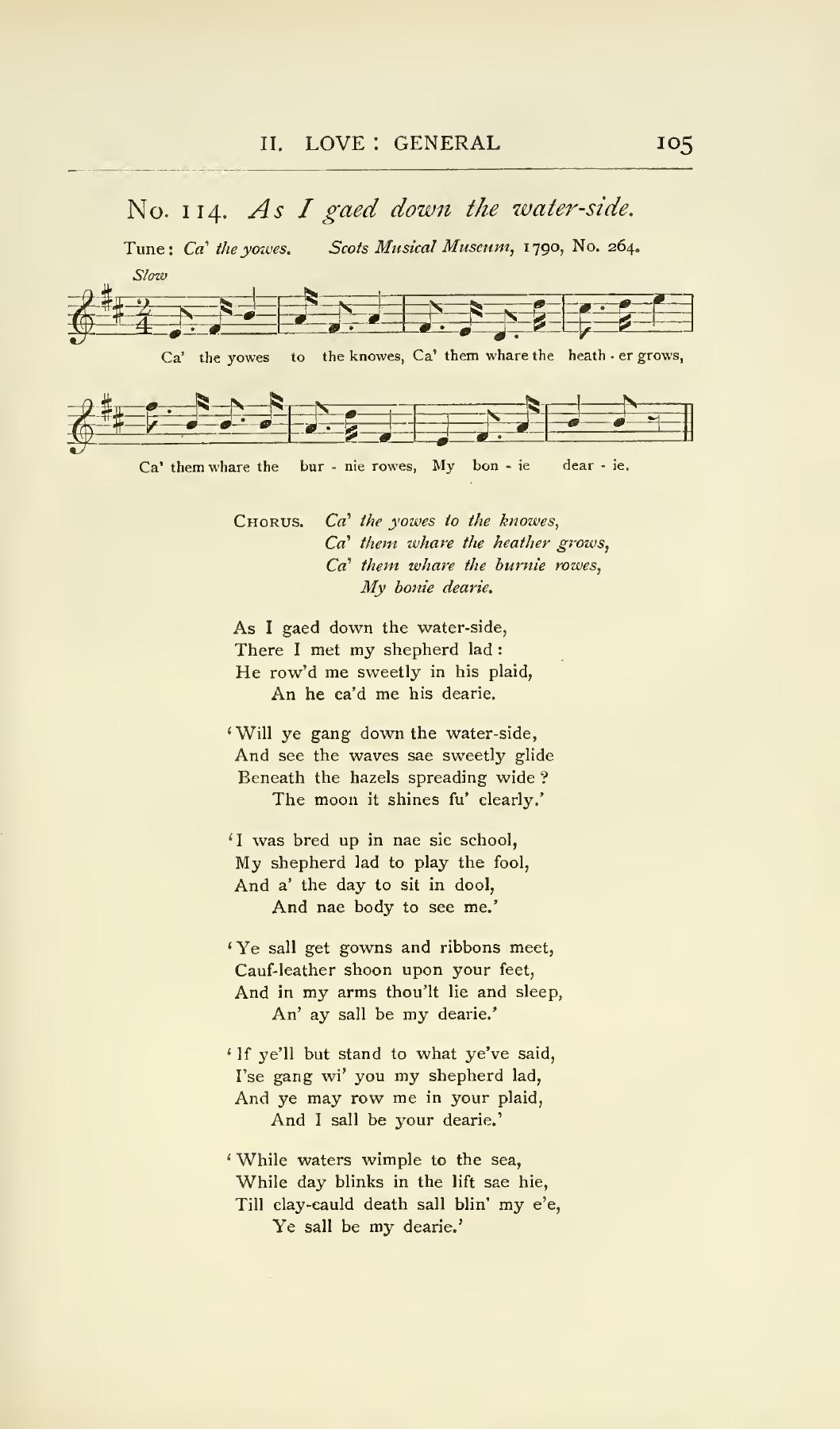 View score Dick’s Songs of Robert Burns (1903)
Lyrics
Choose an edition
Version notes
| Dick (1903) · no. 114 | Cunningham · 1855Ebook transcription |
|---|---|
| in nae sic school | at nae sic school |
| thou’lt lie and sleep | ye’se lie and sleep |
| not reprinted after final stanza | reprinted after final stanza |
| An’ ay sall | And ye shall |
Dick (1903) · no. 114
Chorus. Ca' the yowes to the knowes,
Ca' them whare the heather grows,
Ca' them whare the burnie rowes,
My bonie dearie.

As I gaed down the water-side,
There I met my shepherd lad:
He row'd me sweetly in his plaid,
An he ca'd me his dearie.

'Will ye gang down the water-side,
And see the waves sae sweetly glide
Beneath the hazels spreading wide?
The moon it shines fu' clearly.'

'I was bred up in nae sic school,
My shepherd lad, to play the fool,
And a' the day to sit in dool,
And nae body to see me.'

'Ye sall get gowns and ribbons meet,
Cauf-leather shoon upon your feet,
And in my arms thou'lt lie and sleep,
An' ay sall be my dearie.'

'If ye'll but stand to what ye've said,
I'se gang wi' you my shepherd lad,
And ye may row me in your plaid,
And I sall be your dearie.'

'While waters wimple to the sea,
While day blinks in the lift sae hie,
Till clay-cauld death sall blin' my e'e,
Ye sall be my dearie.'
These are the words printed below the score.
View the source edition · no. 114; p. 105
About this edition
Dick prints a chorus followed by six quatrains; Cunningham additionally prints the chorus after the final stanza. Dick’s “in nae sic school” differs from Cunningham’s “at nae sic school”; “thou’lt lie” and “An’ ay sall” differ from “ye’se lie” and “And ye shall”. The complete later Hark the mavis lyric (Dick no.118) was read separately, including its five stanzas and shared chorus; it has no own score.
Cunningham (1855)
Ca’ the ewes to the knowes,
Ca’ them whare the heather grows,
Ca’ them whare the burnie rowes,
  My bonnie dearie!

As I gaed down the water-side,
There I met my shepherd lad,
He row’d me sweetly in his plaid,
  An’ he ca’d me his dearie.

Will ye gang down the water-side,
And see the waves sae sweetly glide,
Beneath the hazels spreading wide?
  The moon it shines fu’ clearly.

I was bred up at nae sic school,
My shepherd lad, to play the fool,
And a’ the day to sit in dool,
  And naebody to see me.

Ye sall get gowns and ribbons meet,
Cauf-leather shoon upon your feet,
And in my arms ye’se lie and sleep,
  And ye shall be my dearie.

If ye’ll but stand to what ye’ve said,
I’se gang wi’ you, my shepherd lad,
And ye may rowe me in your plaid,
  And I shall be your dearie.

While waters wimple to the sea;
While day blinks in the lift sae hie;
’Till clay-cauld death sall blin’ my e’e,
  Ye sall be my dearie.
    Ca’ the ewes to the knowes,
    Ca’ them whare the heather grows,
    Ca’ them whare the burnie rowes,
      My bonnie dearie.
Digital text from Project Gutenberg.
View the source edition · p. 238
About this edition
Dick prints a chorus followed by six quatrains; Cunningham additionally prints the chorus after the final stanza. Dick’s “in nae sic school” differs from Cunningham’s “at nae sic school”; “thou’lt lie” and “An’ ay sall” differ from “ye’se lie” and “And ye shall”. The complete later Hark the mavis lyric (Dick no.118) was read separately, including its five stanzas and shared chorus; it has no own score.
Music
View historical scores
Dick’s Songs of Robert Burns (1903)
no. 114; p. 105