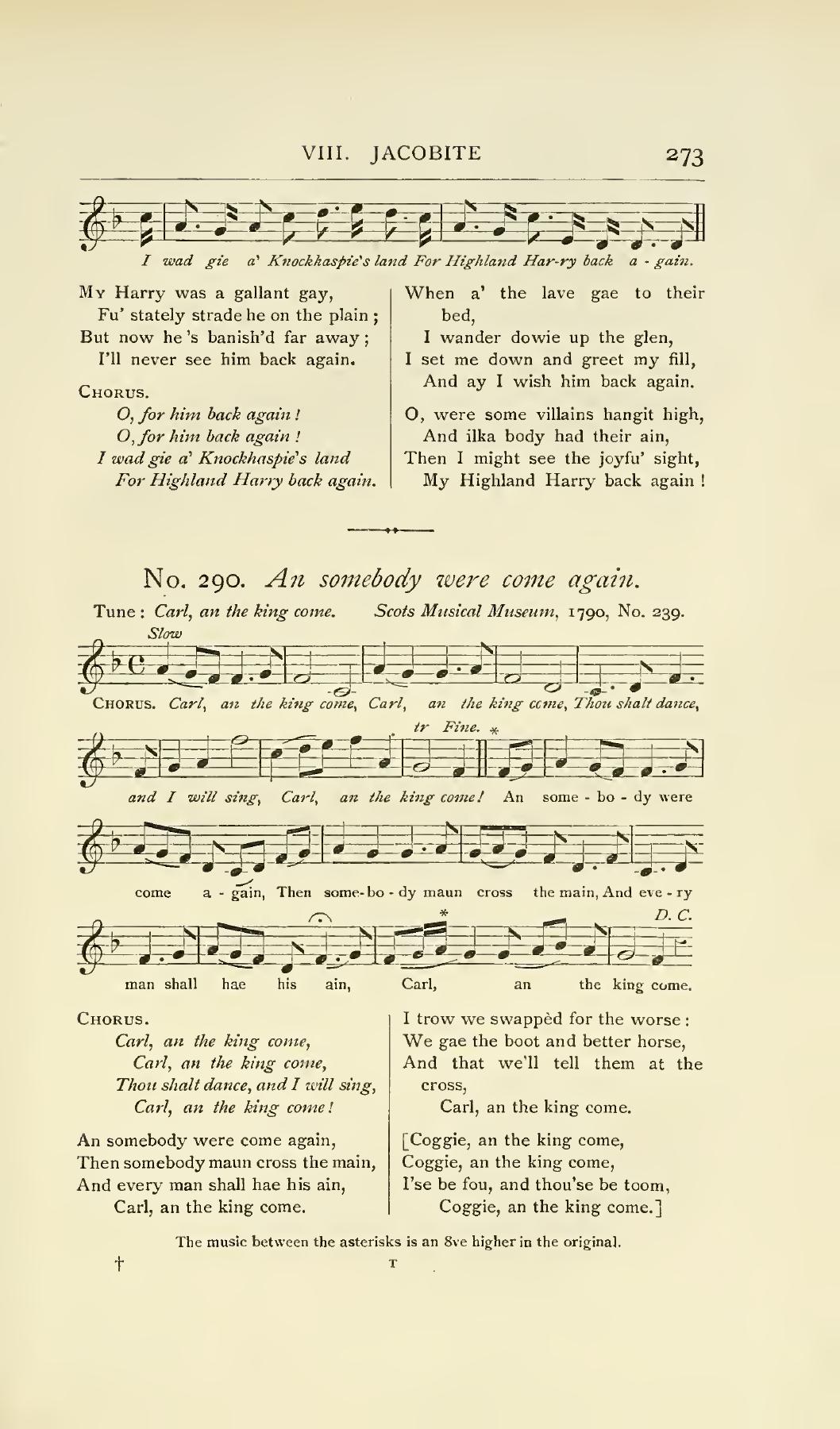
My Harry was a gallant gay
Behind the song
Harry is remembered striding proudly across the plain. Now he is banished, and the singer’s first conclusion is that he will never return. The chorus answers that apparent finality with a repeated wish to have him back, offering all Knockhaspie’s land in exchange. The imagined price makes the scale of the longing plain. [1]
At night, when everyone else goes to bed, the speaker wanders alone up the glen and sits down to weep. The last verse changes the wish into anger at unnamed villains. If they were hanged and everyone had what belonged to them, Harry might come back. Personal loss and a demand for restoration occupy the same lament. [1]
Read the fuller story
Both editors transmit Burns’s statement that he collected the chorus from an old woman in Dunblane and wrote the rest. Cunningham calls the tone Jacobite. Dick reports a manuscript copy in another hand containing two additional stanzas and a different tune reference, The auld Stewarts back again. These accounts distinguish the collected chorus, the song Burns claimed and a further manuscript form. [2][3]
Dick’s tune heading is Highlander’s lament. His note records farewell titles and proposes a date from the Black Watch’s time in Ireland, an inference about the air’s history. Cunningham’s heading gives Highland’s Lament and writes the chorus again at the end. In Dick, the sixteen printed lines run from proud recollection through the chorus to night wandering and the final angry hope. [3]
Story references
- James C. Dick, The Songs of Robert Burns (1903), No. 289; printed pp. 272–273; PDF pp. 328–329
- Allan Cunningham, The Complete Works of Robert Burns (1855), printed 232; HTML #songsLXIII. Project Gutenberg transcription.
- James C. Dick, The Songs of Robert Burns (1903), Dick note 289; printed 467; PDF 523
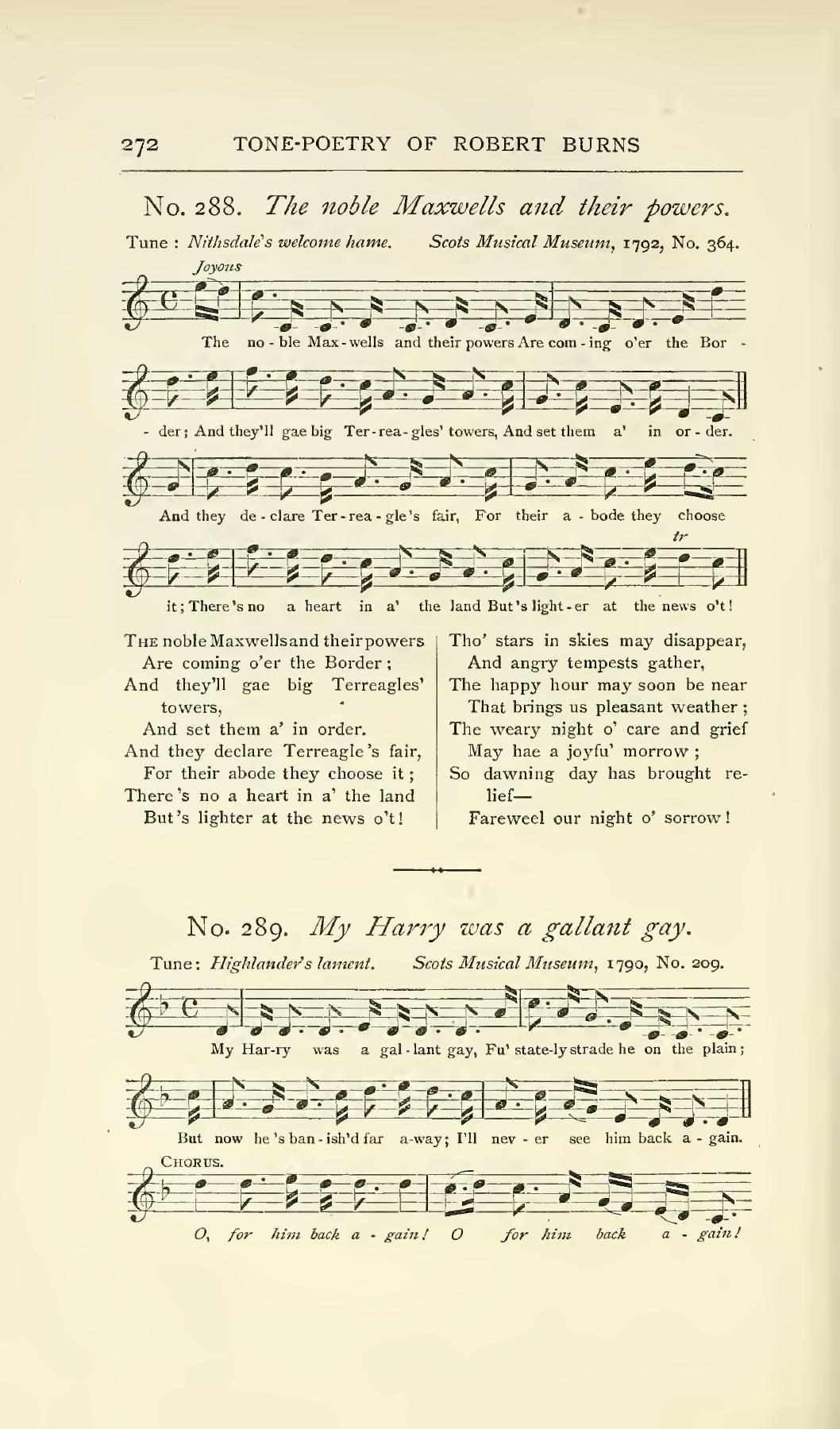 View score Dick’s Songs of Robert Burns (1903)
Lyrics
Choose an edition
Version notes
| Dick (1903) · no. 289 | Cunningham · 1855Ebook transcription |
|---|---|
| strade | strode |
| once after first quatrain | after first and last quatrains |
| I wander dowie up the glen, | I wander dowie up the glen; |
Dick (1903) · no. 289
My Harry was a gallant gay,
Fu' stately strade he on the plain;
But now he's banish'd far away;
I'll never see him back again.

Chorus. O, for him back again!
O, for him back again!
I wad gie a' Knockhaspie's land
For Highland Harry back again.

When a' the lave gae to their bed,
I wander dowie up the glen,
I set me down and greet my fill,
And ay I wish him back again.

O, were some villains hangit high,
And ilka body had their ain,
Then I might see the joyfu' sight,
My Highland Harry back again!
View the source edition · no. 289; pp. 272–273
About this edition
Dick prints first quatrain / chorus / two quatrains, sixteen lines. Cunningham groups first quatrain and chorus, then the night quatrain, then last quatrain and repeated chorus, twenty lines. Dick has strade and Cunningham strode. Knockhaspie’s land is retained in both.
Cunningham (1855)
My Harry was a gallant gay,
  Fu’ stately strode he on the plain:
But now he’s banish’d far away,
  I’ll never see him back again,
    O for him back again!
      O for him back again!
    I wad gie a’ Knockhaspie’s land
      For Highland Harry back again.

When a’ the lave gae to their bed,
  I wander dowie up the glen;
I set me down and greet my fill,
  And ay I wish him back again.

O were some villains hangit high.
  And ilka body had their ain!
Then I might see the joyfu’ sight,
  My Highland Harry back again.
    O for him back again!
      O for him back again!
    I wad gie a’ Knockhaspie’s land
      For Highland Harry back again.
Digital text from Project Gutenberg.
View the source edition · p. 232
About this edition
Dick prints first quatrain / chorus / two quatrains, sixteen lines. Cunningham groups first quatrain and chorus, then the night quatrain, then last quatrain and repeated chorus, twenty lines. Dick has strade and Cunningham strode. Knockhaspie’s land is retained in both.
Scots Musical Museum, vol. III (1790) · no. 209
View the source edition · Volume 3, no. 209; p. 218
Music
View historical scores
Dick’s Songs of Robert Burns (1903)
no. 289; pp. 272–273
View source · Download citation