The Ploughman
Behind the song
A blue bonnet, white stockings and silver buckles turn the ploughman into a fine sight on the dance floor. The singer has travelled east and west and been to Saint Johnston, the old name for Perth, without seeing anyone she would rather watch. His faithful mind is another reason to sing his praises. [1]
The last lines move into the barnyard among the corn heaps. A cup is filled at last, and there is a sexual suggestion in the way the singer praises his vigour. [1]
Read the fuller story
Cunningham’s version includes two further stanzas of household care. The ploughman returns wet and weary, changes into dry clothes and goes to bed; the speaker offers to wash his stockings, dress his outer garment and make his bed. They add labour and recovery to a portrait otherwise dominated by pleasure. Dick quotes these same two stanzas in his note, attributing their source to Herd, and keeps them outside his main reading. [2][3]
Both editors describe alteration of an older rustic song. Dick says the remaining material was considerably changed by Burns and traces the melody through several collections. He also states that the chorus uses the same music as the verse. His printed score is headed The Ploughman and marked Briskly; Cunningham uses Up wi’ the ploughman. The different selections show how a song’s balance can change when its domestic stanzas are included or set aside. [3][1][2]
Story references
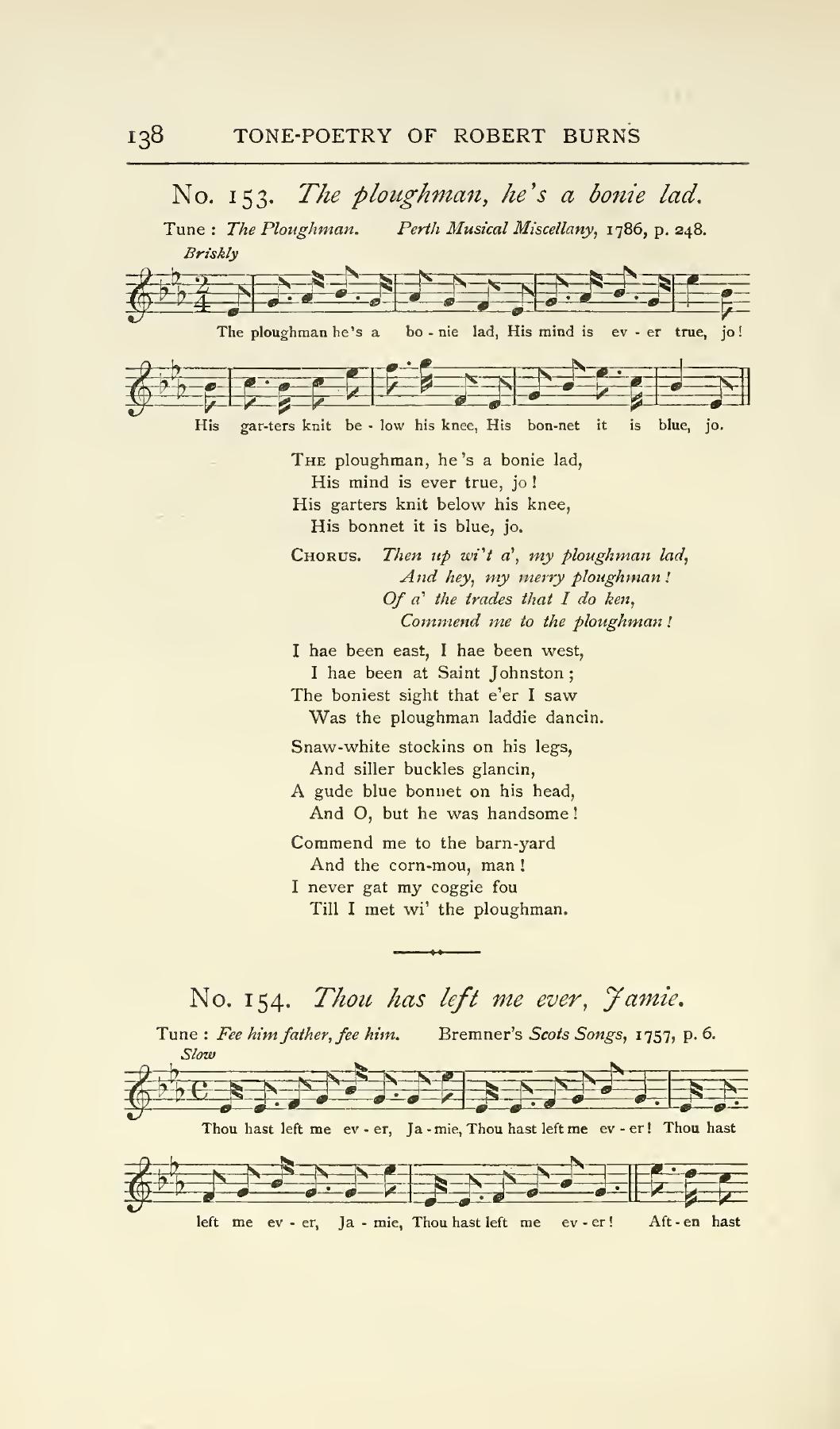 View score Dick’s Songs of Robert Burns (1903)
Lyrics
Choose an edition
Version notes
| Dick (1903) · no. 153 | Cunningham · 1855Ebook transcription |
|---|---|
| Then up wi’t a’, my ploughman lad | Then up wi’ him my ploughman lad |
| after first verse | after first verse and repeated at close |
| bonie / boniest | bonnie / bonniest |
| dancin / glancin | dancin’ / glancin’ |
Dick (1903) · no. 153
The ploughman, he's a bonie lad,
His mind is ever true, jo!
His garters knit below his knee,
His bonnet it is blue, jo.

Chorus. Then up wi't a', my ploughman lad,
And hey, my merry ploughman!
Of a' the trades that I do ken,
Commend me to the ploughman!

I hae been east, I hae been west,
I hae been at Saint Johnston;
The boniest sight that e'er I saw
Was the ploughman laddie dancin.

Snaw-white stockins on his legs,
And siller buckles glancin,
A gude blue bonnet on his head,
And O, but he was handsome!

Commend me to the barn-yard
And the corn-mou, man!
I never gat my coggie fou
Till I met wi' the ploughman.
These are the words printed below the score.
View the source edition · no. 153; p. 138
About this edition
Dick’s main reading has four verse quatrains and a chorus. Cunningham has six verse quatrains, including the wet/weary return and washing/o’erlay stanzas that Dick quotes only in his note. Dick’s chorus begins “Then up wi’t a’, my ploughman lad”; Cunningham has “Then up wi’ him”. Cunningham repeats the chorus at the end. Dick has “bonie”, “stockins”, “glancin” and “corn-mou”; Cunningham has “bonnie”, “stockins”, “glancin’” and “corn-mou”.
Cunningham (1855)
The ploughman he’s a bonnie lad,
  His mind is ever true, jo,
His garters knit below his knee,
  His bonnet it is blue, jo.
    Then up wi’ him my ploughman lad,
      And hey my merry ploughman!
    Of a’ the trades that I do ken,
      Commend me to the ploughman.

My ploughman he comes hame at e’en,
  He’s aften wat and weary;
Cast off the wat, put on the dry,
  And gae to bed, my dearie!

I will wash my ploughman’s hose,
  And I will dress his o’erlay;
I will mak my ploughman’s bed,
  And cheer him late and early.

I hae been east, I hae been west,
  I hae been at Saint Johnston;
The bonniest sight that e’er I saw
  Was the ploughman laddie dancin’.

Snaw-white stockins on his legs,
  And siller buckles glancin’;
A gude blue bonnet on his head—
  And O, but he was handsome!

Commend me to the barn-yard,
  And the corn-mou, man;
I never gat my coggie fou,
  Till I met wi’ the ploughman.
    Up wi’ him my ploughman lad,
      And hey my merry ploughman!
    Of a’ the trades that I do ken,
      Commend me to the ploughman.
Digital text from Project Gutenberg.
View the source edition · p. 227
About this edition
Dick’s main reading has four verse quatrains and a chorus. Cunningham has six verse quatrains, including the wet/weary return and washing/o’erlay stanzas that Dick quotes only in his note. Dick’s chorus begins “Then up wi’t a’, my ploughman lad”; Cunningham has “Then up wi’ him”. Cunningham repeats the chorus at the end. Dick has “bonie”, “stockins”, “glancin” and “corn-mou”; Cunningham has “bonnie”, “stockins”, “glancin’” and “corn-mou”.
Scots Musical Museum, vol. II (1788) · no. 165
View the source edition · Volume 2, no. 165; p. 173
Music
View historical scores
Dick’s Songs of Robert Burns (1903)
no. 153; p. 138