Strathallan’s Lament
Behind the song
After the Jacobite defeat, Strathallan wants the wind to howl and the river to roar past his cave. Halfway through the song his voice changes from “my” to “we”. Other men fought beside him, and now he can think of nowhere in the world where they might find a friend. [1][4]
Two men in the Drummond family have been heard in that voice. William, Viscount Strathallan, was killed at Culloden in 1746. His eldest son James survived and escaped to France. James’s exile fits the plight of Burns’s singer. The song as printed in 1788 gives him only the title Strathallan. [2][3][4][5][6]
Read the fuller story
When R. H. Cromek printed the lament in 1810, he put James’s name in a footnote and called the identification a supposition. Allan Cunningham later chose William and mentioned an old belief that he had escaped to France. James C. Dick chose the son. The family’s exile lasted years. In July 1765, after James died, Andrew Lumisden wrote to James’s brother about seeking a French pension for the widow. [2][3][5][7]
In James Johnson’s Scots Musical Museum the words and music share a page, and the air is marked “Plaintive”. Burns’s friend Allan Masterton, an Edinburgh schoolmaster, wrote the air. Burns recalled that the two friends had agreed to dedicate words and music to the Jacobite cause, though his own enthusiasm came and went. In another manuscript described by Dick the singer bids farewell to peace, pleasure and the good opinion of others. In the Museum his last words are “a world without a friend”. [3][4][5]
Story references
- James C. Dick, The Songs of Robert Burns (1903), No. 297; printed pp. 279–279; PDF pp. 335–335
- Allan Cunningham, The Complete Works of Robert Burns (1855), printed 224; HTML #songsXL. Project Gutenberg transcription.
- James C. Dick, The Songs of Robert Burns (1903), Dick note 297; printed 470; PDF 526
- James Johnson, The Scots Musical Museum, vol. II (1788), no. 132, p. 138. Words and music of Strathallan’s Lament.
- R. H. Cromek, ed., Select Scotish Songs, Ancient and Modern, vol. I (1810), p. 122. Burns’s note on the tune and the editor’s footnote on James.
- University of Glasgow, Jacobite Officers Database. Entries for James Drummond, Master of Strathallan, and William Drummond, fourth Viscount Strathallan.
- Andrew Lumisden to William Drummond, 16 July 1765. James Dennistoun, Memoirs of Sir Robert Strange and of his Brother Andrew Lumisden, vol. I.
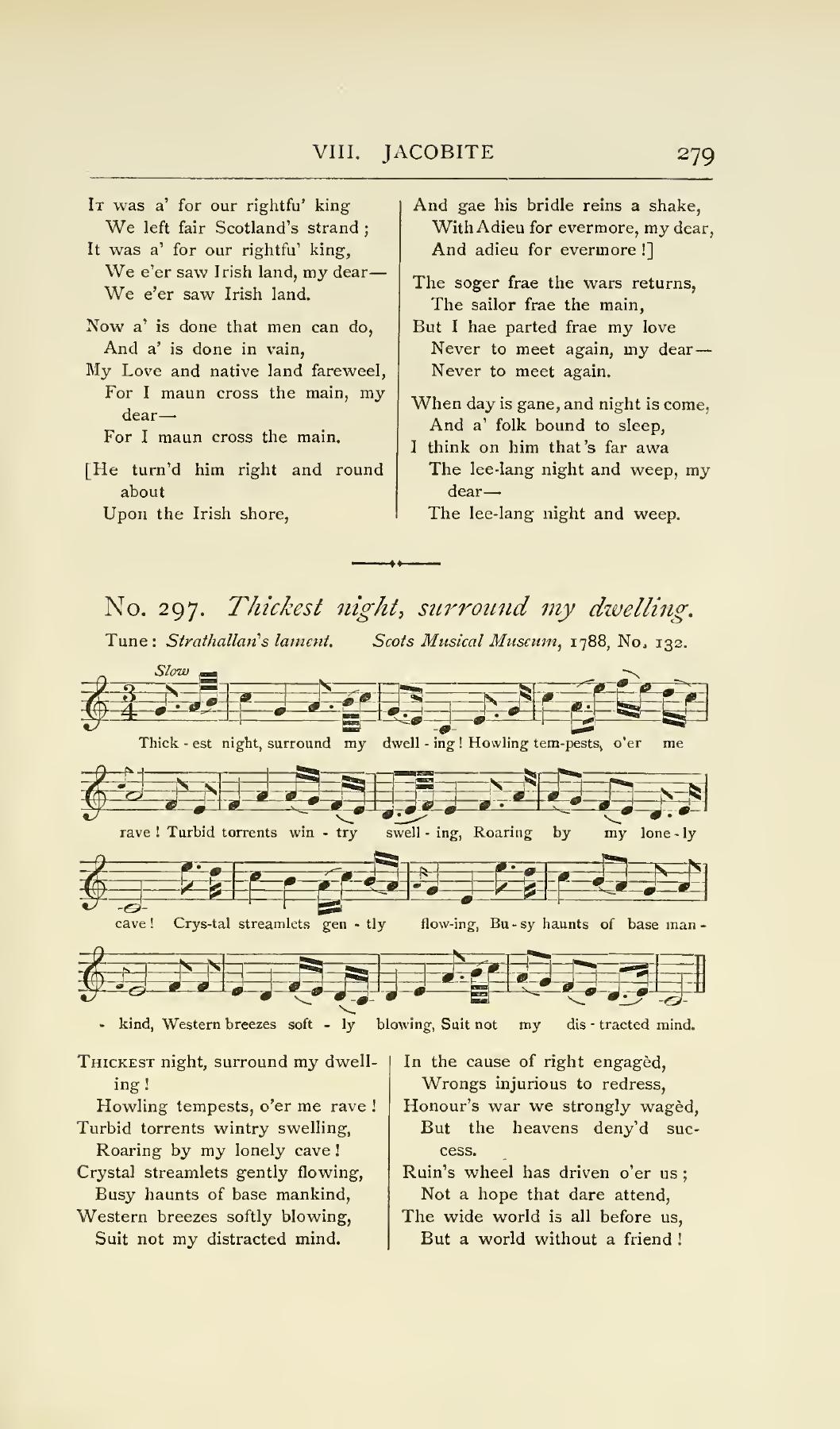 View score Dick’s Songs of Robert Burns (1903)
Lyrics
Choose an edition
Version notes
| Dick (1903) · no. 297 | Cunningham · 1855Ebook transcription |
|---|---|
| Thickest night, surround my dwelling | Cunningham title o’erhang; lyric surround |
| two octaves | four quatrains |
| deny’d | denied |
| wide world | wild world |
More differences between these editions
| Dick (1903) · no. 297 | Cunningham · 1855Ebook transcription |
|---|---|
| Dick identifies son James, exiled | Cunningham identifies father William, killed at Culloden |
Dick (1903) · no. 297
Thickest night, surround my dwelling!
Howling tempests, o'er me rave!
Turbid torrents wintry swelling,
Roaring by my lonely cave!
Crystal streamlets gently flowing,
Busy haunts of base mankind,
Western breezes softly blowing,
Suit not my distracted mind.

In the cause of right engaged,
Wrongs injurious to redress,
Honour's war we strongly waged,
But the heavens deny'd success.
Ruin's wheel has driven o'er us;
Not a hope that dare attend,
The wide world is all before us,
But a world without a friend!
These are the words printed below the score.
View the source edition · no. 297; p. 279
About this edition
Dick prints two octaves; Cunningham divides the same sixteen-line main text into four quatrains. Cunningham’s title uses “o’erhang”, although its lyric agrees with Dick’s “surround”. Dick has “deny’d”, “wide world” and a semicolon after “o’er us”; Cunningham has “denied”, “wild world” and a comma. Dick’s note reports a different manuscript opening “Thickest darkness o’erhang my dwelling” and a farewell quatrain; this is a separate transmitted variant. Father/son identifications differ between editors.
Cunningham (1855)
Thickest night, surround my dwelling!
  Howling tempests, o’er me rave!
Turbid torrents, wintry swelling,
  Roaring by my lonely cave!

Crystal streamlets gently flowing,
  Busy haunts of base mankind,
Western breezes softly blowing,
  Suit not my distracted mind.

In the cause of Right engaged,
  Wrongs injurious to redress,
Honour’s war we strongly waged,
  But the heavens denied success.

Ruin’s wheel has driven o’er us,
  Not a hope that dare attend,
The wild world is all before us—
  But a world without a friend.
Digital text from Project Gutenberg.
View the source edition · p. 224
About this edition
Dick prints two octaves; Cunningham divides the same sixteen-line main text into four quatrains. Cunningham’s title uses “o’erhang”, although its lyric agrees with Dick’s “surround”. Dick has “deny’d”, “wide world” and a semicolon after “o’er us”; Cunningham has “denied”, “wild world” and a comma. Dick’s note reports a different manuscript opening “Thickest darkness o’erhang my dwelling” and a farewell quatrain; this is a separate transmitted variant. Father/son identifications differ between editors.
Scots Musical Museum, vol. II (1788) · no. 132
View the source edition · Volume 2, no. 132; p. 138
Music
View historical scores
Dick’s Songs of Robert Burns (1903)
no. 297; p. 279