I am my mammy’s ae bairn
Behind the song
Her mother’s only child is uneasy among strangers and frightened by the thought of sharing a man’s bed. The chorus insists that she is too young to marry. Winter gives her another reason to delay, though the last verse invites the suitor to consider coming back when she is older in summer.
Read the fuller story
The polite “Sir” keeps returning after the speaker’s refusals. Hallowmas has passed, the nights are long, and a shrill wind blows through bare trees. Against that winter setting, the final prospect of summer changes the conversation: postponement leaves room for another visit. The chorus then renews the plea to remain with her mother a little longer.
Cunningham identifies the title and part of the chorus as older material. He attributes the remainder to Burns and says it was written for Johnson. The selected verses therefore develop an inherited refrain into this brief exchange about marriage, apprehension and waiting.[1]
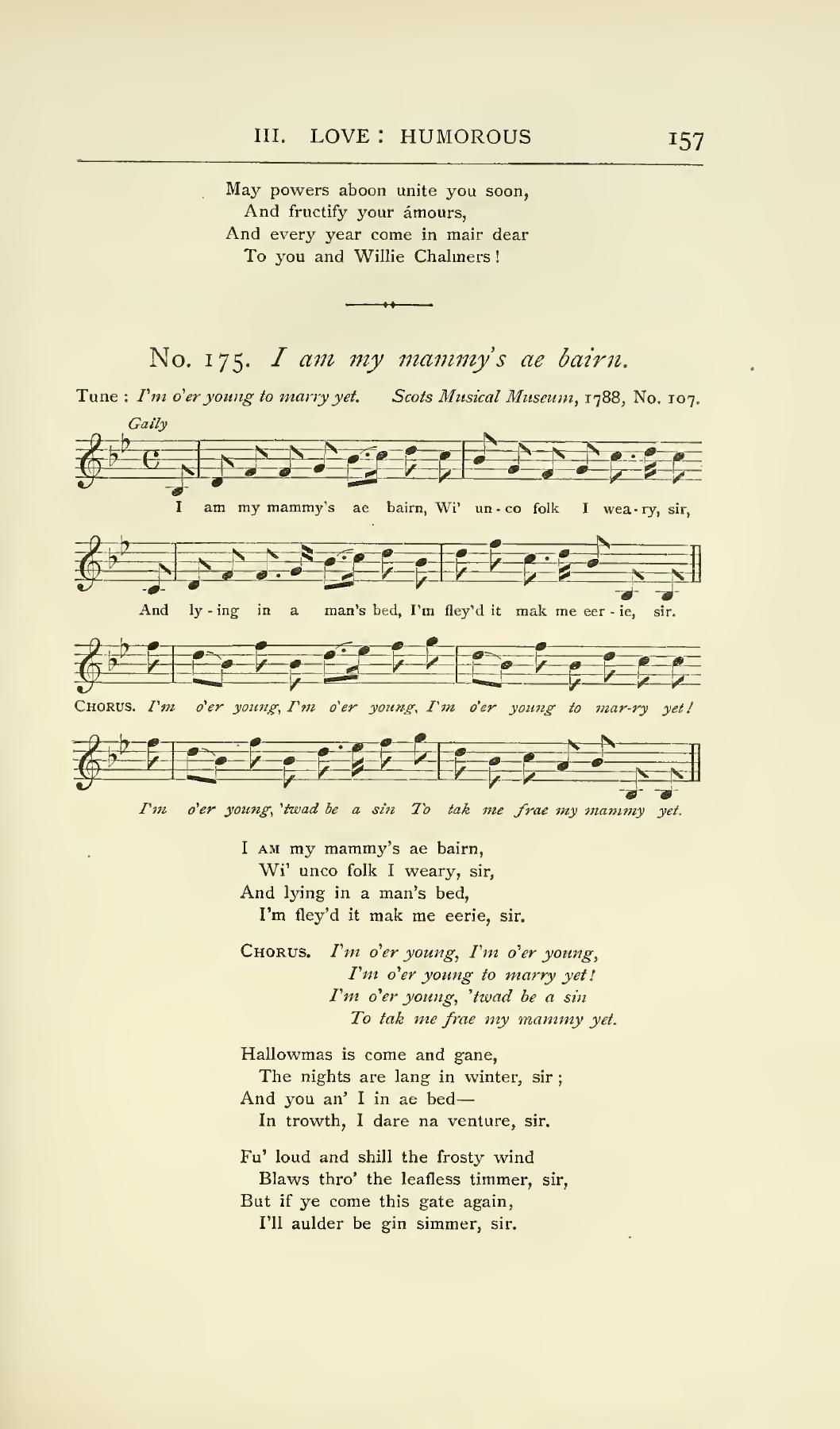 View score Dick’s Songs of Robert Burns (1903)
Lyrics
Choose an edition
Cunningham (1855)
I am my mammy’s ae bairn,
  Wi’ unco folk I weary, Sir;
And lying in a man’s bed,
  I’m fley’d it make me eerie, Sir.
    I’m o’er young to marry yet;
      I’m o’er young to marry yet;
    I’m o’er young—’twad be a sin
      To tak’ me frae my mammy yet.

Hallowmas is come and gane,
  The nights are lang in winter, Sir;
And you an’ I in ae bed,
  In trouth, I dare na venture, Sir.

Fu’ loud and shrill the frosty wind,
  Blaws through the leafless timmer, Sir;
But, if ye come this gate again,
  I’ll aulder be gin simmer, Sir.
    I’m o’er young to marry yet;
      I’m o’er young to marry yet;
    I’m o’er young, ’twad be a sin
      To tak me frae my mammy yet.
Digital text from Project Gutenberg.
View the source edition · p. 222
About this edition
Cunningham’s preface discusses several poems he left out of the collection.
Dick (1903) · no. 175
The words are on the score page.
View the source edition · no. 175; p. 157
Scots Musical Museum, vol. II (1788) · no. 107
View the source edition · Volume 2, no. 107; p. 110
Music
View historical scores
Dick’s Songs of Robert Burns (1903)
no. 175; p. 157
Burns’s verses with older material — qualified attribution
Cunningham credits Burns with the song apart from its older title and part of the chorus.
Words Robert Burns with an older title and partial chorus
Burns’s role Burns’s verses with older material — qualified attribution