O, wat ye wha that lo'es me
Behind the song
The singer begins with a question: do you know the woman who loves him and holds his heart? ‘O, wat ye wha that lo’es me’ then offers a test. Anyone who has met this woman will have felt her charm, listened so closely that everyone else faded away, and found separation painful. The praise invites the listener to recognise the beloved through the effects she produces.[1]
Read the fuller story
The first image is gentle: her sweetness resembles summer dew bathing rosebuds. The chorus immediately raises the claim, calling her queen of womankind and declaring that she has no equal. ‘Wat ye wha’ means do you know who; ‘peer’ means equal. The movement from an intimate question to an expansive public compliment sets the pattern for the verses that follow.[1]
Each begins with ‘If’, building a chain of imagined encounters. Her grace can outshine the person the listener previously preferred; her conversation can command complete attention; departure from her can leave the listener broken-hearted. The last of these claims is startlingly strong for a song celebrating returned love. It measures her power through another person’s imagined loss, before the final chorus brings the praise home to the singer’s own attachment.[1]
James C. Dick identifies a printing in Thomson’s Scotish Airs of 1799 and says the precise date of composition was unknown, though he proposes autumn 1795. His note reports Burns sending a copy to Robert Cleghorn in January 1796, apologising for the delay and explaining that he, his young son and daughter had been ill. Dick adds that Cleghorn had met Jean Lorimer, the woman he identifies as Burns’s model for the song.[2]
The tune is ‘Morag’, and the setting is marked ‘Gracefully’. Dick says Burns chose that air because his ‘Young Highland rover’ did not fit it. On the printed page the opening verse flows into a distinct chorus; the later verses extend across the next page before the chorus is written out again. The final repetition completes the movement from a question about identity to an assured declaration of love.[1][2]
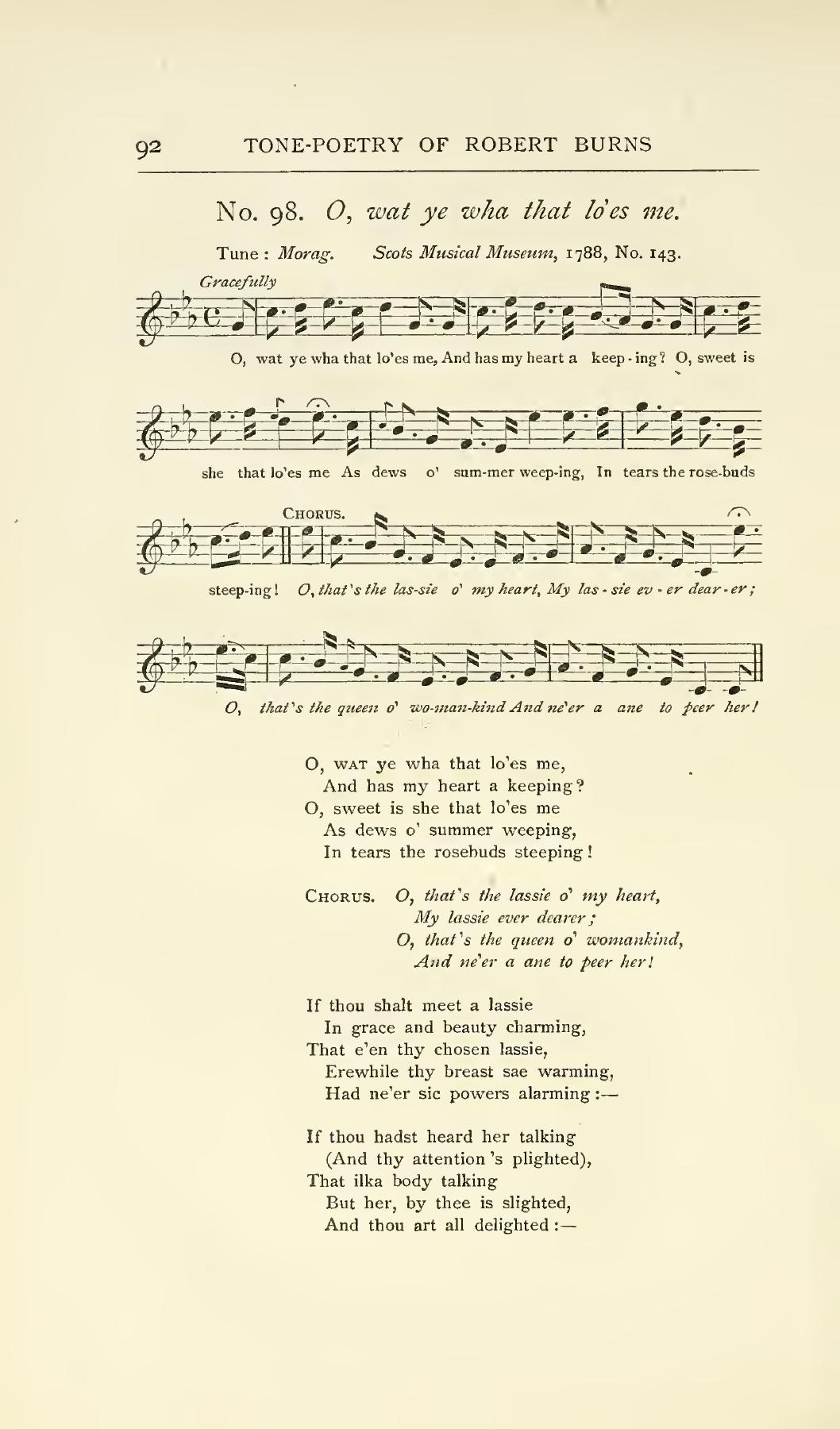 View score Dick’s Songs of Robert Burns (1903)
Lyrics
Dick (1903) · no. 98
O, wat ye wha that lo'es me,
And has my heart a keeping?
O, sweet is she that lo'es me
As dews o' summer weeping,
In tears the rosebuds steeping!
CHORUS
O, that's the lassie o' my heart,
My lassie ever dearer;
O, that's the queen o' womankind,
And ne'er a ane to peer her!

If thou shalt meet a lassie
In grace and beauty charming,
That e'en thy chosen lassie,
Erewhile thy breast sae warming,
Had ne'er sic powers alarming:—

If thou hadst heard her talking
(And thy attention's plighted),
That ilka body talking
But her, by thee is slighted,
And thou art all delighted:—

If thou hast met this fair one,
When frae her thou hast parted,
If every other fair one
But her thou hast deserted,
And thou art broken-hearted;
CHORUS
O, that's the lassie o' my heart,
My lassie ever dearer;
O, that's the queen o' womankind,
And ne'er a ane to peer her!
View the source edition · Dick1903 no. 98; pp. 92–93; PDF [148, 149]
About this edition
Syllables separated by the musical notation are joined into words in this reading.
Music
View historical scores
Dick’s Songs of Robert Burns (1903)
Dick1903 no. 98; pp. 92–93; PDF [148, 149]