Sae Flaxen Were Her Ringlets
Behind the song
Chloris says she loves the singer best of all. That assurance closes his description of her flaxen hair, blue eyes and graceful walk. In the last verse he wants her to come down to the burn in the moonlight, listen to his vows and say it again. [1]
Read the fuller story
Three twelve-line stanzas move from a portrait of her face and figure to an invitation into a moonlit valley. The first two end with her declaration of preference. The last turns that assurance into a question, asking her to walk beside the burn, hear his vows and say it again.[1]
Cunningham praises the likeness as a painter’s might be, while leaving her name unstated in this headnote. The speaker calls her Chloris, and his imagined evening places their conversation among moving water, leaves and a thrush’s closing song.[1]
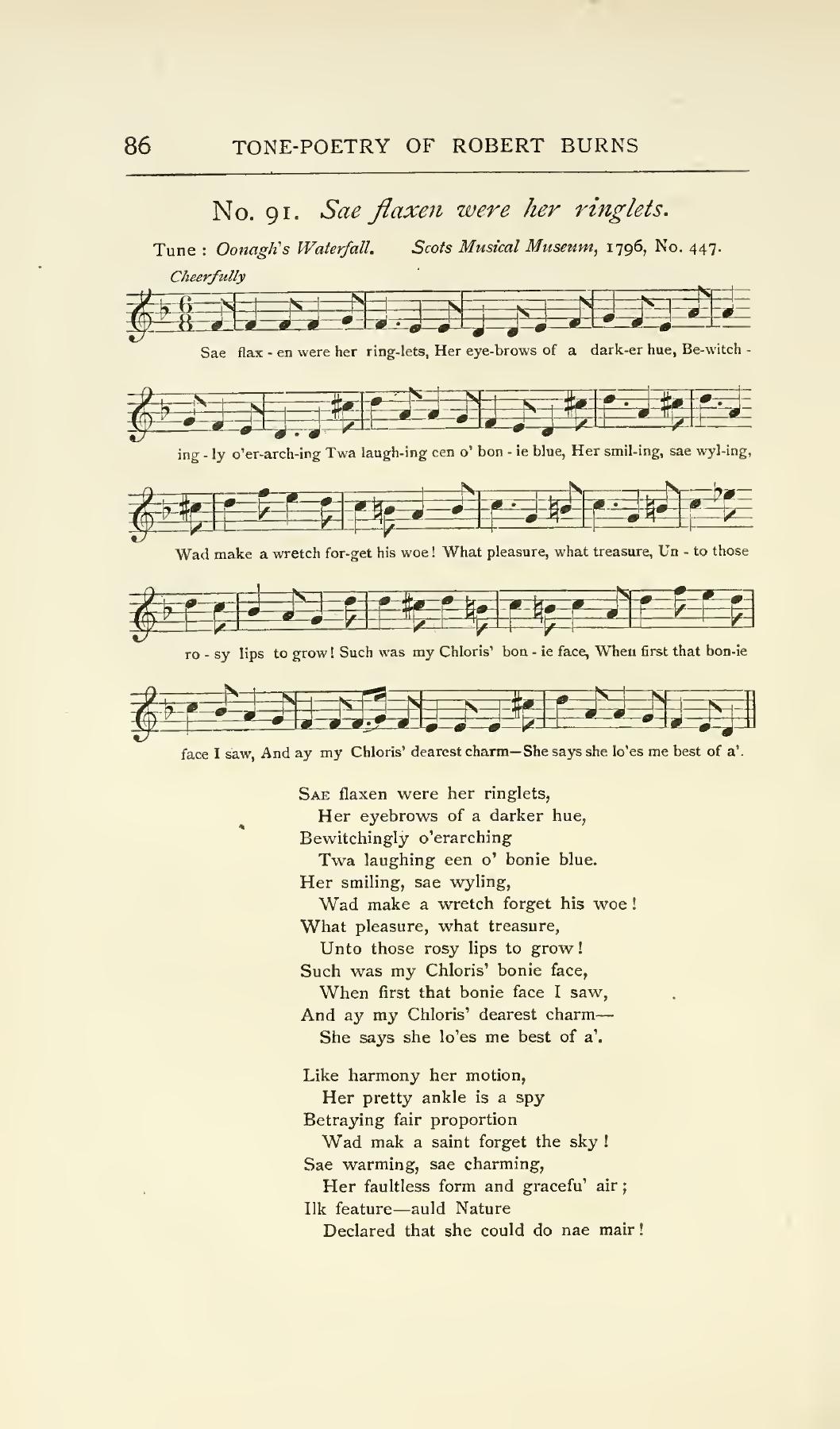 View score Dick’s Songs of Robert Burns (1903)
Lyrics
Choose an edition
Cunningham (1855)
Sae flaxen were her ringlets,
  Her eyebrows of a darker hue,
Bewitchingly o’er-arching
  Twa laughin’ een o’ bonnie blue.
Her smiling sae wyling,
  Wad make a wretch forget his woe;
What pleasure, what treasure,
  Unto these rosy lips to grow:
Such was my Chloris’ bonnie face,
  When first her bonnie face I saw;
And ay my Chloris’ dearest charm,
  She says she lo’es me best of a’.

Like harmony her motion;
  Her pretty ankle is a spy,
Betraying fair proportion,
  Wad mak a saint forget the sky.
Sae warming, sae charming,
  Her faultless form and gracefu’ air;
Ilk feature—auld Nature
  Declar’d that she could do nae mair:
Hers are the willing chains o’ love,
  By conquering beauty’s sovereign law;
And ay my Chloris’ dearest charm,
  She says she lo’es me best of a’.

Let others love the city,
  And gaudy show at sunny noon;
Gie me the lonely valley,
  The dewy eve, and rising moon;
Fair beaming, and streaming,
  Her silver light the boughs amang;
While falling, recalling,
  The amorous thrush concludes his sang;
There, dearest Chloris, wilt thou rove
  By wimpling burn and leafy shaw,
And hear my vows o’ truth and love,
  And say thou lo’es me best of a’?
Digital text from Project Gutenberg.
View the source edition · p. 293
About this edition
Cunningham’s preface discusses several poems he left out of the collection.
Dick (1903) · no. 91
The words are on the score page.
View the source edition · no. 91; pp. 86–87
Scots Musical Museum, vol. V (catalogued 1796) · no. 447
View the source edition · Volume 5, no. 447; pp. 458–459
Music
View historical scores
Dick’s Songs of Robert Burns (1903)
no. 91; pp. 86–87