Will ye go to the Indies, my Mary
Behind the song
Burns later told George Thomson that he had said goodbye to a young woman when he was thinking of going to the West Indies. Dick and Cunningham link the song with Mary Campbell, known as Highland Mary. In the lyric he asks her to go, offers her limes, oranges and pineapples, then asks for her hand. [1][2][3]
Read the fuller story
Dick places the song among those associated with Mary Campbell and quotes a letter sent to George Thomson in October 1792. In that letter Burns describes taking leave of a dear girl when he was thinking of going to the West Indies, and defends the roughness of his early love songs as part of the feeling they preserved. [2]
Cunningham also quotes the recollection and identifies the woman as Highland Mary. Dick sets the lyric to Ewe-bughts Marion, marked Very slow. His note traces an older pastoral attached to that air and records Burns’s uncertainty over whether the melody belonged to the north or south of Scotland. [3][1][2]
Story references
- James C. Dick, The Songs of Robert Burns (1903), No. 57; printed pp. 59–59; PDF pp. 115–115
- James C. Dick, The Songs of Robert Burns (1903), Dick note 57; printed 371,372; PDF 427,428
- Allan Cunningham, The Complete Works of Robert Burns (1855), printed 273; HTML #CLXXIX. Project Gutenberg transcription.
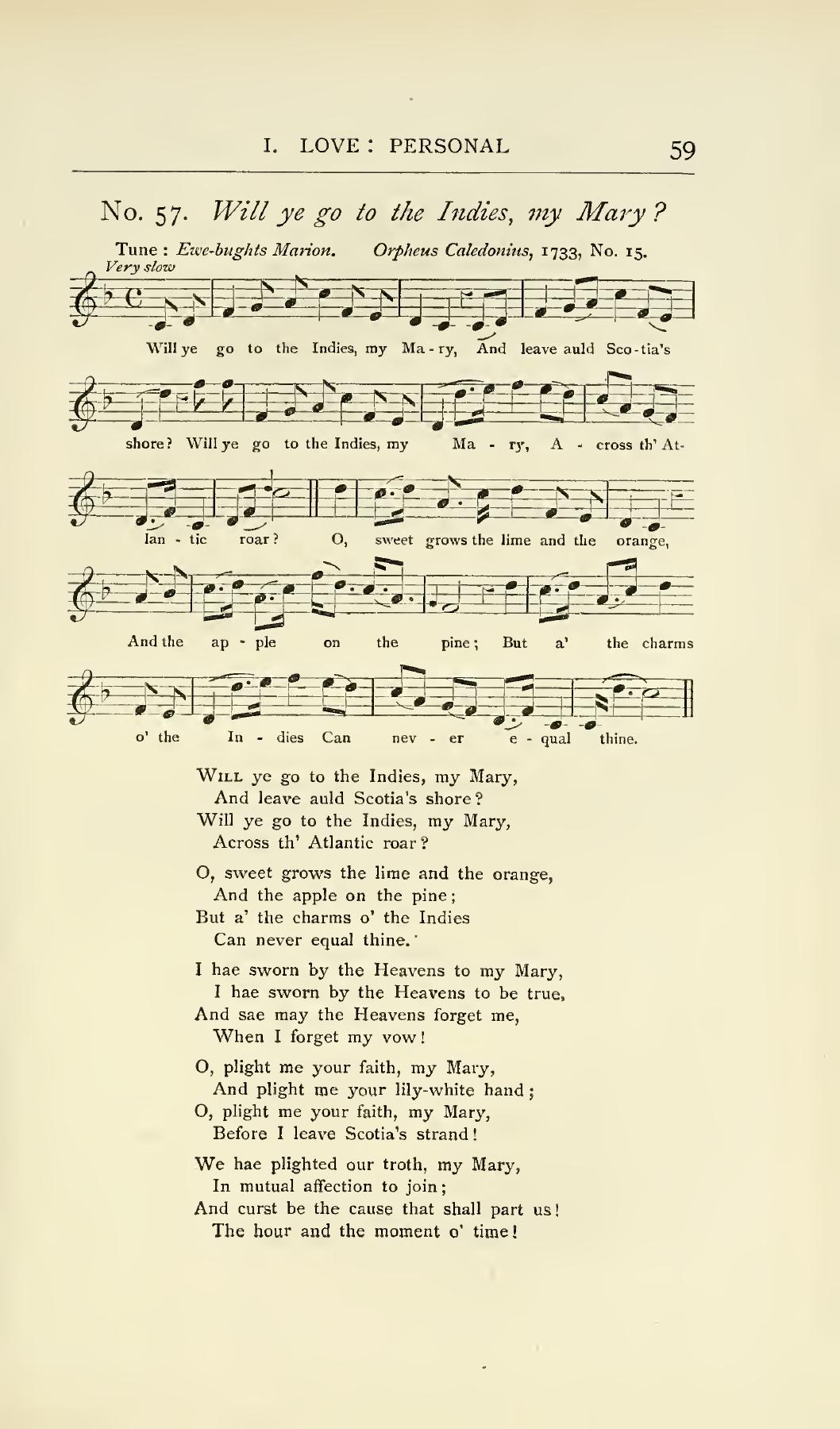 View score Dick’s Songs of Robert Burns (1903)
Lyrics
Choose an edition
Version notes
| Dick (1903) · no. 57 | Cunningham · 1855Ebook transcription |
|---|---|
| auld Scotia’s shore | old Scotia’s shore |
| Atlantic roar | Atlantic’s roar |
| lily-white | lily white |
| O, sweet / O, plight | O sweet / O plight |
Dick (1903) · no. 57
Will ye go to the Indies, my Mary,
And leave auld Scotia's shore?
Will ye go to the Indies, my Mary,
Across th' Atlantic roar?

O, sweet grows the lime and the orange,
And the apple on the pine;
But a' the charms o' the Indies
Can never equal thine.

I hae sworn by the Heavens to my Mary,
I hae sworn by the Heavens to be true,
And sae may the Heavens forget me,
When I forget my vow!

O, plight me your faith, my Mary,
And plight me your lily-white hand;
O, plight me your faith, my Mary,
Before I leave Scotia's strand!

We hae plighted our troth, my Mary,
In mutual affection to join;
And curst be the cause that shall part us!
The hour and the moment o' time!
View the source edition · no. 57; p. 59
About this edition
Both editions contain five quatrains. Dick has auld Scotia, Atlantic roar and lily-white; Cunningham has old Scotia, Atlantic’s roar and lily white. Dick uses a comma after true and an exclamation mark after strand, where Cunningham has a semicolon and full stop. Their introductory titles and Mary identifications belong to their editors; the lyric itself addresses Mary.
Cunningham (1855)
Will ye go to the Indies, my Mary,
  And leave old Scotia’s shore?
Will ye go to the Indies, my Mary,
  Across th’ Atlantic’s roar?

O sweet grows the lime and the orange,
  And the apple on the pine;
But a’ the charms o’ the Indies
  Can never equal thine.

I hae sworn by the Heavens to my Mary,
  I hae sworn by the Heavens to be true;
And sae may the Heavens forget me
  When I forget my vow!

O plight me your faith, my Mary,
  And plight me your lily white hand;
O plight me your faith, my Mary,
  Before I leave Scotia’s strand.

We hae plighted our troth, my Mary,
  In mutual affection to join;
And curst be the cause that shall part us!
  The hour and the moment o’ time!
Digital text from Project Gutenberg.
View the source edition · p. 273
About this edition
Both editions contain five quatrains. Dick has auld Scotia, Atlantic roar and lily-white; Cunningham has old Scotia, Atlantic’s roar and lily white. Dick uses a comma after true and an exclamation mark after strand, where Cunningham has a semicolon and full stop. Their introductory titles and Mary identifications belong to their editors; the lyric itself addresses Mary.
Music
View historical scores
Dick’s Songs of Robert Burns (1903)
no. 57; p. 59