O Mary, at thy window be
Behind the song
The appointed hour has come, and the lover asks Mary to appear at her window. Her smiles and glances make a miser’s treasure seem poor. He imagines bearing dust and toil from sunrise to sunset for the reward of her affection. An ordinary meeting becomes valuable enough to sustain a whole day’s labour. [1]
The middle stanza looks back to the previous night’s dance. Music and a lighted hall surround the speaker, yet his attention has gone to Mary. Other admired women pass before him and each prompts the same comparison. The final stanza turns that absorption into an appeal: if Mary cannot return his love, he asks for pity, trusting the gentleness he attributes to her. [1]
Read the fuller story
Cunningham tentatively connects Mary with a Morison family at Mauchline; Dick identifies the subject as Ellison Begbie. The editions therefore carry competing identifications of the woman addressed. Both also transmit Burns’s description of the song as a juvenile work, offered to Thomson with a modest assessment of its merits. The remembered early song remained available for later musical use. [2][3]
Cunningham heads the song Bide ye yet, while Dick selects Duncan Davison. Dick reports that the copy sent to Thomson on 20 March 1793 specified Duncan Davison, then distinguishes the later Glasgow lasses and The Miller settings. Across those musical associations the lyric keeps its three eight-line stages: anticipation at the window, distraction at the dance and the direct plea for an answer. [3]
Story references
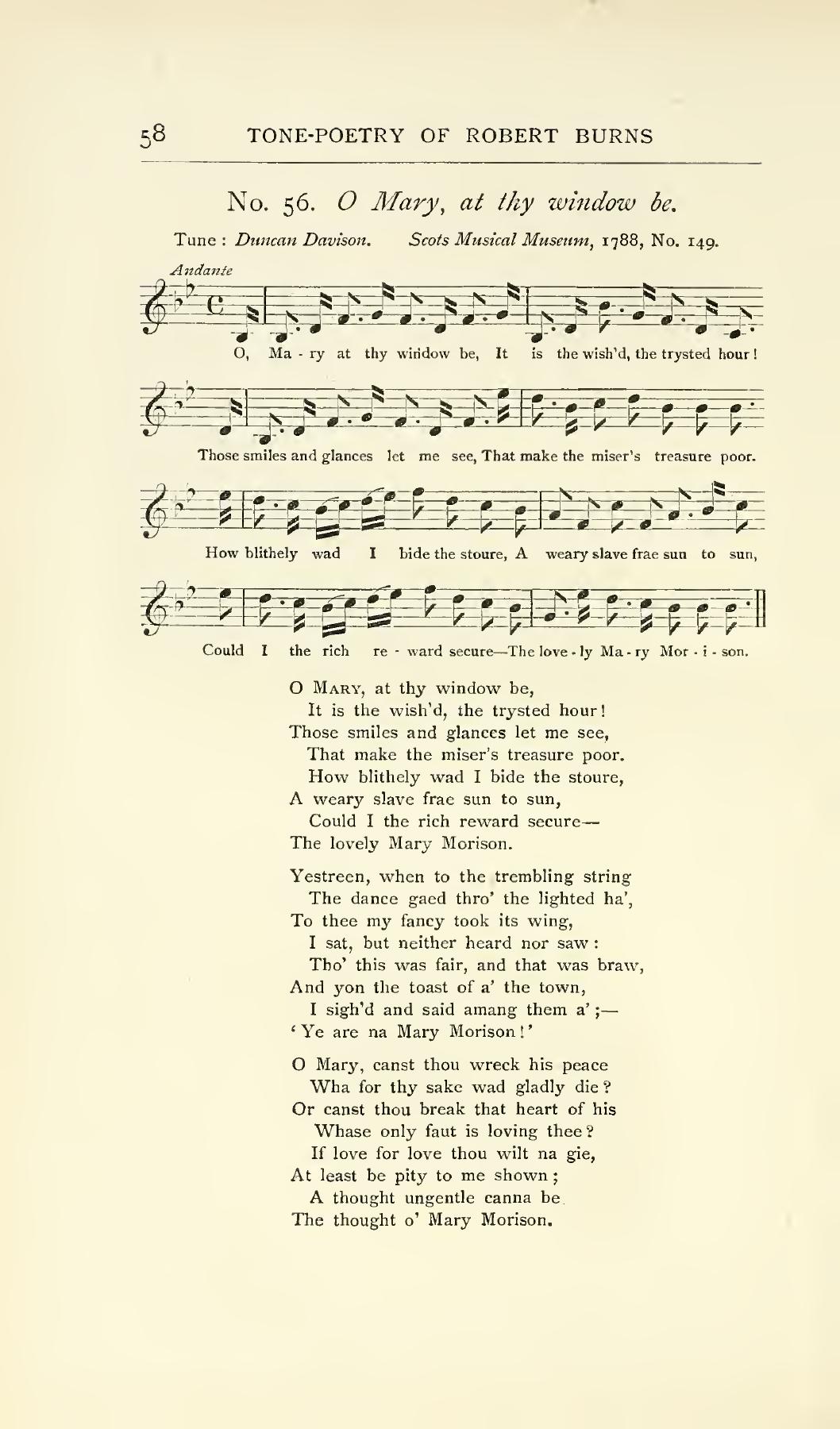 View score Dick’s Songs of Robert Burns (1903)
Lyrics
Choose an edition
Version notes
| Dick (1903) · no. 56 | Cunningham · 1855Ebook transcription |
|---|---|
| neither heard nor saw | neither heard or saw |
| Ye are na Mary Morison! | Ye are na Mary Morison. |
| Duncan Davison | Bide ye yet |
| I sat, but neither heard nor saw: | I sat, but neither heard or saw: |
More differences between these editions
| Dick (1903) · no. 56 | Cunningham · 1855Ebook transcription |
|---|---|
| Or canst thou break that heart of his | Or canst thou break that heart of his, |
Dick (1903) · no. 56
O Mary, at thy window be,
It is the wish'd, the trysted hour!
Those smiles and glances let me see,
That make the miser's treasure poor.
How blithely wad I bide the stoure,
A weary slave frae sun to sun,
Could I the rich reward secure—
The lovely Mary Morison.

Yestreen, when to the trembling string
The dance gaed thro' the lighted ha',
To thee my fancy took its wing,
I sat, but neither heard nor saw:
Tho' this was fair, and that was braw,
And yon the toast of a' the town,
I sigh'd and said amang them a';—
'Ye are na Mary Morison!'

O Mary, canst thou wreck his peace
Wha for thy sake wad gladly die?
Or canst thou break that heart of his
Whase only faut is loving thee?
If love for love thou wilt na gie,
At least be pity to me shown;
A thought ungentle canna be
The thought o' Mary Morison.
View the source edition · no. 56; p. 58
About this edition
Both texts have three eight-line stanzas. Dick prints neither heard nor saw where Cunningham has neither heard or saw; Dick’s dance-stanza closing line is an exclamation, Cunningham’s a full stop. Other punctuation differs.
Cunningham (1855)
O Mary, at thy window be,
  It is the wish’d, the trysted hour!
Those smiles and glances let me see
  That make the miser’s treasure poor:
How blithely wad I bide the stoure,
  A weary slave frae sun to sun;
Could I the rich reward secure,
  The lovely Mary Morison!

Yestreen, when to the trembling string
  The dance gaed thro’ the lighted ha’,
To thee my fancy took its wing,
  I sat, but neither heard or saw:
Tho’ this was fair, and that was braw,
  And yon the toast of a’ the town,
I sigh’d, and said amang them a’,
  “Ye are na Mary Morison.”

O Mary, canst thou wreck his peace,
  Wha for thy sake wad gladly die?
Or canst thou break that heart of his,
  Whase only faut is loving thee?
If love for love thou wilt na gie,
  At least be pity to me shown;
A thought ungentle canna be
  The thought o’ Mary Morison.
Digital text from Project Gutenberg.
View the source edition · p. 277
About this edition
Both texts have three eight-line stanzas. Dick prints neither heard nor saw where Cunningham has neither heard or saw; Dick’s dance-stanza closing line is an exclamation, Cunningham’s a full stop. Other punctuation differs.
Music
View historical scores
Dick’s Songs of Robert Burns (1903)
no. 56; p. 58