← Back to the work and its versions
O Mary, at thy window be
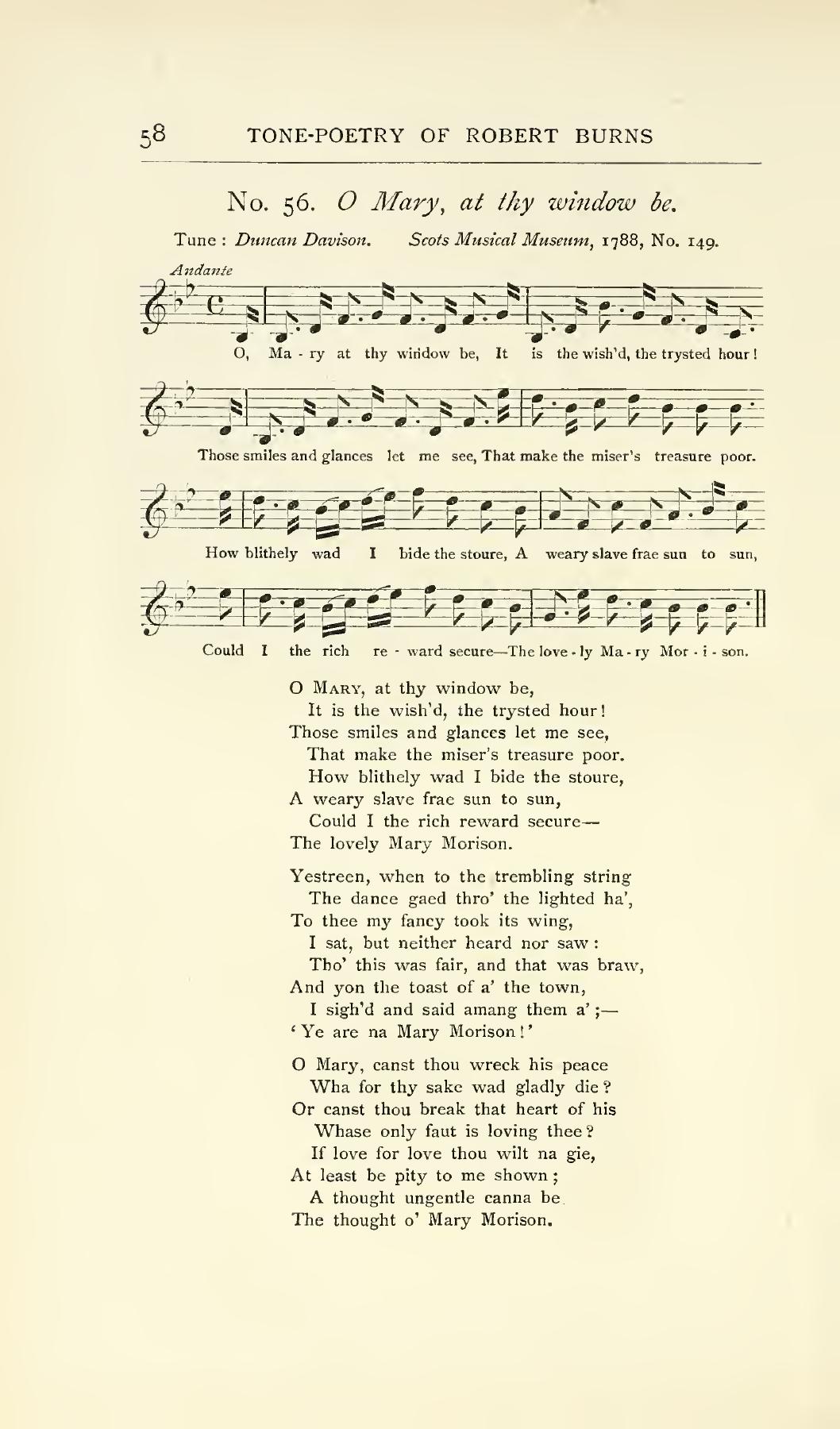
Dick (1903) · no. 56
O Mary, at thy window be,
It is the wish'd, the trysted hour!
Those smiles and glances let me see,
That make the miser's treasure poor.
How blithely wad I bide the stoure,
A weary slave frae sun to sun,
Could I the rich reward secure—
The lovely Mary Morison.

Yestreen, when to the trembling string
The dance gaed thro' the lighted ha',
To thee my fancy took its wing,
I sat, but neither heard nor saw:
Tho' this was fair, and that was braw,
And yon the toast of a' the town,
I sigh'd and said amang them a';—
'Ye are na Mary Morison!'

O Mary, canst thou wreck his peace
Wha for thy sake wad gladly die?
Or canst thou break that heart of his
Whase only faut is loving thee?
If love for love thou wilt na gie,
At least be pity to me shown;
A thought ungentle canna be
The thought o' Mary Morison.
View the source edition · no. 56; p. 58
About this edition
Both texts have three eight-line stanzas. Dick prints neither heard nor saw where Cunningham has neither heard or saw; Dick’s dance-stanza closing line is an exclamation, Cunningham’s a full stop. Other punctuation differs.
View historical scores
Dick’s Songs of Robert Burns (1903)
no. 56; p. 58