Ilk care and fear, when thou art near
Behind the song
Peggy Alison’s presence makes the singer feel richer than a king. ‘Ilk care and fear, when thou art near’ joins repeated kisses to a promise of lasting fidelity. Its confidence grows from the immediate pleasure of being together: anxiety falls away, an embrace becomes a treasure, and a kiss seals the vow.[1]
Read the fuller story
The chorus returns insistently to kissing, repeating ‘yet, yet’ before naming Peggy. The first stanza then explains the security behind that exuberance. ‘Ilk’ means every, and ‘mair’ more: each care and fear loses its power when she is near. The comparison with young kings newly enjoying their thrones turns an intimate happiness into a claim that public wealth and power cannot surpass it.[1]
The second stanza makes the embrace sufficient heaven for the speaker. Its ‘countless treasure’ continues the language of abundance, while the last stanza turns from present delight to future constancy. He swears by her blue eyes that he belongs to her for ever and seals the promise on her lips. The sequence gives the returning chorus a further purpose: each imagined kiss recalls the pledge as well as the pleasure.[1]
James C. Dick’s note distinguishes the song’s surviving forms. He says that the chorus and last two stanzas appeared in the Scots Musical Museum of 1788, no. 193, while the complete song appeared in Cromek’s Reliques in 1808. Dick also reports a manuscript lacking the first stanza. He places the song under Ellison Begbie’s name and associates Peggy Alison with her, while acknowledging that Burns did not directly identify the episode behind the early songs. The printed lyric’s name and Dick’s biographical association remain distinct.[2]
The tune heading names ‘Braes o’ Balquhidder’, and the setting is marked ‘Slow’. Dick reports Burns’s instruction that the chorus should use the tune’s first or lowest part; his printed music lays out chorus and stanza separately, with D.C. leading back to the refrain. Dick describes the air as a favourite reel and lists earlier dance-music collections. The affectionate words thus draw on a melody with a dance history in his account, presented here for a slow song.[1][2]
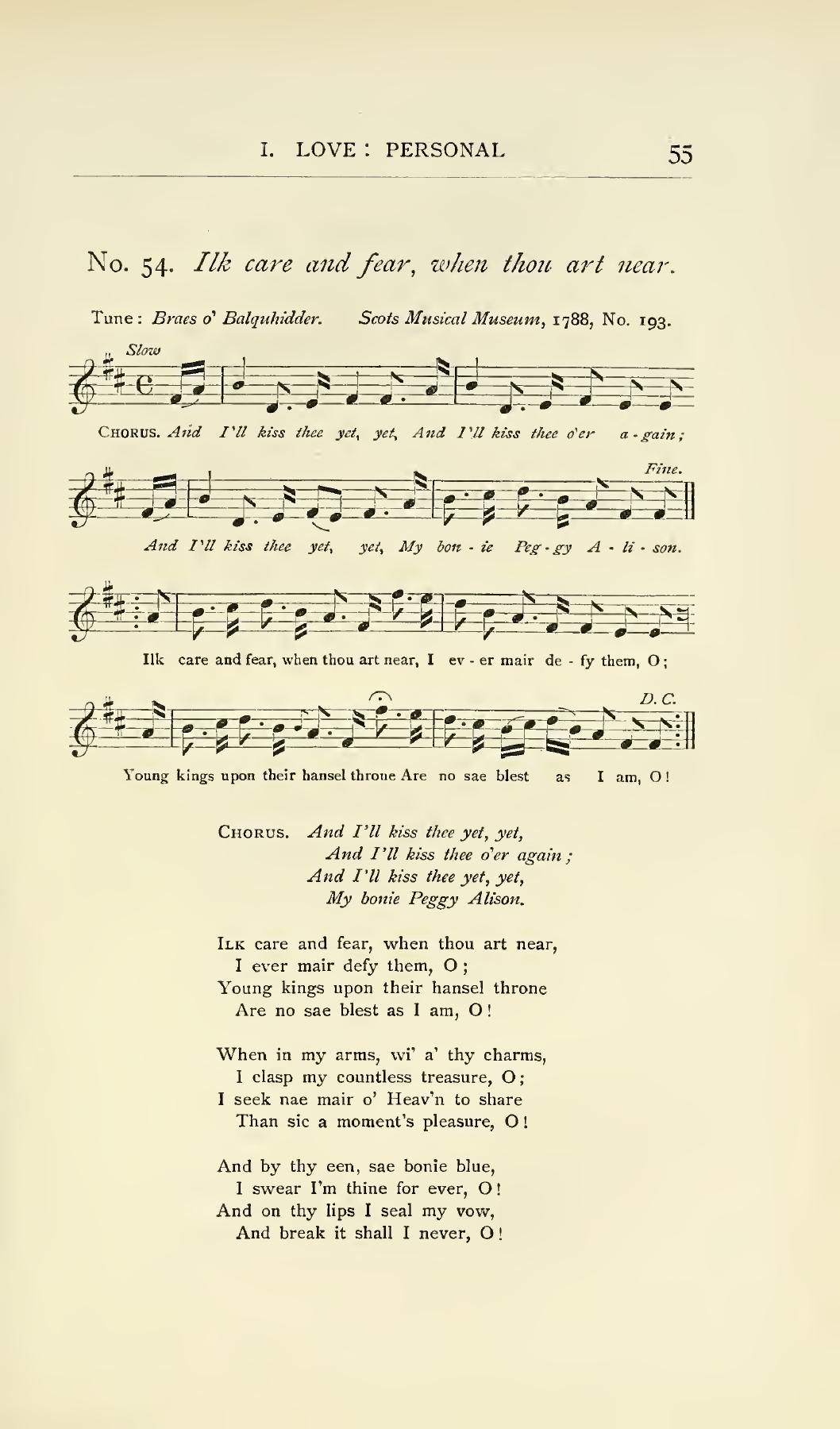 View score Dick’s Songs of Robert Burns (1903)
Lyrics
Dick (1903) · no. 54
CHORUS
And I'll kiss thee yet, yet,
And I'll kiss thee o'er again;
And I'll kiss thee yet, yet,
My bonie Peggy Alison.

Ilk care and fear, when thou art near,
I ever mair defy them, O;
Young kings upon their hansel throne
Are no sae blest as I am, O!

When in my arms, wi' a' thy charms,
I clasp my countless treasure, O;
I seek nae mair o' Heav'n to share
Than sic a moment's pleasure, O!

And by thy een, sae bonie blue,
I swear I'm thine for ever, O!
And on thy lips I seal my vow,
And break it shall I never, O!
View the source edition · Dick1903 no. 54; p. 55
About this edition
Syllables separated by the musical notation are joined into words in this reading.
Music
View historical scores
Dick’s Songs of Robert Burns (1903)
Dick1903 no. 54; p. 55