The Blind Harper
Behind the song
A harper from Lochmaben sets out to steal King Henry’s prized brown horse and finishes with a promise of compensation for his own supposedly stolen mare. The scheme succeeds through music, a resourceful wife and a mare determined to return to her foal. This is a ballad of ingenuity: the royal household hears beautiful playing while the audience watches a theft unfold behind it.[1]
Read the fuller story
The wife supplies the plan before her husband leaves. He must take their grey mare, leave the foal at home and carry a halter hidden in his hose. Once inside the royal stable, he will tie the king’s horse to the mare’s tail and release them. Her desire to reach her foal will bring both animals back to Lochmaben. The instructions make the later action easy to follow, and give the wife a practical authority on which the whole adventure depends.[1]
At the gate, the king asks to hear the blind harper play. The visitor first asks for stabling, securing a place for his mare beside the horse he wants. Music then performs two tasks: it draws the lords into dancing and eventually sends them to sleep. The harper removes his shoes, creeps to the stable and carries out his wife’s instructions. The repeated “harpèd” and “carpit” turn his performance into a sustained spell of distraction.[1]
The scene shifts home while the harper remains in England. The mare arrives before daylight with the stolen horse in tow, and a servant looking through the door mistakes the newcomer for an enormous foal. Her mistress’s answer prolongs the joke. The audience already knows more than the people being deceived, and this small domestic exchange lets it enjoy the successful arrival before returning to the king’s household.[1]
At dawn both horses are missing. The harper loudly laments the loss of his mare and of the foal left behind in Scotland. “Tint” means lost, while “stawn” means stolen. His complaint makes him appear another victim, and the king promises a better mare and payment for the foal. The ballad closes on that generous offer. The supposed poor guest has used hospitality, sympathy and his own performance to take the advantage.[1]
James C. Dick describes Burns as recovering and communicating this traditional ballad and its melody for the Scots Musical Museum. He cites the title in Gray’s manuscript lists, a close version in the Glenriddell manuscript of 1791 and publication in the Museum in 1803. He also discusses Scott’s altered version and identifies an added closing stanza there. Those transmission judgements come through Dick; this selected reading ends with the king’s promise and keeps the traditional tale distinct from Burns’s role in passing it on.[2]
Dick heads the tune “The Lochmaben harper” and says that his setting comes from Glenriddell’s manuscript, with a correction to a copying error. The printed repeat signs give many stanza endings a second hearing. That returning musical space suits a story built on preparation, repetition and recognition: listeners hear the plan, watch it work and finally savour a reward offered to the thief.[1][2]
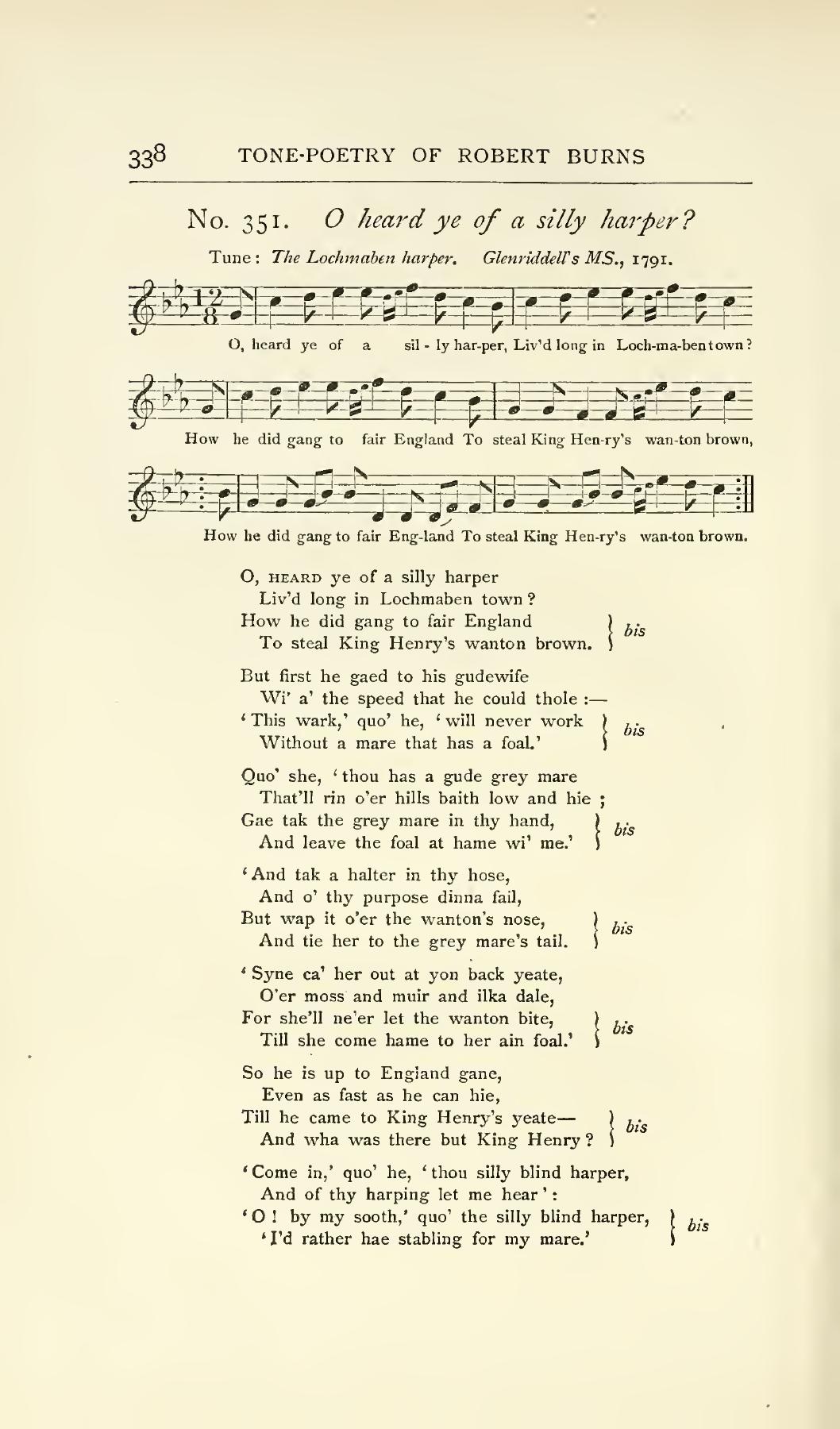 View score Dick’s Songs of Robert Burns (1903)
Lyrics
Choose an edition
Dick (1903) · no. 351
O, heard ye of a silly harper
Liv'd long in Lochmaben town?
How he did gang to fair England
To steal King Henry's wanton brown.

But first he gaed to his gudewife
Wi' a' the speed that he could thole:—
'This wark,' quo' he, 'will never work
Without a mare that has a foal.'

Quo' she, 'thou has a gude grey mare
That'll rin o'er hills baith low and hie;
Gae tak the grey mare in thy hand,
And leave the foal at hame wi' me.'

'And tak a halter in thy hose,
And o' thy purpose dinna fail,
But wap it o'er the wanton's nose,
And tie it to the grey mare's tail.

'Syne ca' her out at yon back yeate,
O'er moss and muir and ilka dale,
For she'll ne'er let the wanton bite,
Till she come hame to her ain foal.'

So he is up to England gane,
Even as fast as he can hie,
Till he came to King Henry's yeate—
And wha was there but King Henry?

'Come in,' quo' he, 'thou silly blind harper,
And o' thy harping let me hear':
'O! by my sooth,' quo' the silly blind harper,
'I'd rather hae stabling for my mare.'

The king looks o'er his left shoulder,
And says unto his stable groom;—
'Gae tak the silly poor harper's mare,
And tie her 'side my wanton brown.'

And ay he harpèd, and ay he carpit,
Till a' the lords gaed through the floor;
They thought the music was sae sweet
That they forgat the stable door.

And ay he harpit, and ay he carpit,
Till a' the nobles were sound asleep;
Then quietly he took aff his shoon,
And saftly down the stair did creep.

Syne to the stable door he hies
Wi' tread as light as light could be,
And when he open'd and gaed in,
There he fand thirty good steeds and three.

He took the halter frae his hose,
And of his purpose did na fail;
He slipt it o'er the wanton's nose,
And tied it to his grey mare's tail.

He ca'd her out at yon back yeate
O'er moss and muir & ilka dale;
And she loot ne'er the wanton bite,
But held her still gaun at her tail.

The grey mare was right swift o' fit,
And did na fail to find the way,
For she was at Lochmaben yeate
Fu' lang three hours ere it was day.

When she came to the harper's door,
There she gae many a nicher and snear;
'Rise,' quo' the wife, 'thou lazy lass,
Let in thy master and his mare.'

Then up she raise, pat on her claes,
And lookit out through the lock-hole:
'O! by my sooth, then,' quo' the lass,
'Our mare has gotten a braw big foal.'

'Come haud thy peace thou foolish lass,
The moon's but glancing in thy e'e;
I'd wad my haill fee 'gainst a groat
It's bigger than e'er our foal will be.'

The neighbours too that heard the noise
Cried to the wife to put her in;
'By my sooth, then,' quoth the wife,
'She's better than ever he rade on.'

But on the morn at fair daylight,
When they had ended a' their cheer:
King Henry's wanton brown was stawn,
And eke the poor auld harper's mare.

'Alace! alace!' says the silly blind harper;
'Alace! alace! that I came here,
In Scotland I've tint a braw cowte foal,
In England they've stawn my gude grey mare.'

'Come haud thy tongue, thou silly blind harper,
And of thy alacing let me be,
For thou shall get a better mare,
And weel paid shall thy cowte foal be.
For thou shall get a better mare,
And weel paid shall thy cowte foal be.'
View the source edition · Dick1903 no. 351; pp. 338–340
About this edition
Syllables separated by the musical notation are joined into words in this reading.
Scots Musical Museum, vol. VI (1839) · no. 579
View the source edition · pp. 598–599
About this edition
Museum no. 579.
Music
View historical scores
Dick’s Songs of Robert Burns (1903)
Dick1903 no. 351; pp. 338–340