O Ken Ye What Meg o' the Mill Has Gotten
Behind the song
Meg likes an early dram. By her wedding, the priest needs someone under his arm, the clerk has to be carried and the bridegroom ends up on the floor beside the bed. Dick prints a second version in which Meg marries a wealthy fool and breaks a miller’s heart. Both songs get the gossip started with the same question. [1][2]
Read the fuller story
The wedding becomes progressively less dignified. Meg likes an early dram; at the ceremony the priest has to be supported under the arm and the clerk carried. By the last stanza the bridegroom is so drunk that he falls beside the bed. The verse keeps its gossiping rhythm while the participants lose their ability to stand. “Strunt” means spirits, and “oxter’d” describes being carried or supported under the arm. Those concrete Scots words give the scene its bodily awkwardness. [1][2]
Dick’s second version uses the same opening to announce a different disappointment. Meg has married a “coof”, a fool with money, and broken the barley miller’s heart. The singer warmly praises the miller’s appearance and character, then heaps insults on the laird she has chosen. The two men compete through different offers. The miller promises faithful affection; the laird produces a fine pacing horse, a chained bridle, a whip and a handsome side-saddle. Their attractiveness to Meg is allowed to emerge through this carefully itemised display. [1][2]
The final stanza turns the individual marriage into an argument about love and possessions. A “mailen” is a farm and a “tocher” a marriage portion: the speaker rejects the calculation of property that has governed Meg’s choice. His vigorous dismissal of the world at the end gives the disappointed lover’s cause a rallying cry. This is a partisan account of the match. Meg’s reasons reach us through the voice that condemns her, while the luxury of the riding outfit remains plainly visible. [1][2]
The two versions also show how Burns’s songs could change as they passed between collectors. The 1839 Museum prints the drunken wedding with an explicit Burns credit; its accompanying commentary reproduces the wealth-and-marriage version separately. Dick calls them the first and second versions and describes an exchange with George Thomson in April 1793, quoting Burns’s offer to send both a song and the air Jackie Hume’s lament. In Dick’s account, Thomson prompted the new version, then still found its vernacular too strong for his collection. [3][4]
The later accounts differ over the song’s progress. The Museum commentary says Burns retouched and sent the older song in 1788, then altered it about five years later. Dick describes him as still preparing to send the first version to the Museum in April 1793, when he offered it to Thomson. Their accounts also leave uncertainty over the air called Jackie Hume’s lament: Dick explicitly declines to identify it with the tune printed for the first version. He supplies the second with O bonie lass, will ye lie in a barrack? The adjacent settings therefore preserve two distinct presentations. A drunken wedding and a bitter complaint about marrying for wealth share their opening question, then take the singer and listener in different directions. [1][3][4]
Story references
- James C. Dick, The Songs of Robert Burns (1903), nos. 192–193, pp. 172–173, both versions and settings.
- Allan Cunningham, ed., The Complete Works of Robert Burns (1855), glossary, “Coof”, “Mailen”, “Oxtered”, “Strunt” and “Tocher”; Project Gutenberg transcription.
- The Scots Musical Museum, vol. VI (1839 edition), no. 566, p. 585; commentary DLXVI, pp. 488–489.
- James C. Dick, The Songs of Robert Burns (1903), notes 192–193, p. 416.
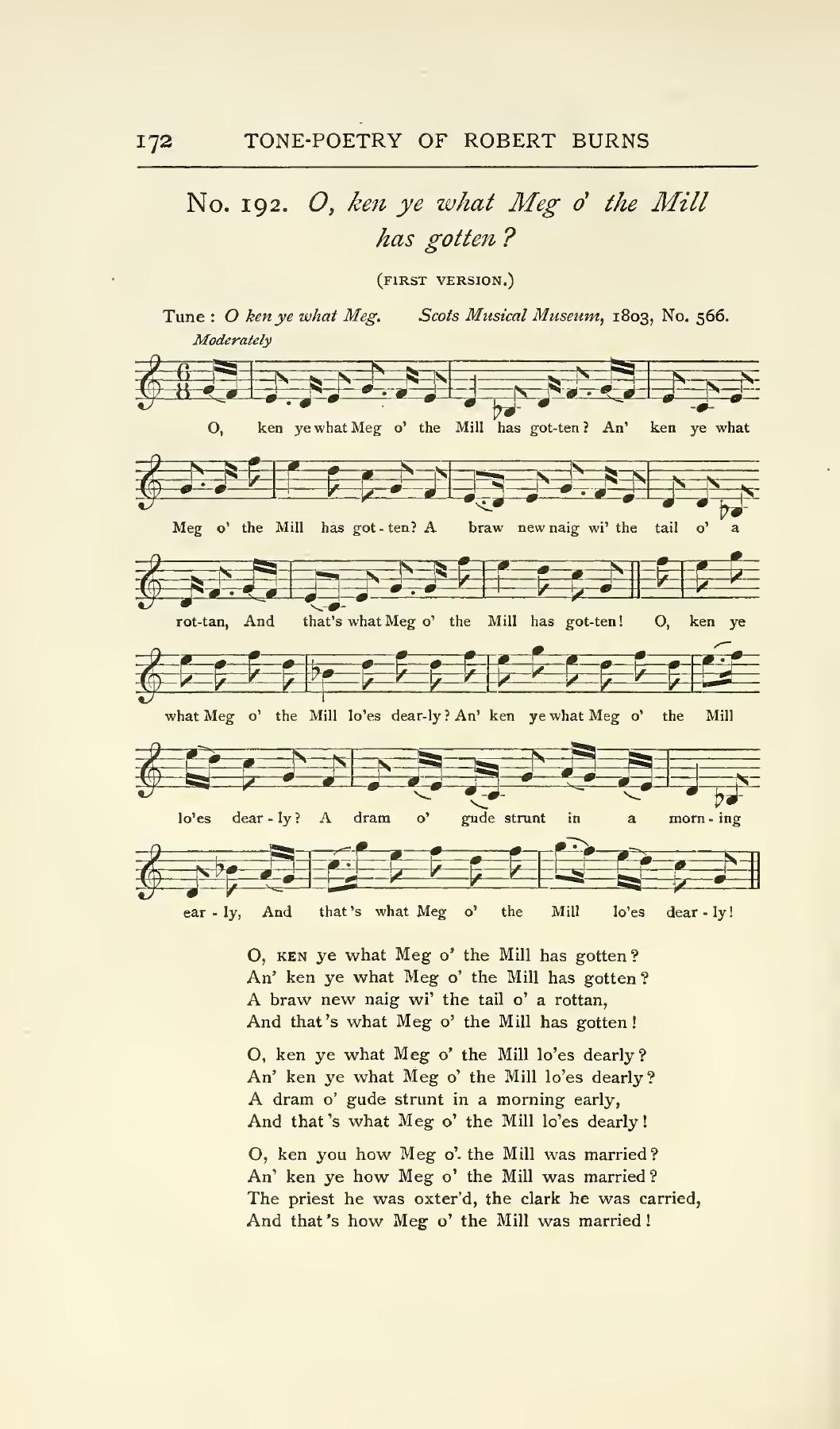 View score Dick’s Songs of Robert Burns (1903)
Lyrics
Choose an edition
Version notes
| Scots Musical Museum, vol. VI (1839) · no. 566 | Dick (1903) · no. 192 · First version |
|---|---|
| O ken ye how Meg o' the mill was married, | O, ken you how Meg o' the Mill was married? |
| And ken ye how Meg o' the mill was married; | An' ken ye how Meg o' the Mill was married? |
| The Priest he was oxterd, the Clerk he was carried, | The priest he was oxter'd, the clark he was carried, |
| Scots Musical Museum, vol. VI (1839) · no. 566 | Dick (1903) · no. 193 · Second version |
|---|---|
| She has gotten a coof wi' a claut o' siller, | She's gotten a coof wi' a claut o' siller, |
| The laird was a widdiefu' bleerit knurl; | The laird was a widdifu', bleerit knurl— |
| She's left the guid fallow and ta'en the churl. | She's left the gude fellow, and taen the churl! |
| A whip by her side, and a bonnie side-saddle. | A whip by her side, and a bonie side-saddle. |
More differences between these editions
| Scots Musical Museum, vol. VI (1839) · no. 566 | Dick (1903) · no. 193 · Second version |
|---|---|
| A tocher's nae word in a true lover's parle, | A tocher's nae word in a true lover's parl, |
Dick (1903) · no. 192 · First version
O, ken ye what Meg o' the Mill has gotten?
O, ken ye what Meg o' the Mill has gotten?
An' ken ye what Meg o' the Mill has gotten?
A braw new naig wi' the tail o' a rotan,
And that's what Meg o' the Mill has gotten!

O, ken ye what Meg o' the Mill lo'es dearly?
An' ken ye what Meg o' the Mill lo'es dearly?
A dram o' gude strunt in a morning early,
And that's what Meg o' the Mill lo'es dearly!

O, ken you how Meg o' the Mill was married?
An' ken ye how Meg o' the Mill was married?
The priest he was oxter'd, the clark he was carried,
And that's how Meg o' the Mill was married!

O, ken ye how Meg o' the Mill was bedded?
An' ken ye how Meg o' the Mill was bedded?
The groom gat sae fu', he fell awald beside it,
And that's how Meg o' the Mill was bedded!
Complete first version as printed by Dick in 1903.
View the source edition · Dick no. 192; pp. 172–173
About this edition
Complete first version as printed by Dick in 1903.
Dick (1903) · no. 193 · Second version
O, ken ye what Meg o' the Mill has gotten?
O, ken ye what Meg o' the Mill has gotten?
An' ken ye what Meg o' the Mill has gotten?
She's gotten a coof wi' a claut o' siller,
And broken the heart o' the barley miller!

The miller was strappin, the miller was ruddy,
A heart like a lord, and a hue like a lady.
The laird was a widdifu', bleerit knurl—
She's left the gude fellow, and taen the churl!

The miller, he hecht her a heart leal and loving,
The laird did address her wi' matter mair moving;
A fine pacing horse wi' a clear, chained bridle,
A whip by her side, and a bonie side-saddle.

O, wae on the siller, it is sae prevailing,
And wae on the love that is fixed on a mailen!
A tocher's nae word in a true lover's parl,
But gie me my love and a fig for the warl'!
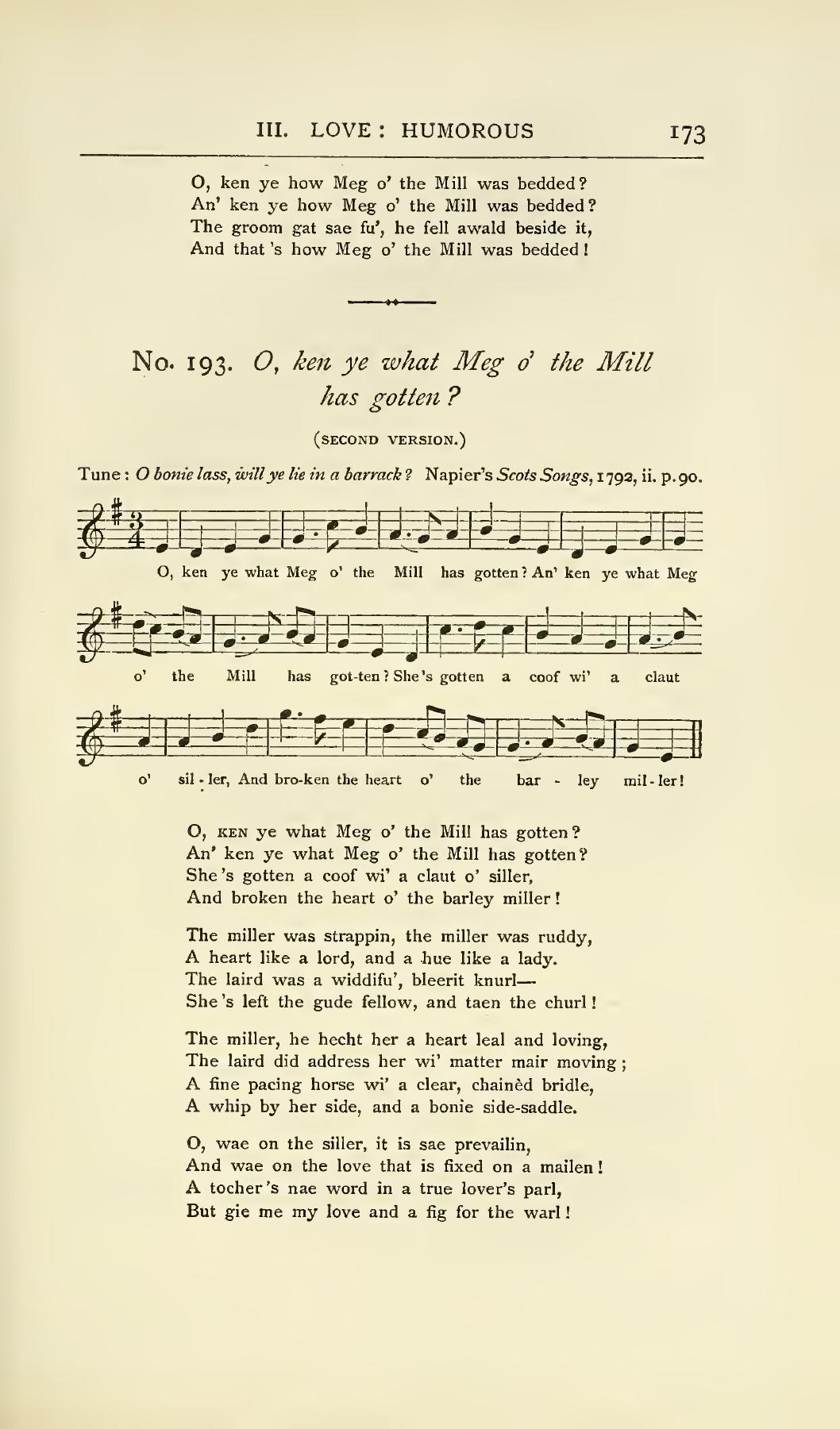
Complete second version as printed by Dick in 1903.
View the source edition · Dick no. 193; p. 173
About this edition
Complete second version as printed by Dick in 1903.
Scots Musical Museum, vol. VI (1839) · no. 566
O ken ye what Meg o' the mill has gotten.
O ken ye what Meg o' the mill has gotten,
An' ken ye what Meg o' the mill has gotten;
A braw new naig wi' the tail o' a rotan,
And that's what Meg o' the mill has gotten.

O ken ye what Meg o' the mill loes dearly,
An' ken ye what Meg o' the mill loes dearly,
A dram o' gude strunt in a morning early
And that's what Meg o' the mill loes dearly.

O ken ye how Meg o' the mill was married,
And ken ye how Meg o' the mill was married;
The Priest he was oxterd, the Clerk he was carried,
And that's how Meg o' the mill was married

O ken ye how Meg o' the mill was bedded,
An ken ye how Meg o' the mill was bedded;
The groom gat sae fu' he fell awald beside it,
And that's how Meg o' the mill was bedded.
View the source edition · O ken ye what Meg o' the mill has gotten.; p. 585
Music
View historical scores
Dick’s Songs of Robert Burns (1903)
Dick no. 192; pp. 172–173
View source · Download citation
Dick’s Songs of Robert Burns (1903)
Dick no. 193; p. 173
Credited to Burns in print
The printed score names Burns. How much he wrote or revised is uncertain.
Words Burns credited by the printed edition
Burns’s role Credited in print. The extent of his contribution is uncertain.