The Dumfries Volunteers
Behind the song
The Nith will reverse its course towards Corsincon and Criffel will sink into Solway before an invader is allowed to rally on British ground. The song calls on ships at sea and local volunteers ashore. [1]
Then it turns on people quarrelling at home. A stranger can step into the quarrel with a cudgel. Church and state are a kettle bought with the fathers’ blood, and if it needs patching, the singer says British hands must do the work. [1]
Read the fuller story
The ending condemns tyranny and a mob placed above the throne, then couples the king with the people. Its final promise gives the loyal toast a second obligation: “We’ll ne’er forget the People!” The language combines defence of the country, internal reform and resistance to political extremes in the song’s own emphatic terms. [1]
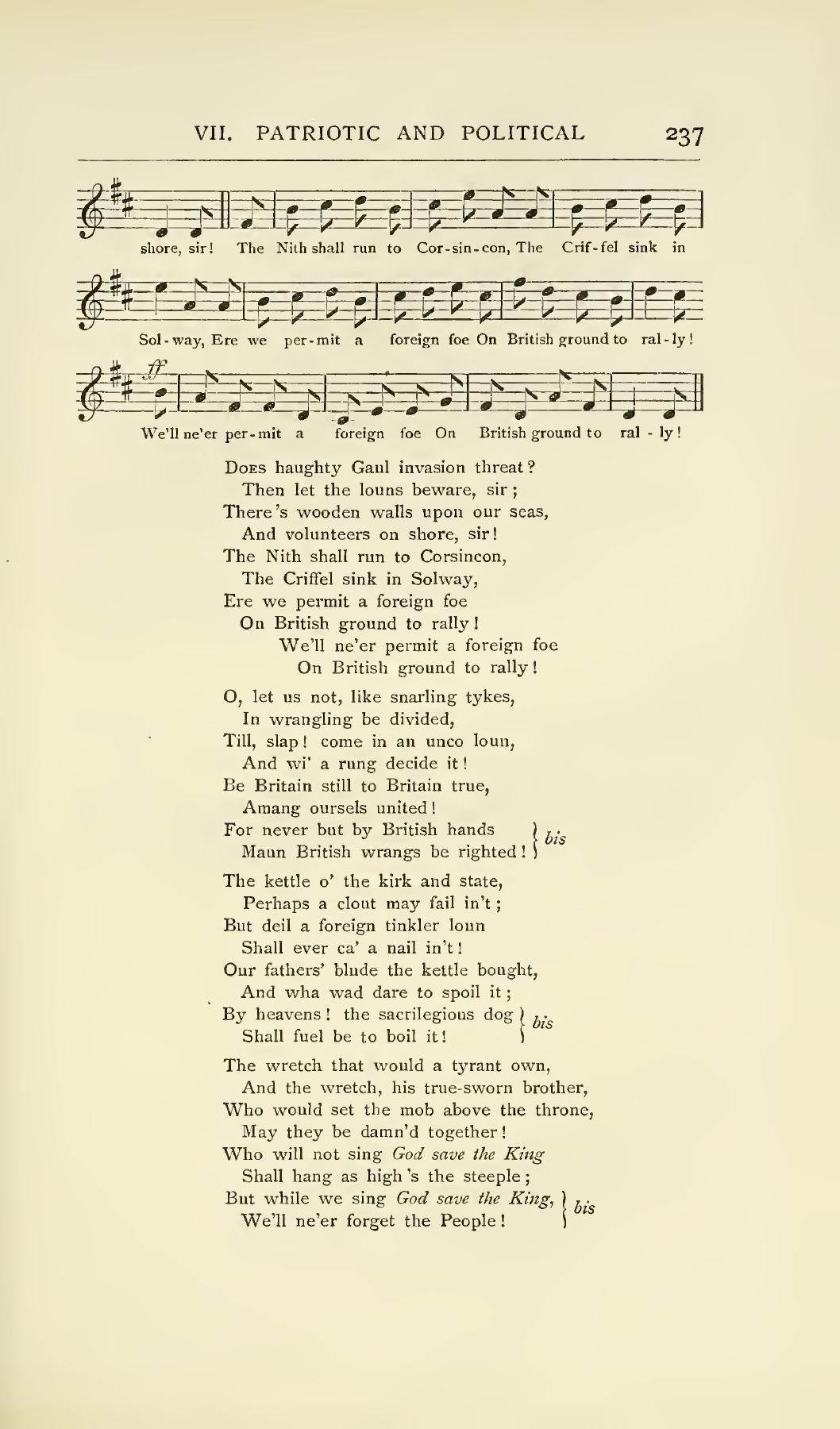
Cunningham dates the song to April 1795 and tells of Burns sending it to the editor of the Dumfries Journal. Dick reports a March 1795 sheet with music by Stephen Clarke. Both editions give Push about the jorum as a musical direction, while Dick also reports a later Thomson setting to Get up and bar the door. The year 1795 is common ground; the accounts differ over its early circulation. [2][3]
The Museum volume of 1839 prints the song as no.546 with an explicit Burns credit and music marked “with Spirit”. Its words include “snarling curs” where Dick has “snarling tykes”, and the Nith “rin” where Dick prints “run”. The page carries the same repeated refusal of a foreign foe and the closing king-and-people pairing. It offers another complete edition reading of the political argument, with its own notation and wording. [4][1]
Story references
- James C. Dick, The Songs of Robert Burns (1903), No. 259; printed pp. 236–237; PDF pp. 292–293
- Allan Cunningham, The Complete Works of Robert Burns (1855), printed 303; HTML #CCXLVIII. Project Gutenberg transcription.
- James C. Dick, The Songs of Robert Burns (1903), Dick note 259; printed 452; PDF 508
- James Johnson, The Scotish Musical Museum, volume VI (1839), no.546, printed565/PDF65.
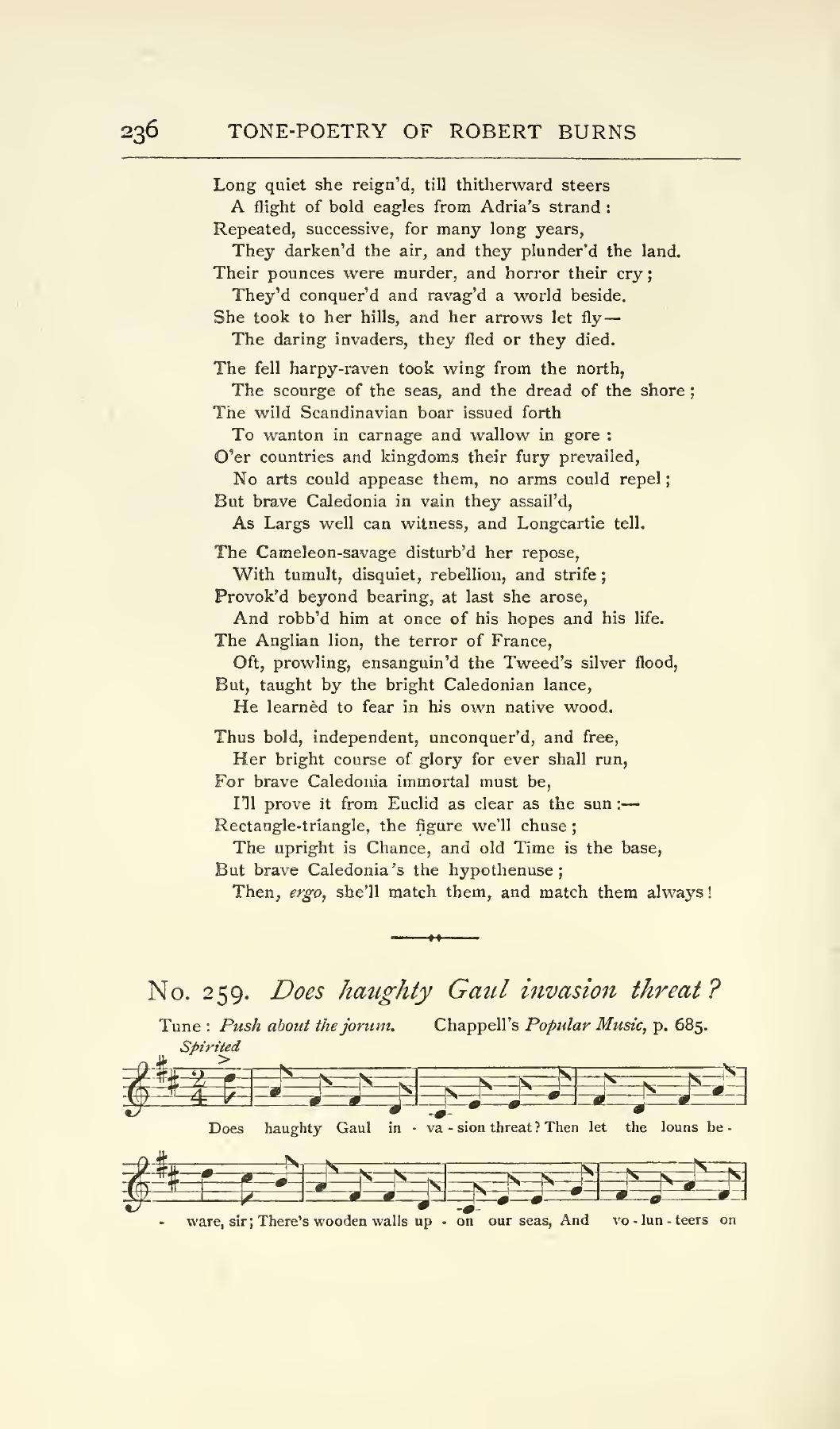 View score Dick’s Songs of Robert Burns (1903)
Lyrics
Choose an edition
Version notes
| Dick (1903) · no. 259 | Cunningham · 1855Ebook transcription |
|---|---|
| written first-stanza extra couplet and bis for later closing couplets | four octaves; no extra couplet or bis directions |
| louns / blude / above | loons / bluid / aboon |
| true-sworn brother | true-born brother |
| By heavens | By heaven |
| Dick (1903) · no. 259 | Scots Musical Museum, vol. VI (1839) · no. 546 |
|---|---|
| snarling tykes | snarling curs |
| Nith shall run | Nith shall rin |
| true-sworn brother | true sworn brother |
| Spirited; single melody staff | with Spirit; melody and lower staff |
Dick (1903) · no. 259
Does haughty Gaul invasion threat?
Then let the louns beware, sir;
There's wooden walls upon our seas,
And volunteers on shore, sir!
The Nith shall run to Corsincon,
The Criffel sink in Solway,
Ere we permit a foreign foe
On British ground to rally!
We'll ne'er permit a foreign foe
On British ground to rally!

O, let us not, like snarling tykes,
In wrangling be divided,
Till, slap! come in an unco loun,
And wi' a rung decide it!
Be Britain still to Britain true,
Amang oursels united!
For never but by British hands
Maun British wrangs be righted! (bis)

The kettle o' the kirk and state,
Perhaps a clout may fail in't;
But deil a foreign tinkler loun
Shall ever ca' a nail in't!
Our fathers' blude the kettle bought,
And wha wad dare to spoil it;
By heavens! the sacrilegious dog
Shall fuel be to boil it! (bis)

The wretch that would a tyrant own,
And the wretch, his true-sworn brother,
Who would set the mob above the throne,
May they be damn'd together!
Who will not sing God save the King
Shall hang as high's the steeple;
But while we sing God save the King,
We'll ne'er forget the People! (bis)
These are the words printed below the score.
View the source edition · no. 259; pp. 236–237
About this edition
Cunningham has four octaves without Dick’s fully written extra two-line first-stanza refrain; Dick directs repetition of the last two lines in stanzas 2–4 with bis. Dick has “louns”, “blude”, “true-sworn brother”, “above” and “By heavens”; Cunningham has “loons”, “bluid”, “true-born brother”, “aboon” and “By heaven”. Museum 1839 no. 546 prints “snarling curs”, “rin”, “blude” and “true sworn brother”; Dick has “snarling tykes”, “run”, “blude” and “true-sworn brother”. Museum score includes a lower staff and marks with Spirit; Dick’s selected page marks Spirited.
Scots Musical Museum, vol. VI (1839) · no. 546
View the source edition · p. 565
About this edition
Cunningham has four octaves without Dick’s fully written extra two-line first-stanza refrain; Dick directs repetition of the last two lines in stanzas 2–4 with bis. Dick has “louns”, “blude”, “true-sworn brother”, “above” and “By heavens”; Cunningham has “loons”, “bluid”, “true-born brother”, “aboon” and “By heaven”. Museum 1839 no. 546 prints “snarling curs”, “rin”, “blude” and “true sworn brother”; Dick has “snarling tykes”, “run”, “blude” and “true-sworn brother”. Museum score includes a lower staff and marks with Spirit; Dick’s selected page marks Spirited.
Cunningham (1855)
Does haughty Gaul invasion threat,
  Then let the loons beware, Sir,
There’s wooden walls upon our seas,
  And volunteers on shore, Sir.
The Nith shall run to Corsincon,
  And Criffel sink in Solway,
Ere we permit a foreign foe
  On British ground to rally!

O let us not, like snarling tykes,
  In wrangling be divided;
Till slap come in an unco loon
  And wi’ a rung decide it.
Be Britain still to Britain true,
  Amang oursels united;
For never but by British hands
  Maun British wrangs be righted!

The kettle o’ the kirk and state,
  Perhaps a clout may fail in’t;
But deil a foreign tinkler loon
  Shall ever ca’ a nail in’t.
Our fathers’ bluid the kettle bought,
  And wha wad dare to spoil it;
By heaven! the sacrilegious dog
  Shall fuel be to boil it.

The wretch that wad a tyrant own,
  And the wretch his true-born brother,
Who would set the mob aboon the throne,
  May they be damned together!
Who will not sing, “God save the King,”
  Shall hang as high’s the steeple;
But while we sing, “God save the King,”
  We’ll ne’er forget the people.
Digital text from Project Gutenberg.
View the source edition · p. 303
About this edition
Cunningham has four octaves without Dick’s fully written extra two-line first-stanza refrain; Dick directs repetition of the last two lines in stanzas 2–4 with bis. Dick has “louns”, “blude”, “true-sworn brother”, “above” and “By heavens”; Cunningham has “loons”, “bluid”, “true-born brother”, “aboon” and “By heaven”. Museum 1839 no. 546 prints “snarling curs”, “rin”, “blude” and “true sworn brother”; Dick has “snarling tykes”, “run”, “blude” and “true-sworn brother”. Museum score includes a lower staff and marks with Spirit; Dick’s selected page marks Spirited.
Music
View historical scores
Dick’s Songs of Robert Burns (1903)
no. 259; pp. 236–237
View source · Download citation
Credited to Burns in print
The printed score names Burns. How much he wrote or revised is uncertain.
Words Burns credited by the printed edition
Burns’s role Credited in print. The extent of his contribution is uncertain.