Had I the Wyte she Bade Me
Behind the song
The singer opens by asking whether the blame was his: the woman invited him. He returns to that defence as he tells how she brought him indoors while her husband was away. His account mixes attraction, sympathy for her and a determined effort to excuse himself. The repeated question makes the listener part of an argument whose most interested witness is the man telling it. [1]
Read the fuller story
She first watches for him beside the highway and directs him up the lane. When he hesitates, he says, she calls him a coward. His answer turns the hesitation into a boast: even kirk and state would not have stopped him accepting her invitation. That extravagance exposes the pleasure he takes in his own willingness, despite his repeated appeal to what she asked him to do. [1]
Inside, she tells him to be quiet because her ill-tempered husband is across the water. The singer describes kissing and caressing her, then challenges any critic to stand in his place before judging him. “Wyte” means blame, “ben” means into the inner room, and “dawte” means caress or fondle. His language keeps moving between the intimate encounter and the imagined audience he hopes to persuade. [1]
The third stanza gives his defence a more troubling ground. He says that her husband has struck her with a rippling comb and left her bruised and bloody. He presents kindness to her as something his manhood required and asks who could refuse to excuse her. Her reported suffering carries real weight within the song, while his use of it also serves his own case. The lyric lets compassion and self-justification occupy the same voice. [1]
The final stanza remembers wiping her eyes, cursing the cruel husband and enjoying her willing kisses. Its ending supplies a comic measure of the visit: he arrived at dusk on Monday and left through Tuesday’s dew, on his way to Willie’s brandy. After so much argument about blame, the precise overnight timetable lets the audience judge the extent of his involvement. [1]
Dick identifies the song in the Museum of 1796, signed Z, and reports a different version in the Merry Muses. He also places the chorus and an unused stanza in Herd’s manuscript. These are separate stages and forms in his account of the song’s transmission. The setting printed here names the tune “Come kiss with me” and directs a brisk performance. Dick traces that melody through several names and collections. The quick pace can sharpen the singer’s repeated excuses and the closing joke about time. [1][2]
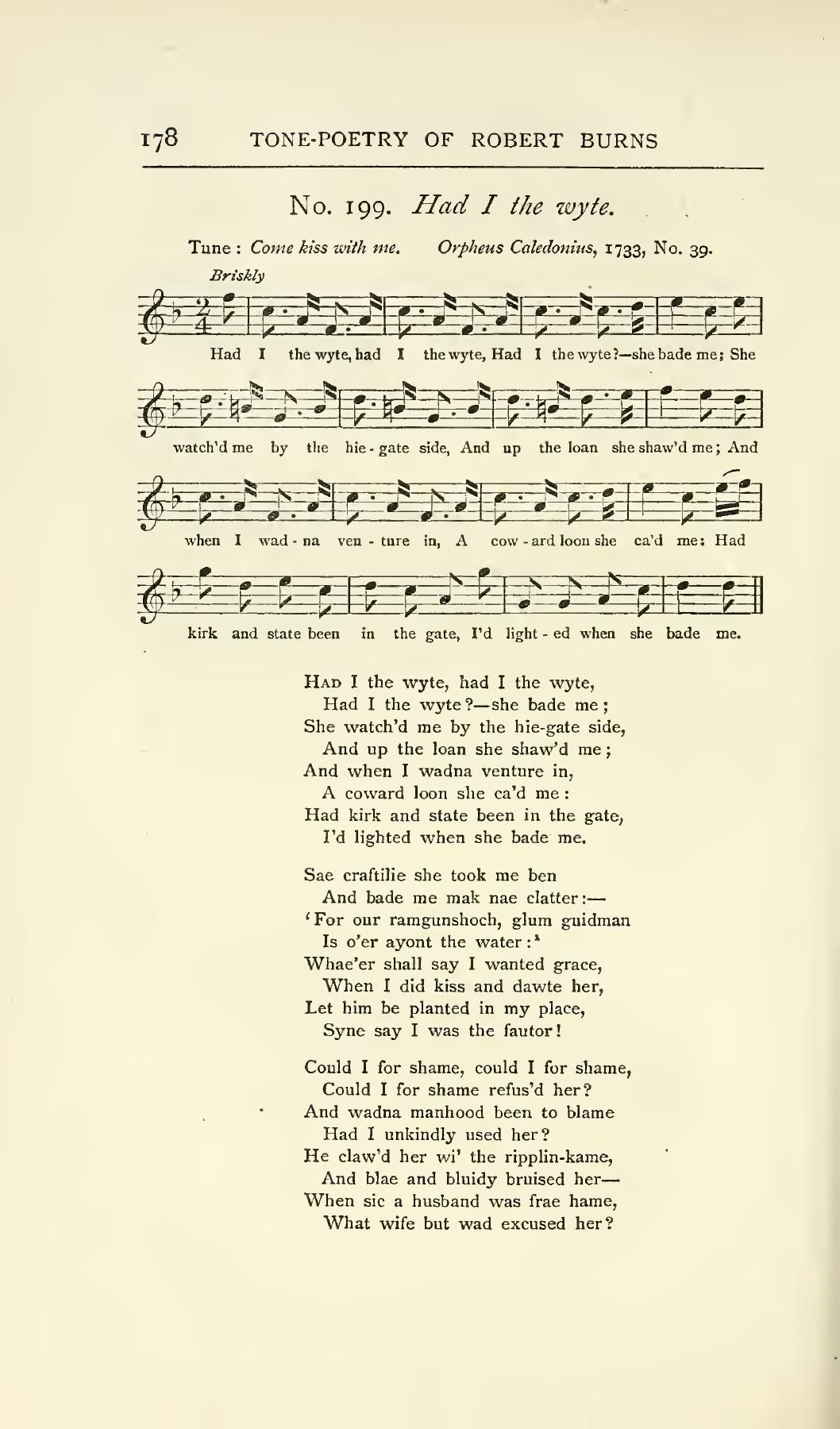 View score Dick’s Songs of Robert Burns (1903)
Lyrics
Dick (1903) · no. 199
Had I the wyte, had I the wyte,
Had I the wyte?—she bade me;
She watch'd me by the hie-gate side,
And up the loan she shaw'd me;
And when I wadna venture in,
A coward loon she ca'd me:
Had kirk and state been in the gate,
I'd lighted when she bade me.

Sae craftilie she took me ben
And bade me mak nae clatter:—
'For our ramgunshoch, glum guidman
Is o'er ayont the water:'
Whae'er shall say I wanted grace,
When I did kiss and dawte her,
Let him be planted in my place,
Syne say I was the fautor!

Could I for shame, could I for shame,
Could I for shame refus'd her?
And wadna manhood been to blame
Had I unkindly used her?
He claw'd her wi' the ripplin-kame,
And blae and bluidy bruised her—
When sic a husband was frae hame,
What wife but wad excused her?

I dighted ay her een sae blue,
An' bann'd the cruel randy;
And, weel I wat, her willin mou'
Was sweet as sugar-candy.
At gloamin-shot it was, I wot,
I lighted on the Monday,
But I cam thro' the Tyesday's dew
To wanton Willie's brandy.
View the source edition · Dick1903 no. 199; pp. 178–179
About this edition
Syllables separated by the musical notation are joined into words in this reading.
Music
View historical scores
Dick’s Songs of Robert Burns (1903)
Dick1903 no. 199; pp. 178–179
Sources
- The Merry Muses of Caledonia (1911), p. 56