When Guilford Good Our Pilot Stood
Behind the poem
Burns makes war and political struggle sound like a fast-moving Scots account delivered to a listener close at hand. Leaders steer a ship, lose their way, carve a joint, play cards and knock an opponent about like a ball. The repeated “man” keeps drawing the listener back into the telling, while the jokes steadily reduce grand affairs to familiar actions.[1]
Read the fuller story
The 1787 volume prints the piece as “A Fragment”, with the tune heading “Gillicrankie”. It contains nine numbered stanzas of eight lines and is followed by a row of asterisks. The tune heading makes singing part of the original presentation. Many personal names are partly masked, while places such as America, Quebec, Philadelphia and Saratoga remain openly named.[1][2]
The opening turns government into navigation. Guilford is the pilot, twisting the helm, when an argument begins over tea in America. The “maskin-pat”, the pot used for brewing, is thrown into the sea; Congress then refuses “our law”. The homely vocabulary makes the conflict sound like a quarrel which has abruptly become a challenge to authority. The speaker’s “our” places the account on one side of that quarrel, even as the poem finds plenty to mock among its own leaders.[1]
The military episodes move between admiration and ridicule. Montgomery falls at Quebec with sword in hand before his band, a moment of gallantry within the rapid narrative. Another commander is treated much less generously: supposedly reluctant to shed Christian blood with sword and gun, he is readily occupied with knife and fork, hacking “Sir Loin” small. The change of weapons turns military criticism into a dinner-table pun. Elsewhere defeat becomes losing the way in a misty wood, and an unused sword hangs on the wall to keep it from rusting.[1]
The later stanzas carry the same physical wit into political rivalry. Opponents are driven to the wall, and Charlie’s success becomes a game played with Clubs and Hearts. An Indian Diamond’s Ace brings a “faux pas”, or false step. The imagery makes power look precarious: one player’s winnings can disappear with the next turn. Noisy voices, secret words behind the throne and shifting partnerships keep the contest in motion.[1]
Scotland enters as a figure who draws out her pipe and urges Willie to defeat them all. Chatham’s ghost then appears in heavenly dress, calling on him to rise. The parenthetical assurance that inspired bards saw the apparition adds another layer of playful storytelling. Willie is soon being struck like a ball, but supporters rise behind him. In the last lines Caledon puts aside the drone and draws her “whittle”, a knife, swearing through dirt and blood to make the cause good in law.[1]
The movement from pipe to knife gives the printed fragment a forceful ending. Its ordinary Scots verbs continually turn remote contests into things a listener can picture: throwing, striking, eating, twisting and drawing a blade. The recurring “man” and the rhymes tucked within the longer lines help the succession of names and scenes keep its pace. Politics becomes an energetic performance, with praise, mockery and partisan excitement carried together.[1]
Story references
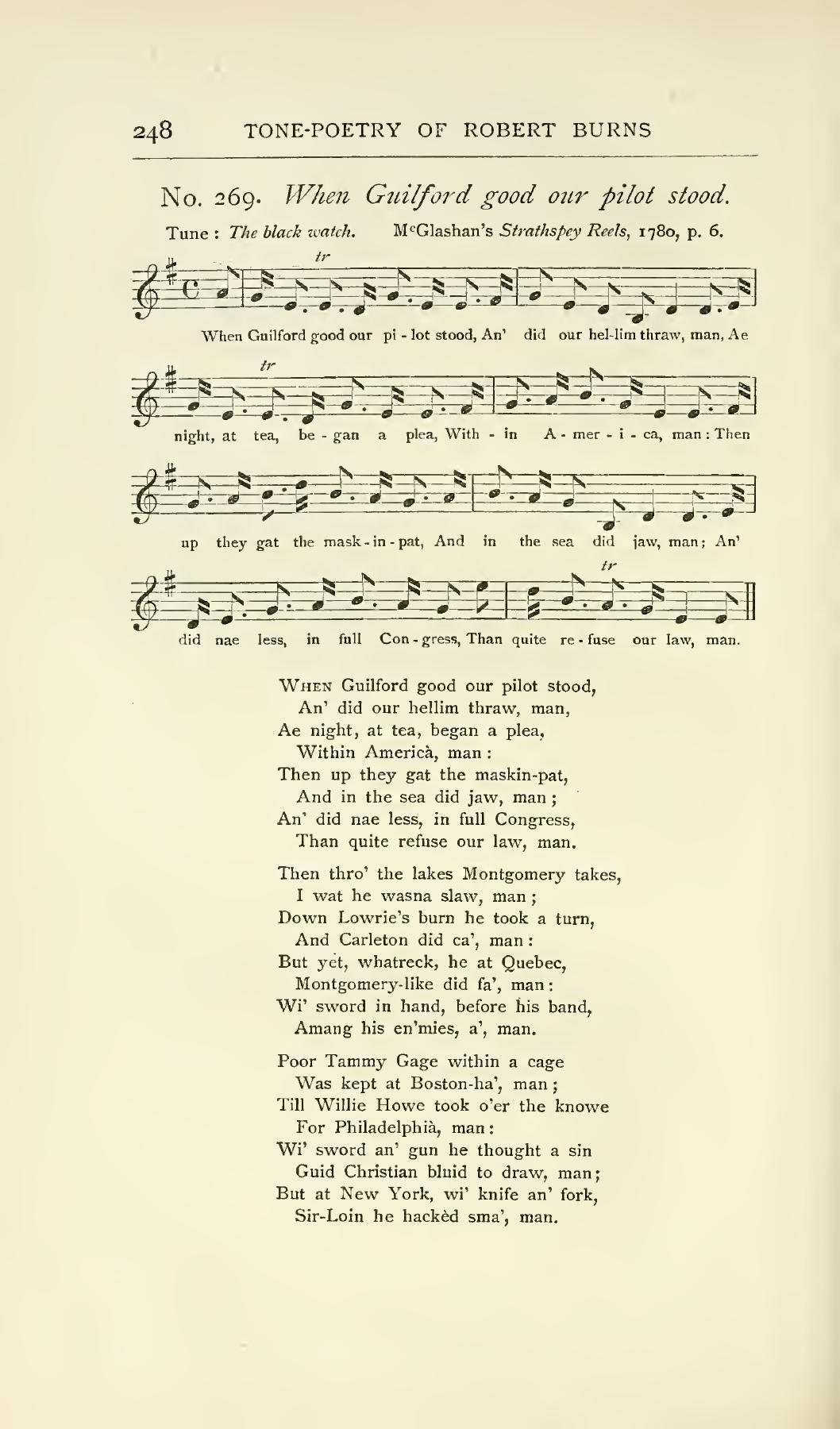 View score Dick’s Songs of Robert Burns (1903)
Poem
Choose an edition
Edinburgh Poems (1787) · printed fragment
A FRAGMENT.
I.
WHEN Guilford good our Pilot stood,
    An’ did our hellim thraw, man,
Ae night, at tea, began a plea,
    Within America, man:
Then up they gat the maskin-pat,
    And in the sea did jaw, man;
An’ did nae less, in full Congress,
    Than quite refuse our law, man.

II.
Then thro’ the lakes Montgomery takes,
    I wat he was na slaw, man;
Down Lowrie’s burn he took a turn,
    And C-rl-t-n did ca’, man:
But yet, whatreck, he, at Quebec,
    Montgomery-like did fa’, man,
Wi’ sword in hand, before his band,
    Amang his en’mies a’, man.

III.
Poor Tammy G-ge within a cage
    Was kept at Boston-ha’, man;
Till Willie H--e took o’er the knowe
    For Philadelphia, man:
Wi’ sword an’ gun he thought a sin
    Guid Christian bluid to draw, man;
But at New-York, wi’ knife an’ fork,
    Sir Loin he hacked sma’, man.

IV.
B-rg--ne gaed up, like spur an’ whip,
    Till Fraser brave did fa’, man;
Then lost his way, ae misty day,
    In Saratoga shaw, man.
C-rnw-ll-s fought as lang’s he ought,
    An’ did the Buckskins claw, man;
But Cl-nt-n’s glaive frae rust to save
    He hung it to the wa’, man.

V.
Then M-nt-gue, an’ Guilford too,
    Began to fear a fa’, man;
And S-ckv-lle doure, wha stood the stoure,
    The German Chief to thraw, man:
For Paddy B-rke, like ony Turk,
    Nae mercy had at a’, man;
An’ Charlie F-x threw by the box,
    An’ lows’d his tinkler jaw, man.

VI.
Then R-ck-ngh-m took up the game;
    Till Death did on him ca’, man;
When Sh-lb-rne meek held up his cheek,
    Conform to Gospel law, man:
Saint Stephen’s boys, wi’ jarring noise,
    They did his measures thraw, man,
For N-rth an’ F-x united stocks,
    An’ bore him to the wa’, man.

VII.
Then Clubs an’ Hearts were Charlie’s cartes,
    He swept the stakes awa’, man,
Till the Diamond’s Ace, of Indian race,
    Led him a sair faux pas, man:
The Saxon lads, wi’ loud placads,
    On Chatham’s Boy did ca’, man;
An’ Scotland drew her pipe an’ blew,
    ‘Up, Willie, waur them a’, man!’

VIII.
Behind the throne then Gr-nv-lle’s gone,
    A secret word or twa, man;
While slee D-nd-s arous’d the class
    Be-north the Roman wa’, man:
An’ Chatham’s wraith, in heav’nly graith,
    (Inspired Bardies saw, man)
Wi’ kindling eyes cry’d, ‘Willie, rise!
    ‘Would I hae fear’d them a’, man?’

IX.
But, word an’ blow, N-rth, F-x, and Co.
    Gowff’d Willie like a ba’, man,
Till Suthron raise, an’ coost their claise
    Behind him in a raw, man:
An’ Caledon threw by the drone,
    An’ did her whittle draw, man;
An’ swoor fu’ rude, thro’ dirt an’ blood,
    To mak it guid in law, man.
Fragment: seventy-two verse lines in nine numbered stanzas, with its tune heading.
View the source edition · pp. 311–315
About this edition
The 1787 edition calls the piece “A Fragment”, names “Gillicrankie” as its tune, and ends it with seven asterisks. This reading follows that printed fragment.
Dick (1903) · no. 269
The words are on the score page.
View the source edition · no. 269; pp. 248–249
Scots Musical Museum, vol. II (1788) · no. 101
View the source edition · Volume 2, no. 101; pp. 102–103
Music
View historical scores
Dick’s Songs of Robert Burns (1903)
no. 269; pp. 248–249
Burns’s own writing
Burns wrote the words printed as “A Fragment” in his 1787 Poems. The page names “Gillicrankie” as the tune.
Words Robert Burns
Burns’s role Author of the printed song fragment