 Open full image
James C. Dick · 1903 · National Library of Scotland · Licence · Source
View related pages
 Open full image
James C. Dick · 1903 · National Library of Scotland · Licence · Source
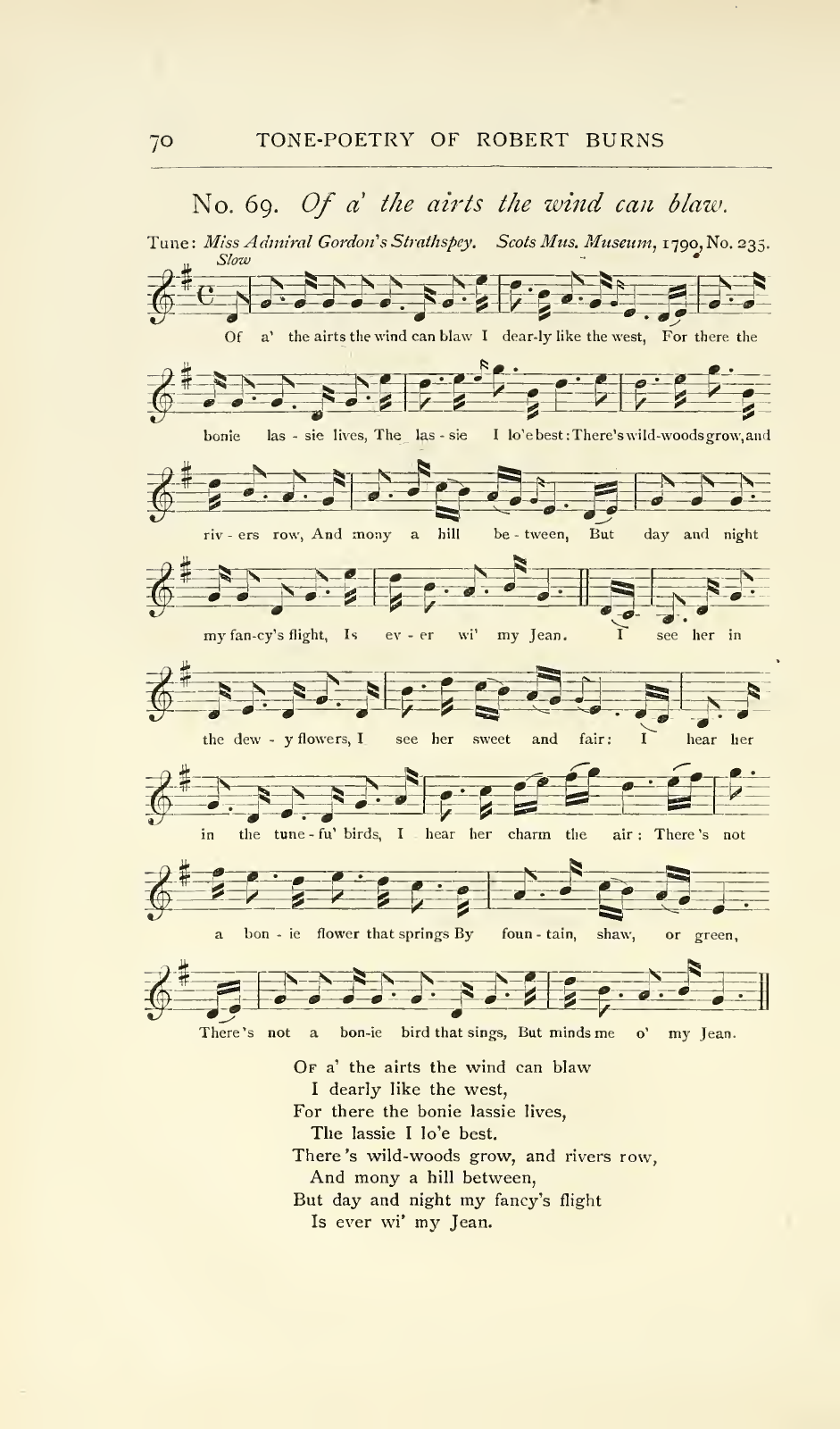
Robert Burns described Of a’ the Airts as a compliment to his wife, Jean Armour, composed during the honeymoon. James C. Dick later placed its writing at Ellisland in June 1788, while Jean was still in Ayrshire. Burns’s own note establishes the occasion; the precise month comes from Dick’s account.
The song’s speaker looks west towards Jean across woods, rivers and hills. Flowers recall her appearance and birdsong recalls her voice, keeping the absent woman present in his thoughts. William Marshall’s Miss Admiral Gordon’s Strathspey supplied the melody.
Burns was beginning work at Ellisland, while Jean learned dairy work from his mother and sisters before joining him. In the song, those preparations give way to the repeated movement of the singer’s thoughts towards her. Johnson later published the words and Marshall’s air as I love my Jean.
Sources
- The Songs of Robert Burns: now first printed with the melodies for which they were written · note 69 p 375 quotingReliques 273
- The Songs of Robert Burns: now first printed with the melodies for which they were written · note 69 pp 375–376
- The Complete Works of Robert Burns: poems, songs and correspondence · Cunningham 1855, CXXII 13 June 1788 and CLXIV 4 June 1789, dairy preparation and household singing
- The Songs of Robert Burns: now first printed with the melodies for which they were written · Dick 1903, song 69 pp 70–71 and note 69 pp 375–376; composition, melody and publication