The Farewell to the Brethren of St James’s Lodge, Tarbolton
Behind the song
Burns asks the Freemasons of St James’s Lodge in Tarbolton for one thing. When they meet each year, will they drink a round to the bard who is far away? He remembers the evenings he spent among them, sometimes presiding himself. Facing the prospect of going abroad, he sends his old companions the blessing of a fellow craftsman, in the language of the line and the plummet. [1]
Read the fuller story
Burns’s farewell to the brethren of St James’s Lodge opens with the warmth of a direct address. The men are dear brothers, companions in social pleasure and members of the mystic tie. The speaker imagines leaving for foreign lands in pursuit of fortune, while promising to remember the lodge from a distance. The repeated prospect of being far away gives the four stanzas their common thread.
Memory takes a more particular form in the second stanza. Cheerful nights with the social band are joined to the speaker’s experience of presiding over it. The lodge’s shared signs and customs become ways of remembering those gatherings. In the next stanza, the song moves from recollection to a prayer for the company’s future. Freedom, harmony and love are placed beside the language of architecture: the design, the line and the plummet all serve the wish for an ordered fellowship.
The final stanza addresses a member whose honoured position receives a personal blessing, then makes a request to the assembled brethren. When they meet each year, they are to drink one round to the absent bard. The song thus gives the farewell a recurring place in the lodge’s gatherings. It closes on an action the company can perform together, keeping remembrance within their ordinary social life.[1]
Cunningham prints the words to the tune “Good-night, and joy be wi’ you a’”. Dick’s 1903 collection also prints the lodge song with notation under that tune heading. The words of this farewell form their own four-stanza song; the short first song printed under the same air in the Museum has a separate reader page.[1][2][3]
Story references
- Robert Burns, “The Farewell to the Brethren of St. James’s Lodge, Tarbolton”, in Allan Cunningham’s edition (1855), song XXVII, printed pp.218–219.
- James C. Dick, The Songs of Robert Burns (1903), no.240, printed p.214: opening words and tune heading.
- The Scotish Musical Museum (1839), volume VI, no.600, printed p.620: separate first song and Burns farewell.
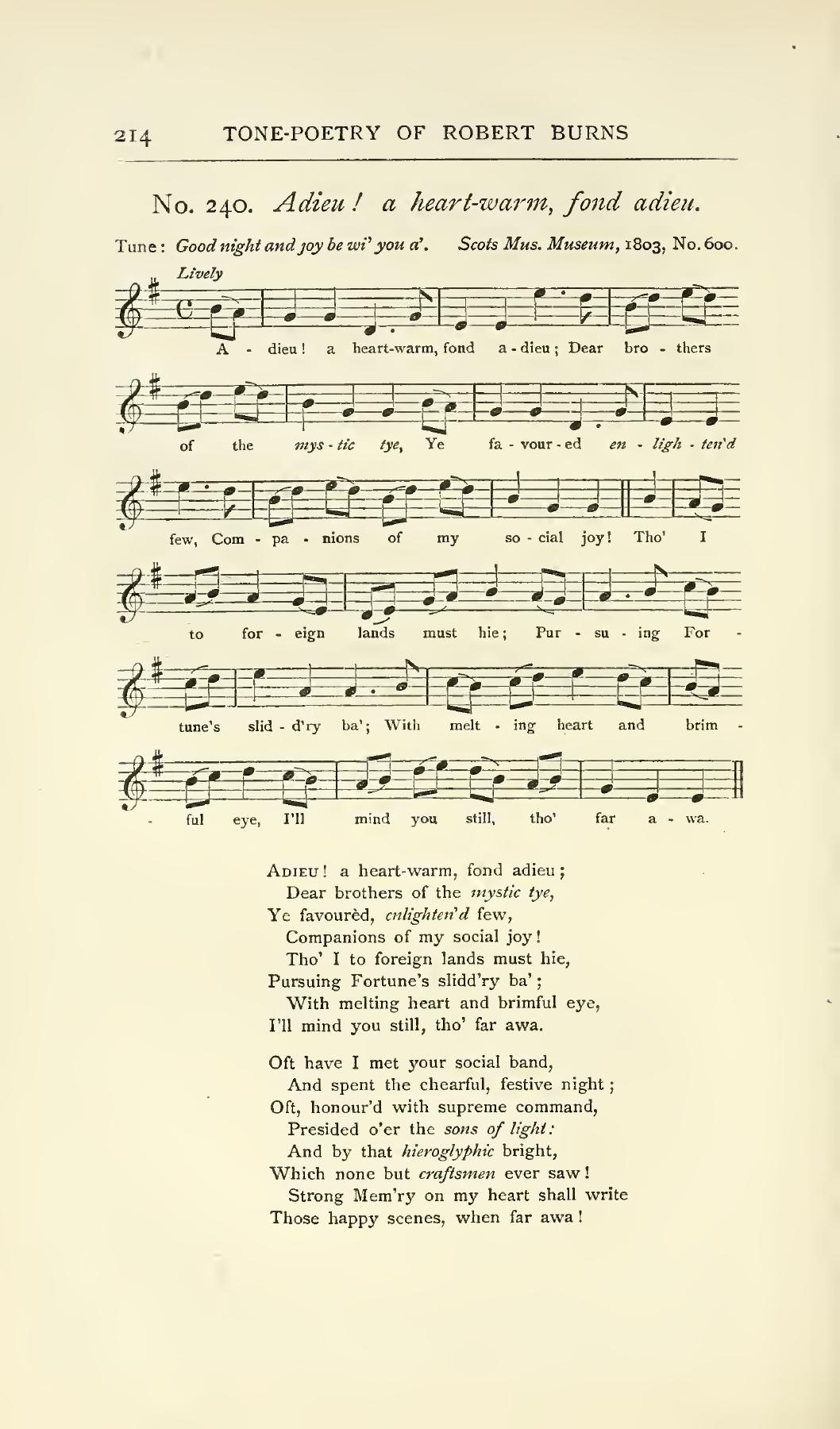 View score Dick’s Songs of Robert Burns (1903)
Lyrics
Choose an edition
Cunningham (1855)
Adieu! a heart-warm, fond adieu!
  Dear brothers of the mystic tie!
Ye favour’d, ye enlighten’d few,
  Companions of my social joy!
Tho’ I to foreign lands must hie,
  Pursuing Fortune’s slidd’ry ba’,
With melting heart, and brimful eye,
  I’ll mind you still, tho’ far awa’.

Oft have I met your social band,
  And spent the cheerful, festive night;
Oft honour’d with supreme command,
  Presided o’er the sons of light:
And by that hieroglyphic bright,
  Which none but craftsmen ever saw!
Strong mem’ry on my heart shall write
  Those happy scenes when far awa’.

May freedom, harmony, and love
  Unite you in the grand design,
Beneath th’ Omniscient Eye above,
  The glorious architect divine!
That you may keep th’ unerring line,
  Still rising by the plummet’s law,
Till order bright completely shine,
  Shall be my pray’r when far awa’.

And you farewell! whose merits claim,
  Justly, that highest badge to wear!
Heav’n bless your honour’d, noble name,
  To masonry and Scotia dear!
A last request permit me here,
  When yearly ye assemble a’,
One round—I ask it with a tear,—
  To him, the Bard that’s far awa’.
Digital text from Project Gutenberg.
View the source edition · p. 218
About this edition
Four eight-line stanzas from Cunningham’s 1855 edition.
Kilmarnock Poems (1786)
View the source edition · pp. 228–229
About this edition
The saved page extraction supports the lodge-song identity. These original pages await a complete text check.
Edinburgh Poems (1787)
View the source edition · pp. 333–335
About this edition
The saved page extraction supports the lodge-song identity. These original pages await a complete text check.
Dick (1903) · no. 240
The words are on the score page.
View the source edition · no. 240; pp. 214–215
Music
View historical scores
Dick’s Songs of Robert Burns (1903)
no. 240; pp. 214–215
Burns’s own writing
The words appear as a separate work in Cunningham’s 1855 edition of Burns.
Words Robert Burns
Burns’s role Author of the lodge farewell