The sun he is sunk in the west
Behind the song
Everyone around the singer can sleep. The creatures have settled, a prosperous man rests undisturbed, and the singer’s wife and children have a brief release from care. He remains awake with thoughts of their poverty. The song moves from the evening sky into the household, where love makes his distress harder to bear and gives him a reason to go on. [1]
Read the fuller story
The opening sets his wakefulness against a world at rest. In the second stanza, the prosperous man sleeps through the sound of the storm, while the speaker keeps watch with misery for company. The contrast makes security seem like the freedom to stop worrying. It also gives the song a physical rhythm: the storm continues outside, and the thought of fickle Fortune returns at the end of every stanza. [1]
As his attention turns to his wife, he remembers her youthful promise and asks how he can endure seeing her brought so low. The children lie in her arms, protected for the moment from anxious fear. Their sleep offers him no similar peace. His care for them makes their vulnerability painfully visible. A later stanza recalls a time when he could help people in distress; now even a small livelihood is difficult to earn. The reversal has cost him the satisfaction of being useful to others as well as material comfort. [1]
His despair reaches the wish for a grave, but the thought of his wife and children immediately checks it: where would they go? The final stanza leaves him asking where he himself can turn. There is no arrival of help within the song. The recurring appeal to Fortune holds the seven stanzas together while the questions become more urgent, carrying the listener from sleeplessness into the fear of abandonment. [1]
Dick cites Chambers’s Works of 1852, where the piece is headed as a song in the character of a ruined farmer. He describes a manuscript in Burns’s handwriting and interprets its distressed farmer as a representation of Burns’s father. That family connection comes to this reading through Dick’s historical note. The words themselves make the speaker’s responsibilities clear, while the particular biographical identification depends on the editorial account. [2]
The printed tune is “Go from my window, love, do”. Dick says the unusual metre was made for an air which Burns was later said to have communicated to the Museum with traditional verses. Each stanza here has five lines, ending in the same appeal to changeable Fortune. That regular return gives a singer a recurring point of emphasis: every fresh thought about the household comes back to the force which the speaker feels has overturned his life. [1][2]
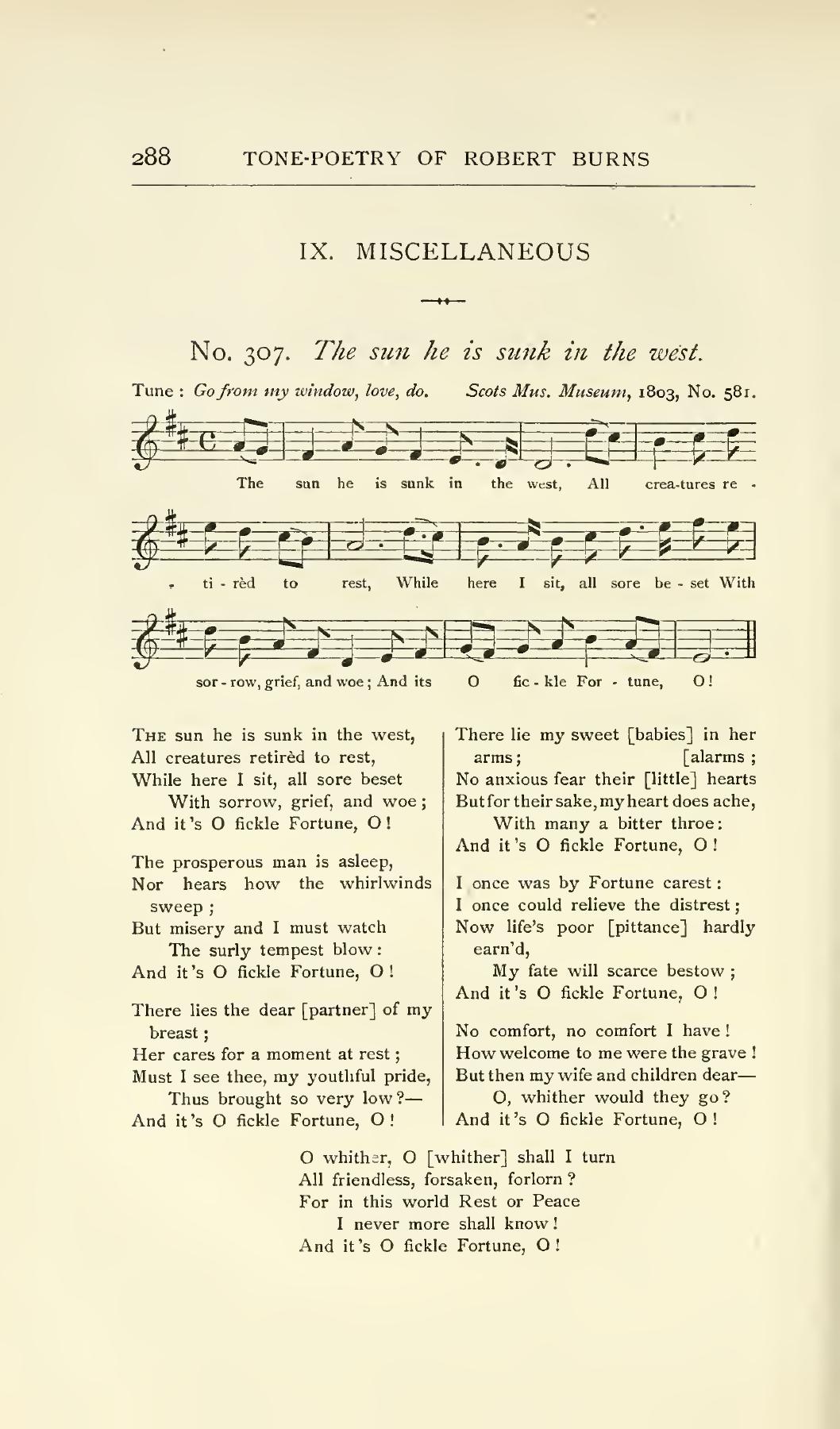 View score Dick’s Songs of Robert Burns (1903)
Lyrics
Dick (1903) · no. 307
The sun he is sunk in the west.
The sun he is sunk in the west,
All creatures retired to rest,
While here I sit, all sore beset
With sorrow, grief, and woe;
And it's O fickle Fortune, O!

The prosperous man is asleep,
Nor hears how the whirlwinds sweep;
But misery and I must watch
The surly tempest blow:
And it's O fickle Fortune, O!

There lies the dear [partner] of my breast;
Her cares for a moment at rest;
Must I see thee, my youthful pride,
Thus brought so very low?—
And it's O fickle Fortune, O!

There lie my sweet [babies] in her arms;
No anxious fear their [little] hearts alarms;
But for their sake, my heart does ache,
With many a bitter throe:
And it's O fickle Fortune, O!

I once was by Fortune carest:
I once could relieve the distrest;
Now life's poor [pittance] hardly earn'd,
My fate will scarce bestow;
And it's O fickle Fortune, O!

No comfort, no comfort I have!
How welcome to me were the grave!
But then my wife and children dear—
O, whither would they go?
And it's O fickle Fortune, O!

O whither, O [whither] shall I turn
All friendless, forsaken, forlorn?
For in this world Rest or Peace
I never more shall know!
And it's O fickle Fortune, O!
View the source edition · Dick1903 no. 307; p. 288
About this edition
Syllables separated by the musical notation are joined into words in this reading.
Music
View historical scores
Dick’s Songs of Robert Burns (1903)
Dick1903 no. 307; p. 288