A nobleman liv’d in a village of late
Behind the song
A nobleman and his neighbour, a thresher, make their living very differently. The nobleman has wealth. The thresher must work for everything his children eat. The two stanzas printed here linger over the poorer man’s household and the contentment he finds in it. [1]
Read the fuller story
The thresher goes out early, carrying his flail and a bottle of beer. A flail was used to beat grain from its husks, and the object on his back makes his occupation visible before he reaches the workplace. The narrator insists that he never idles, then declares him as happy as people with thousands a year. The comparison gives the labourer's happiness a value independent of income.[1]
Dick ends the extract with ‘&c., &c.’ after eight lines. His note explains that the full song has sixteen stanzas and describes a meeting between the labourer and the nobleman which brings a gift of forty acres. He quotes a later stanza in which kindness to the man's wife is rewarded with easier days and land for his heirs. The note reports that later reward; the displayed opening shows the daily work before the gift.[1][2]
James C. Dick records the song as ‘The poor thresher’ in the Museum of 1792, no. 372, and says Burns transmitted it to the editor. He quotes Burns calling it rather long but pretty and saying that he had never known it printed. Dick identifies a manuscript in Burns's handwriting and describes the ballad as English in ancestry. Its presence among Burns's papers records his interest in circulating the song.[2]
The score is headed ‘The poor thresher’ and set in three beats to the bar. Dick also mentions related English versions with a different tune. Here the repeated emphasis falls on a household sustained by one man's effort: many small children, an early start and the tools carried to work. The extract gives that routine the dignity on which the fuller tale's reward depends.[1][2]
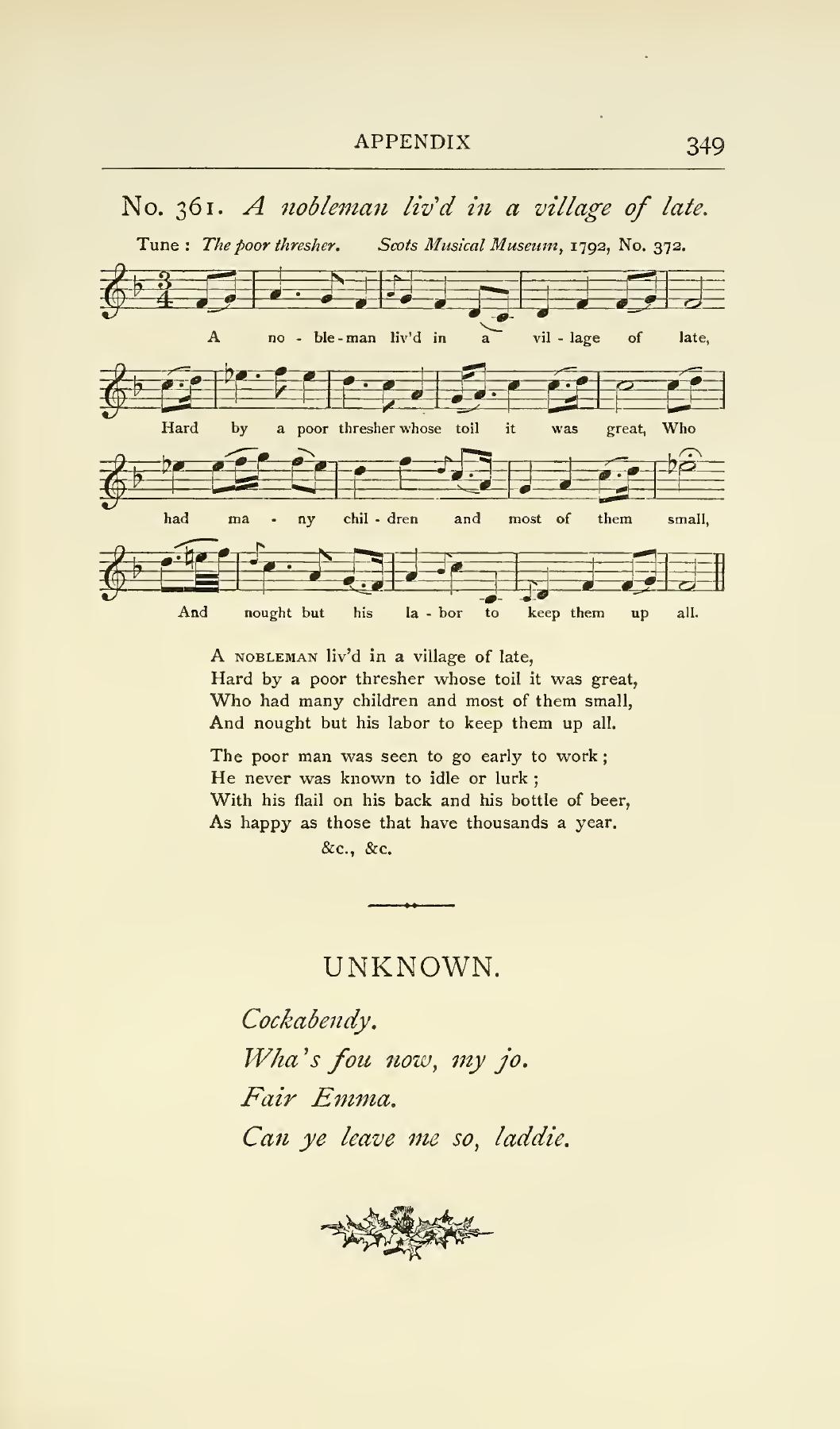 View score Dick’s Songs of Robert Burns (1903)
Lyrics
Choose an edition
Dick (1903) · no. 361
A nobleman liv'd in a village of late.
A nobleman liv'd in a village of late,
Hard by a poor thresher whose toil it was great,
Who had many children and most of them small,
And nought but his labor to keep them up all.

The poor man was seen to go early to work;
He never was known to idle or lurk;
With his flail on his back and his bottle of beer,
As happy as those that have thousands a year.
Complete two-stanza excerpt printed in Dick’s 1903 edition.
View the source edition · A nobleman liv'd in a village of late.
About this edition
Complete two-stanza excerpt printed in Dick’s 1903 edition.
Scots Musical Museum, vol. IV (1792) · no. 372
View the source edition · Volume 4, no. 372; pp. 384–385
Music
View historical scores
Dick’s Songs of Robert Burns (1903)
A nobleman liv'd in a village of late.