It’s whisper’d in parlour
Behind the song
A whisper passes through the house, and a flowering landscape becomes a place of dread. ‘It’s whisper’d in parlour’ preserves three stanzas of a ballad about Lady Marget and her brother. The bright recurring line about broom in bloom sits beside an accusation of incest and, after a break, an instruction to shoot at the sound of a cry.[1]
Read the fuller story
The first stanza spreads news of Marget's pregnancy through parlour and hall. In the second, one woman whispers to another that Sir Richard, Marget's brother, is the father. The news reaches the reader as household speech. Repetition makes the secret feel increasingly public, while each stanza returns to the warning that she dare not go down to the broom again.[1]
A row of asterisks separates that exchange from the last stanza. Its speaker asks an unnamed listener to bend a bow and let arrows fly on hearing a loud cry. The refrain changes into the first person: ‘I dare na’. The surviving words bring fear into the voice of someone within the story, but the missing passage leaves the immediate situation broken. Another row of asterisks closes the extract.[1]
James C. Dick places the fragment in the Museum of 1796, no. 461, and cites Stenhouse for Burns having recovered the words with their air. Dick says that the original manuscript was lost. He connects this short text with the longer ballad known as ‘Sheath and Knife’, and reports a version in Motherwell in which the brother kills his sister and buries her with her child. That is the fuller narrative described in his note; the displayed fragment stops before such an ending.[2]
The tune is headed ‘The broom blooms bonie’ and marked Slow. Its refrain praises the flowering broom while the closing line makes return to that place impossible. ‘Bonie’ means beautiful and ‘ha’’ means hall. The song's few surviving stanzas let beauty, circulating rumour and threatened violence occupy the same repeated musical space.[1]
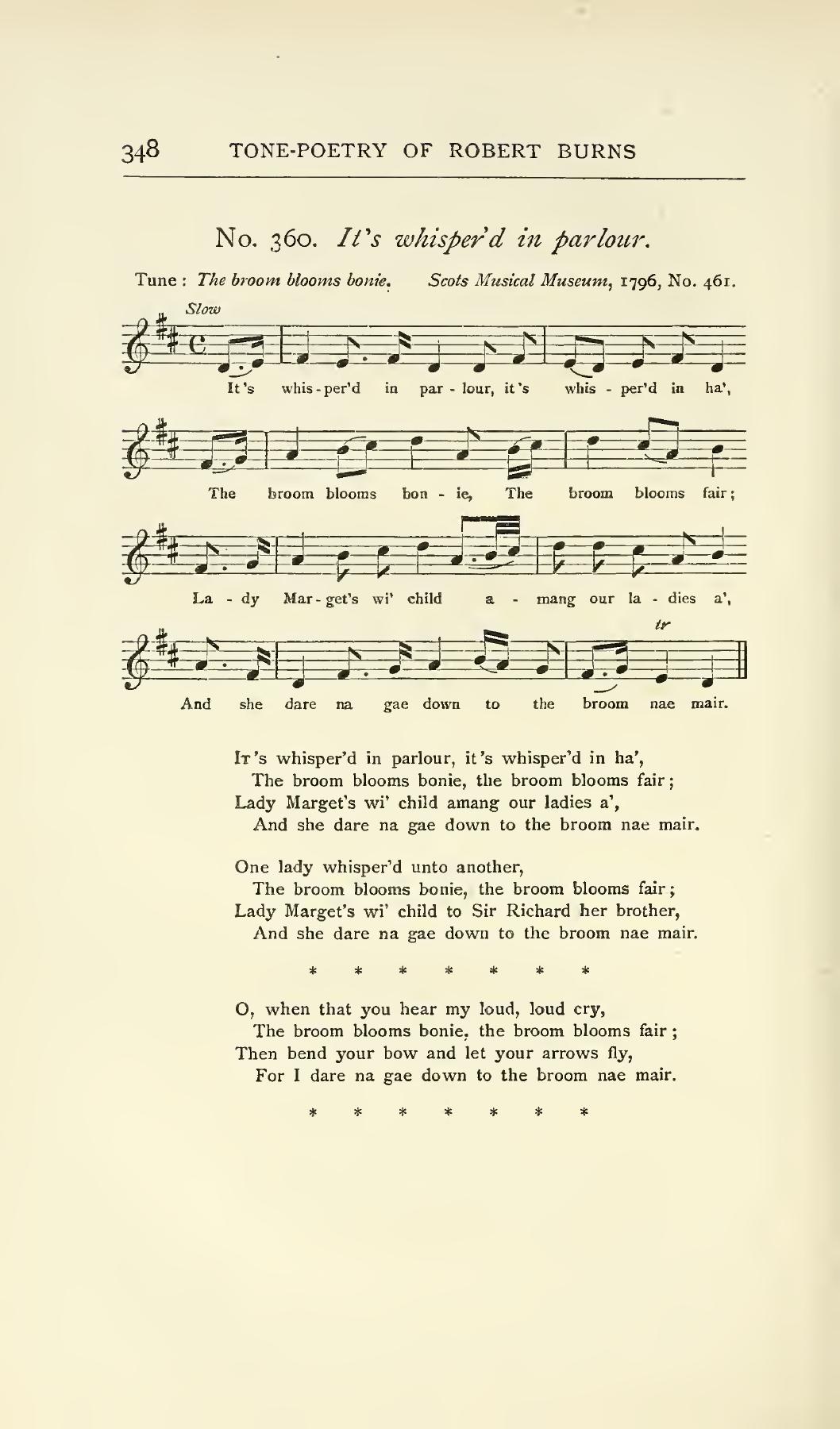 View score Dick’s Songs of Robert Burns (1903)
Lyrics
Dick (1903) · no. 360
It's whisper'd in parlour.
It's whisper'd in parlour, it's whisper'd in ha',
The broom blooms bonie, the broom blooms fair;
Lady Marget's wi' child amang our ladies a',
And she dare na gae down to the broom nae mair.

One lady whisper'd unto another,
The broom blooms bonie, the broom blooms fair;
Lady Marget's wi' child to Sir Richard her brother,
And she dare na gae down to the broom nae mair.

O, when that you hear my loud, loud cry,
The broom blooms bonie, the broom blooms fair;
Then bend your bow and let your arrows fly,
For I dare na gae down to the broom nae mair.
Fragment from Dick’s 1903 edition.
View the source edition · It's whisper'd in parlour.
About this edition
Complete numbered fragment from Dick’s 1903 edition.
Scots Musical Museum, vol. V (catalogued 1796) · no. 461
View the source edition · Volume 5, no. 461; p. 474
Music
View historical scores
Dick’s Songs of Robert Burns (1903)
It's whisper'd in parlour.