She sat down below a thorn
Behind the song
Flowers and green leaves keep returning through a story of a child's death. In ‘She sat down below a thorn’, the natural refrain accompanies birth, killing and burial without changing its words. That steady beauty makes the mother's actions more disturbing, and gives the child's final reply a terrible clarity.[1]
Read the fuller story
The opening places the birth beneath a thorn. The mother addresses the smiling baby with tenderness and alarm, saying that its sweetness will smile her dead. The next stanza moves abruptly to the killing. A grave dug by moonlight follows. Each brief step is interrupted by the same two refrain lines, so that the narrative advances through repeated pauses rather than a continuous explanation.[1]
On her way to church, the woman sees a child in the porch and offers to clothe it in fine silk if it were hers. The answer calls her mother and reminds her how little kindness she showed when it was in her care. Recognition comes through that accusation. The final voice gives the dead child the power to answer the care promised too late.[1]
‘Twinn’d’ means deprived or parted from, and ‘howket’ means dug. These compact Scots verbs give the violence and burial a directness which the repeated flowers cannot soften. The seven printed quatrains end with a row of asterisks: this is the end of the selected fragment. Its tune, ‘Fine flowers in the valley’, is marked Very slow, allowing the refrain to linger between the actions.[1]
James C. Dick records the fragment in the Museum of 1792, no. 320. He cites Stenhouse as his authority for Burns having transmitted both words and air to Johnson, and says that no manuscript was known. Dick places it among related versions later called ‘Lady Anne’ and ‘The Cruel Mother’, while leaving the origin of particular descriptive touches uncertain. Dick’s account presents Burns as transmitting a fragment of that ballad tradition.[2]
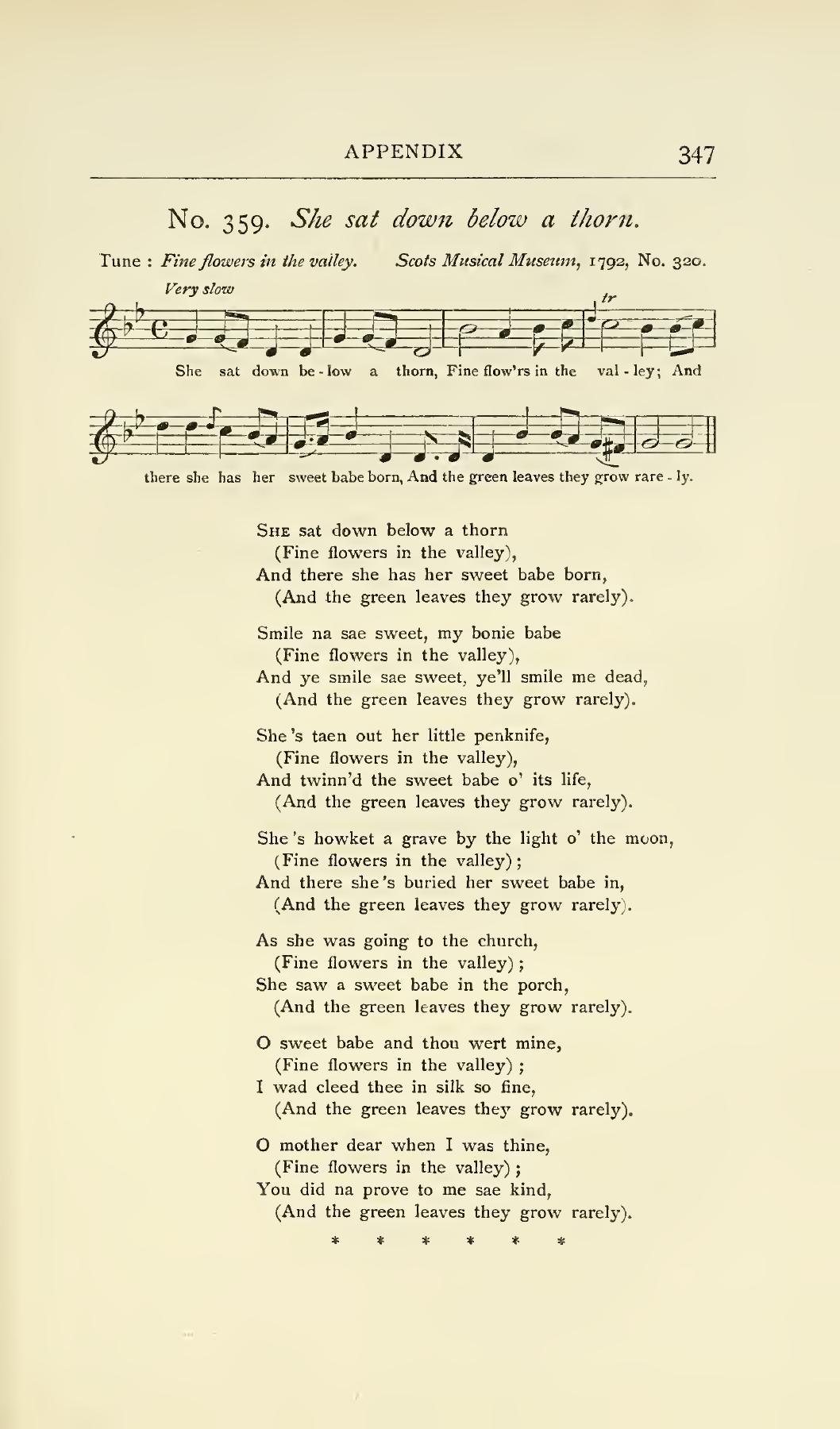 View score Dick’s Songs of Robert Burns (1903)
Lyrics
Choose an edition
Dick (1903) · no. 359
She sat down below a thorn.
She sat down below a thorn
(Fine flowers in the valley),
And there she has her sweet babe born,
(And the green leaves they grow rarely).

Smile na sae sweet, my bonie babe
(Fine flowers in the valley),
And ye smile sae sweet, ye'll smile me dead,
(And the green leaves they grow rarely).

She's taen out her little penknife,
(Fine flowers in the valley),
And twinn'd the sweet babe o' its life,
(And the green leaves they grow rarely).

She's howket a grave by the light o' the moon,
(Fine flowers in the valley);
And there she's buried her sweet babe in,
(And the green leaves they grow rarely).

As she was going to the church,
(Fine flowers in the valley);
She saw a sweet babe in the porch,
(And the green leaves they grow rarely).

O sweet babe and thou wert mine,
(Fine flowers in the valley);
I wad cleed thee in silk so fine,
(And the green leaves they grow rarely).

O mother dear, when I was thine,
(Fine flowers in the valley);
You did na prove to me sae kind,
(And the green leaves they grow rarely).
Fragment from Dick’s 1903 edition.
View the source edition · She sat down below a thorn.
About this edition
Complete numbered fragment from Dick’s 1903 edition.
Scots Musical Museum, vol. IV (1792) · no. 320
View the source edition · Volume 4, no. 320; p. 331
Music
View historical scores
Dick’s Songs of Robert Burns (1903)
She sat down below a thorn.