The auld man’s mare’s dead
Behind the song
The dead mare in this song receives a noisy, unsentimental obituary. ‘The auld man’s mare’s dead’ piles bodily defects and ailments upon a chorus that keeps announcing the loss. Then the animal seems to speak for herself, remembering a master who drank while giving her nothing. The joke gathers force from the demands still being made upon an exhausted working creature.[1]
Read the fuller story
The opening chorus places the death a mile above Dundee. Its repeated announcement leads into a string of sharply joined descriptions: ears, lips, belly, feet, jaws and neck are crowded into three lines before the blunt conclusion that the brute died. The following stanza adds another catalogue of complaints. Their packed sounds and accumulating stresses give the mare a presence far larger than a sober list could provide.[1]
The change to ‘My master’ gives the last stanza a different voice. Taken into town and tied to a stanchion, the speaker watches the master take a drink for himself and give her not a drop. The final chorus changes its wording to mention peats and turfs still to be carried. That practical burden makes the repeated surprise at her death sound absurd: work is waiting even after the worker has died.[1]
‘Auld’ is old and ‘aboon’ is above; ‘fient a drap’ is an emphatic not a drop. The song's Scots also makes room for a dense vocabulary of animal condition. The chorus is printed before and after the three stanzas, with different words at the close. In the score, a return instruction takes the singer back to the opening refrain.[1]
James C. Dick credits Burns with rewriting the second stanza and verbally altering the rest. He cites a letter to Johnson from about March 1795 directing him to an air in Aird and words in the Scots Nightingale; the song appeared in the Museum in 1796 as no. 485. Dick also records conflicting older author attributions, to Pate Birnie and to Mr Watt, and suggests that they concern different songs. This is a revised traditional piece whose earlier identity remains unsettled in his account.[2]
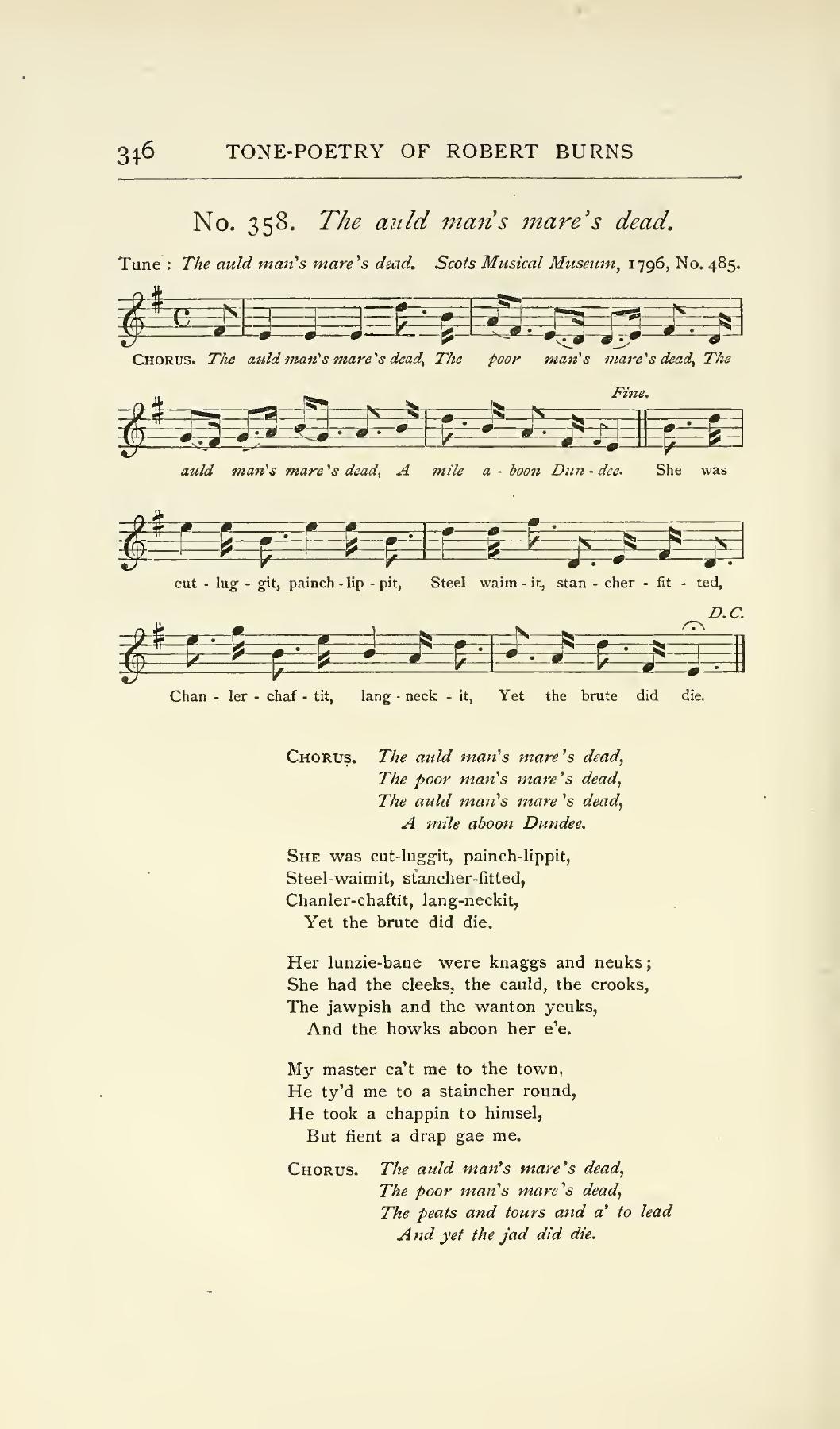 View score Dick’s Songs of Robert Burns (1903)
Lyrics
Dick (1903) · no. 358
The auld man's mare's dead.
CHORUS
The auld man's mare's dead,
The poor man's mare's dead,
The auld man's mare's dead,
A mile aboon Dundee.

She was cut-luggit, painch-lippit,
Steel-waimit, stancher-fitted,
Chanler-chaftit, lang-neckit,
Yet the brute did die.

Her lunzie-bane were knaggs and neuks;
She had the cleeks, the cauld, the crooks,
The jawpish and the wanton yeuks,
And the howks aboon her e'e.

My master ca't me to the town,
He ty'd me to a staincher round,
He took a chapin to himsel,
But fient a drap gae me.
CHORUS
The auld man's mare's dead,
The poor man's mare's dead,
The peats and tours and a' to lead
And yet the jad did die.
View the source edition · The auld man's mare's dead.
Scots Musical Museum, vol. V (catalogued 1796) · no. 485
View the source edition · Volume 5, no. 485; p. 500
Music
View historical scores
Dick’s Songs of Robert Burns (1903)
The auld man's mare's dead.