Near Edinburgh was a young son born
Behind the song
Young Hynhorn knows from the change in his ring that it is time to return. Banished from court and facing the loss of his sweetheart, he exchanges his horse for a beggar’s clothes. At the king’s gate he slips the ring into a wine cup for Jean. She asks where he got it. From your own hand, he says. [1]
Read the fuller story
Hynhorn serves the king for seven years for the sake of his daughter Jean. The angry king sends him to sea. Jean gives him a ring and tells him that its becoming pale will signify her love for another man. When that change comes, he leaves the sea and learns from an old beggar that Jean is about to marry. The ring makes distant danger visible before he hears the news.[1]
He offers his grey horse for the beggar's clothes. After a printed gap, he reaches the king's gate, asks for wine in Hynhorn's name, drinks it and places the ring in the vessel to be carried to Jean. Her questions test whether the bearer found it by sea or land, or took it from a dead man's hand. His answer identifies the giver: he received it from her own hand.[1]
Jean offers to abandon her bridal gown and follow him from town to town. The answering promise turns wandering into possession: he will make her lady of many towns. Her willingness to follow comes before that assurance of wealth. ‘Yett’ means gate and ‘weed’ means clothing; the change into beggar's dress gives the returning lover a way into the household without announcing his rank.[1]
The page preserves five breaks in the narrative, an explicitly bracketed line about the ring's diamonds, and abbreviated repetitions of the refrain. James C. Dick places the fragment among old pieces Burns sent to William Tytler, and dates this transmission to 1787. He says he reprints these fragments through Cromek because the originals sent to Tytler were missing. Burns's contribution here is transmission; Dick leaves open whether he added words.[1][2]
Dick connects Hynhorn with the medieval story of King Horn, outlining a longer romance with different names and fuller adventures. That comparison shows how much a short sung version can concentrate around the ring and disguise. The melody printed above the fragment comes, Dick says, from Motherwell's Minstrelsy of 1827, where it was described as traditional. This setting therefore brings the transmitted words together with a separately recorded air.[2]
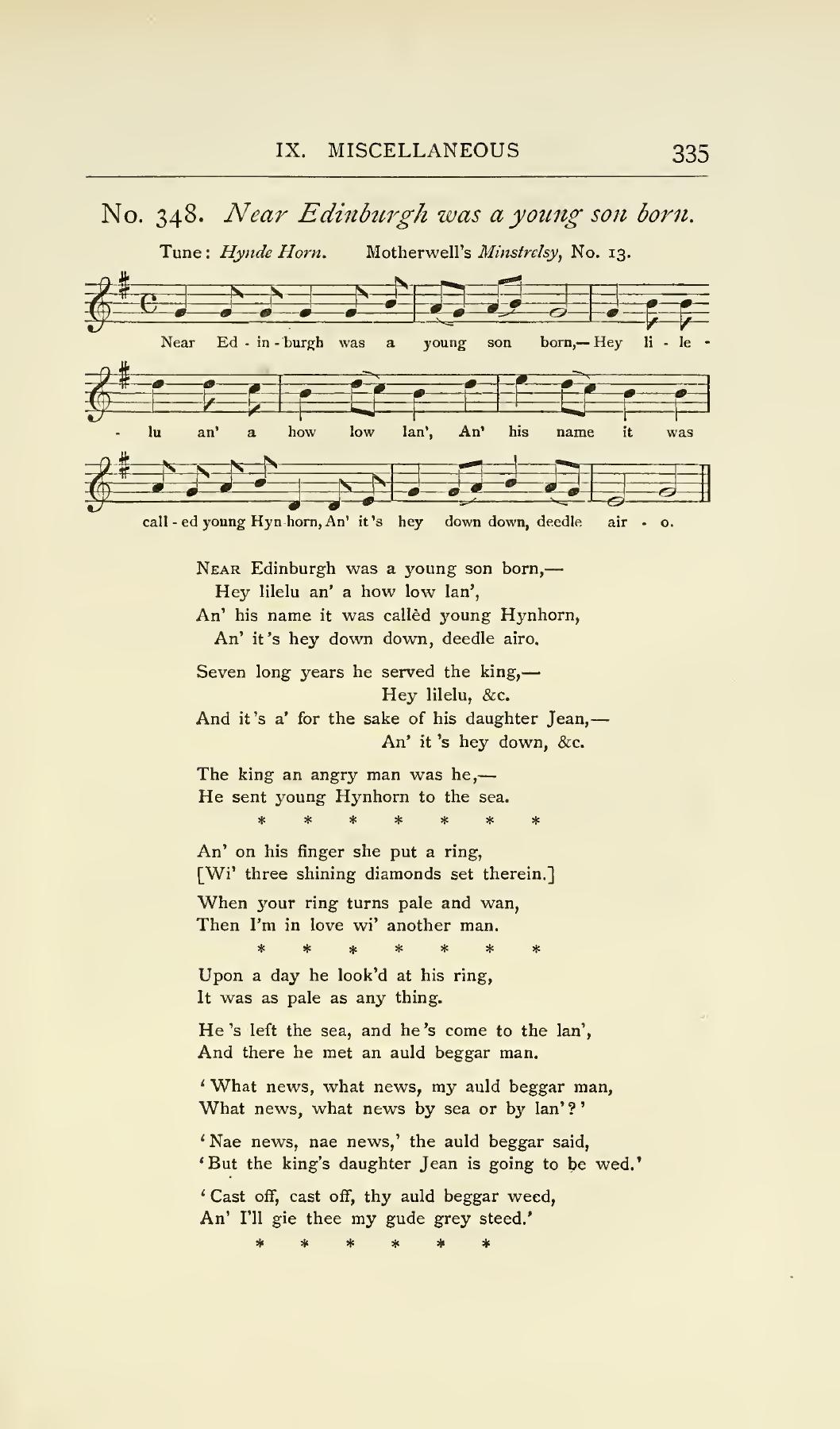 View score Dick’s Songs of Robert Burns (1903)
Lyrics
Dick (1903) · no. 348
Near Edinburgh was a young son born.
Near Edinburgh was a young son born,—
Hey lilelu an' a how low lan',
An' his name it was callèd young Hynhorn,
An' it's hey down down, deedle airo.

Seven long years he served the king,—
Hey lilelu, &c.
And it's a' for the sake of his daughter Jean,—
An' it's hey down, &c.

The king an angry man was he,—
He sent young Hynhorn to the sea.

An' on his finger she put a ring,
[Wi' three shining diamonds set therein.]

When your ring turns pale and wan,
Then I'm in love wi' another man.

Upon a day he look'd at his ring,
It was as pale as any thing.

He's left the sea, and he's come to the lan',
And there he met an auld beggar man.

'What news, what news, my auld beggar man,
What news, what news by sea or by lan'?'

'Nae news, nae news,' the auld beggar said,
'But the king's daughter Jean is going to be wed.'

'Cast off, cast off, thy auld beggar weed,
An' I'll gie thee my gude grey steed.'

When he cam to our gude king's yett,
He sought a glass o' wine for young Hynhorn's sake.

He drank out the wine and he put in the ring,
And he bade them carry't to the king's dochter Jean.

'O gat ye't by sea, or gat ye't by lan',
O gat ye't aff a dead man's han'?

'I gat na't by sea, I gat na't by lan',
But I gat it out of your own fair han'.'

'Go, take away my bridal gown,
And I'll follow him frae town to town.'

'Ye need na leave your bridal gown,
For I'll make ye ladie o' mony a town.'
Fragment from Dick’s 1903 edition.
View the source edition · Near Edinburgh was a young son born.
About this edition
Complete printed fragment from Dick’s 1903 edition.
Music
View historical scores
Dick’s Songs of Robert Burns (1903)
Near Edinburgh was a young son born.