O, for my ain king, quo’ gude Wallace
Behind the song
Wallace enters an inn where fifteen Englishmen are looking for him. They take him for an old, crooked man and offer him money to reveal his own whereabouts. The encounter turns a hunt for the Scottish hero into a trap for his hunters. In this ballad, courage, disguise and sudden violence carry Wallace through successive dangers towards a meal with his companions at Lochmaben.[1]
Read the fuller story
The story begins with loyalty to Scotland’s rightful king and an ominous sense of trouble. A woman washing at a well tells Wallace where his enemies are waiting. He goes to meet them despite having no money, and the captain’s contempt allows the disguised hero to answer with an assertion of Scottish birth. The audience knows what the captain misses. His offer of fifteen shillings sharpens the irony just before Wallace strikes him and kills the others at the table.[1]
Hunger gives the violence an earthy counterpoint. Wallace demands dinner because almost three days have passed since he tasted meat; before it is ready, another fifteen Englishmen arrive. This time the innkeeper’s husband stands beside him. Ten enemies fall at the door and the remaining five flee to the greenwood, where Wallace hangs them. The next day’s dinner in Lochmaben closes the tale with the hero restored to his ‘merry men’. The extraordinary numbers magnify Wallace’s strength and survival in the legend.[1]
Several Scots words carry the action briskly. An ‘auld crookit carl’ is an old, bent man; the ‘yett’ is the gate, and a ‘grain’ here is a branch. The verb ‘lippen’ expresses Wallace’s trust in God even while he calls himself unworthy. That brief religious appeal comes between the new threat and the innkeeper’s support, adding dependence and fellowship to a story otherwise dominated by exceptional personal force.[1]
James C. Dick’s 1903 edition presents this as a transmitted ballad associated with Burns. His note says that he used a Burns holograph in the British Museum and compared it with the Scots Musical Museum of 1796, no. 484. Dick traces the incidents through an Edinburgh chapbook of about 1745 to Henry the Minstrel’s Wallace, and surveys other ballad versions. These are Dick’s source identifications; his account itself stresses the marvellous and mythical character of the incidents. The song offers a vivid form of Wallace legend rather than a secure reconstruction of his movements.[2]
The setting, named ‘Gude Wallace’ and marked ‘Slowish’, gives the first stanza’s four lines a single melodic span. Dick distinguishes this tune from two other airs called Wallace’s March and Wallace’s Lament. The shared hero’s name therefore does not establish a shared melody. Two lines in the sixth stanza are printed in square brackets, a visible editorial feature retained in this text.[1][2]
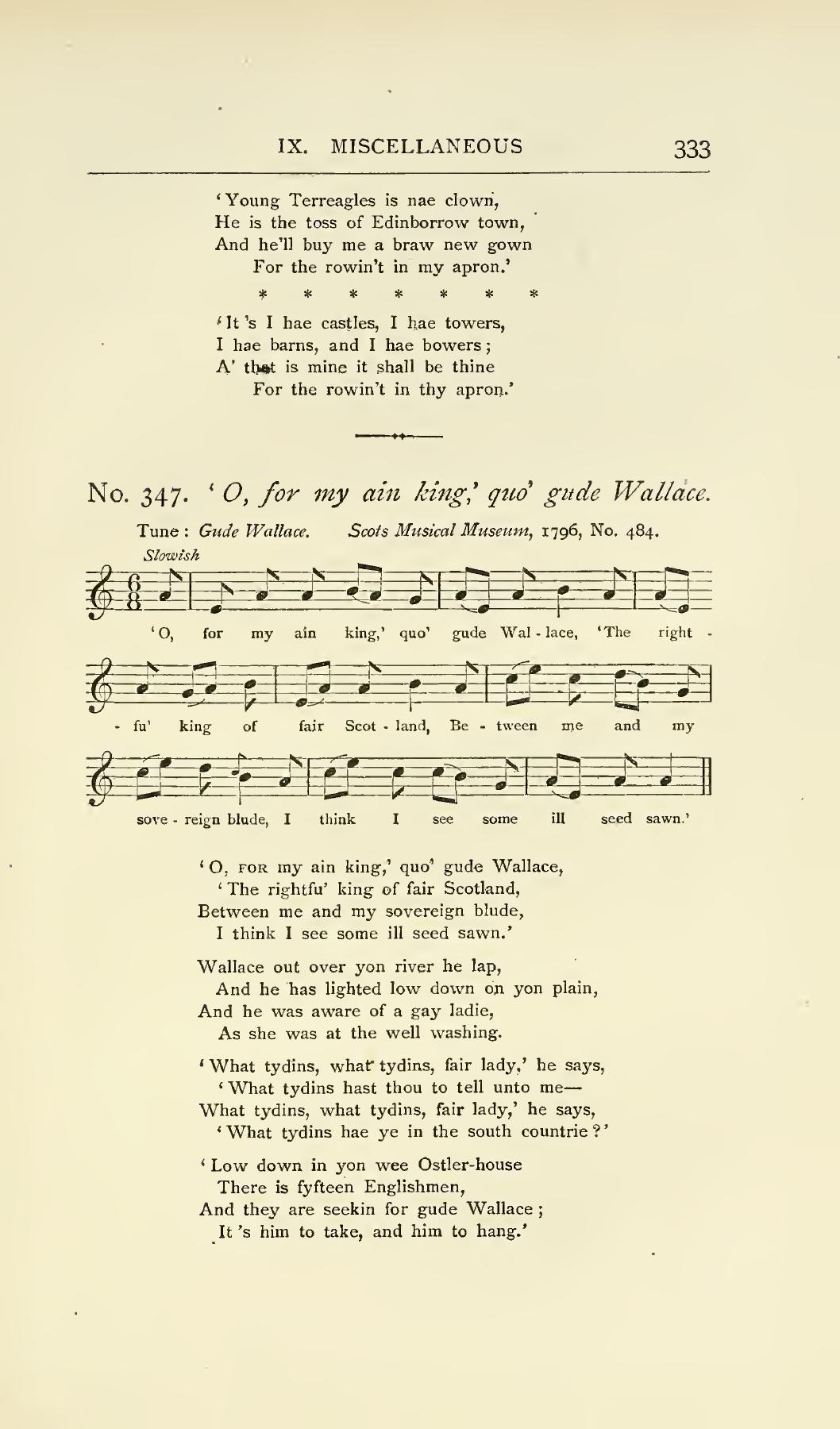 View score Dick’s Songs of Robert Burns (1903)
Lyrics
Dick (1903) · no. 347
'O, for my ain king,' quo' gude Wallace.
'O, for my ain king,' quo' gude Wallace,
'The rightfu' king of fair Scotland,
Between me and my sovereign blude,
I think I see some ill seed sawn.'

Wallace out over yon river he lap,
And he has lighted low down on yon plain,
And he was aware of a gay ladie,
As she was at the well washing.

'What tydins, what tydins, fair lady,' he says,
'What tydins hast thou to tell unto me—
What tydins, what tydins, fair lady,' he says,
'What tydins hae ye in the south countrie?'

'Low down in yon wee Ostler-house
There is fyfteen Englishmen,
And they are seekin for gude Wallace;
It's him to take, and him to hang.'

'There's nocht in my purse,' quo' gude Wallace,
'There's nocht, not even a bare pennie;
But I will down to yon wee Ostler-house
Thir fyfteen Englishmen to see.'

And when he cam to yon wee Ostler-house
He bad benedicite be there;
[The Englishmen at the table sat
The wine-fac'd captain at him did stare.]

'Where was ye born, auld crookit carl,
Where was ye born—in what countrie?'
'I am a true Scot born and bred,
And an auld crookit carl just sic as ye see.'

'I wad gie fyfteen shillings to onie crookit carl—
To onie crookit carl just sic as ye,
If ye will get me gude Wallace,
For he is the man I wad very fain see.'

He hit the proud captain alang the chaft blade,
That never a bit o' meal he ate mair;
And he sticket the rest at the table where they sat,
And he left them a' lyin sprawlin there.

'Get up, get up, gudewife,' he says,
'And get to me some dinner in haste;
For it will soon be three lang days
Sin I a bit o' meat did taste.'

The dinner was na weel readie,
Nor was it on the table set,
Till other fyfteen Englishmen
Were a' lighted about the yett.

'Come out, come out, now gude Wallace
This is the day that thou maun die;'
'I lippen nae sae little to God,' he says,
'Altho' I be but ill wordie.'

The gudewife had an auld gudeman,
By gude Wallace he stiffly stood;
Till ten o' the fyfteen Englishmen
Before the door lay in their blude.

The other five to the greenwood ran,
And he hang'd these five upon a grain;
And on the morn wi' his merry men a'
He sat at dine in Lochmaben town.
View the source edition · 'O, for my ain king,' quo' gude Wallace.
Scots Musical Museum, vol. V (catalogued 1796) · no. 484
View the source edition · Volume 5, no. 484; pp. 498–499
Music
View historical scores
Dick’s Songs of Robert Burns (1903)
'O, for my ain king,' quo' gude Wallace.