Our young lady’s a huntin’ gane
Behind the song
A fine apron becomes a baby's first covering in ‘Our young lady’s a huntin’ gane’. The young woman returns from her outing with a child, and the repeated image of the bundle in her apron carries the ballad from childbirth to a confrontation over family standing. Care for the baby comes before the questions about its father.[1]
Read the fuller story
The opening says that she has taken neither sheets nor blankets. Her richly trimmed apron must serve instead. Two successive stanzas dwell on its fine cloth and lace, each ending with the child wrapped inside it. ‘Row’d’ means wrapped, while ‘tyne’ means lose: the costly garment matters less to her than protecting the baby. Repetition makes that practical act the centre of the scene.[1]
Her father hears a child crying while he is in the hall among knights and nobles. She acknowledges the birth directly, hopes that it will do him no harm, and declares her confidence that the man she loves will love her in return. Her father's question turns immediately to rank: is the man a gentleman or a clown? Here ‘clown’ sets a man of low standing against a gentleman.[1]
She names young Terreagles, praises his standing in Edinburgh and anticipates a fine new gown. After a marked gap, the final voice offers castles, towers, barns and bowers, promising everything to the woman and child. The fragment moves towards material security, but its two printed breaks interrupt the exchanges. The surviving eight quatrains give the apron a stronger continuity than the missing portions of the story.[1]
James C. Dick prints the fragment from a Burns manuscript compared with the Scots Musical Museum, where it appeared in 1796 as no. 424. He connects the ballad's noble family with the Maxwells of Terregles, near the meeting of the Nith and Cluden.[2]
The tune is headed ‘The rowin’t in her apron’ and marked Slow. Dick quotes Stenhouse's claim that Burns recovered the ancient fragment and its original air, but disputes the musical part: he points to the melody in Patrick McDonald's Airs of 1784. In Dick's account, the melody was already in print before the fragment appeared in the Museum. The slow setting carries the repeated image of the child held close.[1][2]
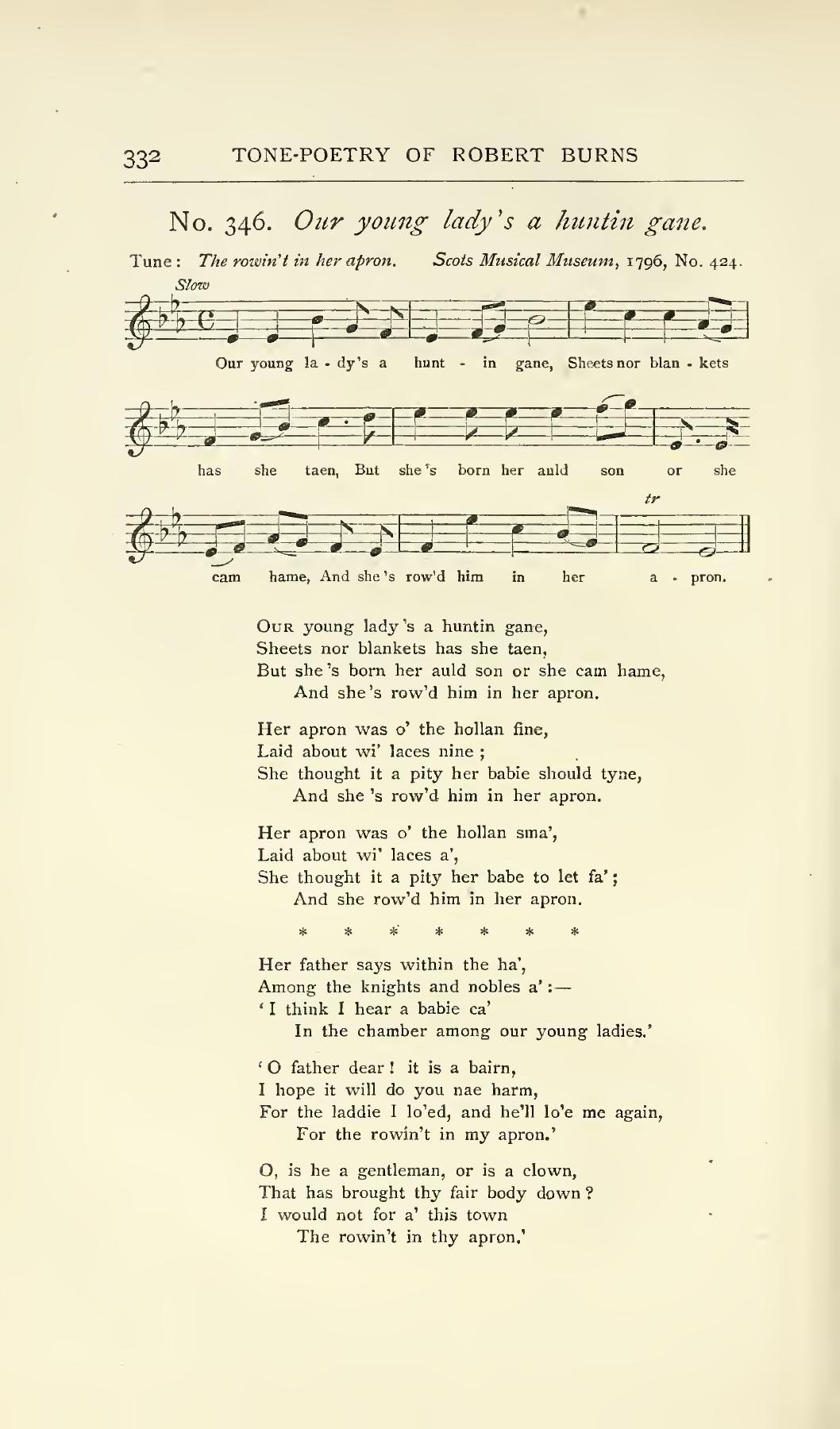 View score Dick’s Songs of Robert Burns (1903)
Lyrics
Version notes
| Dick (1903) · no. 346 | Scots Musical Museum, vol. V (catalogued 1796) · no. 424 |
|---|---|
| Young Terreagles is nae clown | Young Terreagles has nae clown |
Dick (1903) · no. 346
Our young lady's a huntin gane.
Our young lady's a huntin gane,
Sheets nor blankets has she taen,
But she's born her auld son or she cam hame,
And she's row'd him in her apron.

Her apron was o' the hollan fine,
Laid about wi' laces nine;
She thought it a pity her babie should tyne,
And she's row'd him in her apron.

Her apron was o' the hollan sma',
Laid about wi' laces a',
She thought it a pity her babe to let fa';
And she row'd him in her apron.

Her father says within the ha',
Among the knights and nobles a':—
'I think I hear a babie ca'
In the chamber among our young ladies.'

'O father dear! it is a bairn,
I hope it will do you nae harm,
For the laddie I lo'ed, and he'll lo'e me again,
For the rowin't in my apron.'

O, is he a gentleman, or is a clown,
That has brought thy fair body down?
I would not for a' this town
The rowin't in thy apron.'

'Young Terreagles is nae clown,
He is the toss of Edinborrow town,
And he'll buy me a braw new gown
For the rowin't in my apron.'

'It's I hae castles, I hae towers,
I hae barns, and I hae bowers;
A' that is mine it shall be thine
For the rowin't in thy apron.'
Fragment from Dick’s 1903 edition.
View the source edition · Our young lady's a huntin gane.
About this edition
Complete printed fragment from Dick’s 1903 edition.
Scots Musical Museum, vol. V (catalogued 1796) · no. 424
View the source edition · Volume 5, no. 424; p. 437
Music
View historical scores
Dick’s Songs of Robert Burns (1903)
Our young lady's a huntin gane.