Aften hae I play’d at the cards and the dice
Behind the song
A young mother sits in her father's kitchen corner, abandoned by the people who once served her. ‘Aften hae I play’d at the cards and the dice’ turns that isolation into a spectacular promise of rescue. The man she calls her ‘rantin laddie’ proves to be an earl, and the letter she longs to send brings five hundred mounted men into motion.[1]
Read the fuller story
Her opening memory of cards and dice gives way to nursing her child. Father, mother, friends and servants each fail her in a different phrase. ‘Lightlied’ means treated with contempt; ‘balou’ is to lull a baby. The repeated neglect makes her wish for a messenger painfully modest. She asks for one servant, remembering a time when many were at her command.[1]
The question about her lover tests his social position: is he a laird, a lord, or merely a cadie? She answers that he is the Earl of Aboyne. A messenger is then promised. The change exposes how readily access to help follows the disclosure of rank. Her feelings have remained constant while other people's response changes.[1]
Aboyne first smiles at the letter, then grows sorrowful before reading three lines. His question is who has dared to treat his lassie so cruelly. The story repeats the catalogue of her family's rejection before he orders five hundred men, each with a milk-white horse, to bring home his lady. The last surviving stanza pictures their claymores shining as they pass through Buchan. The printed fragment ends with their approach.[1]
James C. Dick records the song in the Museum of 1796, no. 462, and identifies a Burns manuscript. He reports Stenhouse's statement that Burns sent the tune with the words. Scott-Douglas's suggestion that Burns collected it during his Highland tour with Nicol remains a conjecture. Dick also discusses a proposed historical Aboyne, while leaving the child's mother's identity unresolved.[2]
Two bracketed lines in the eighth stanza come from The Thistle of 1823, supplied by Dick to fill a gap. They form part of this printed version's declaration of rescue, rather than an unqualified surviving Burns text. The tune is headed ‘The rantin laddie’ and marked Slow; its measured presentation gives room to the woman's complaint before the ballad opens into its final armed procession.[1][2]
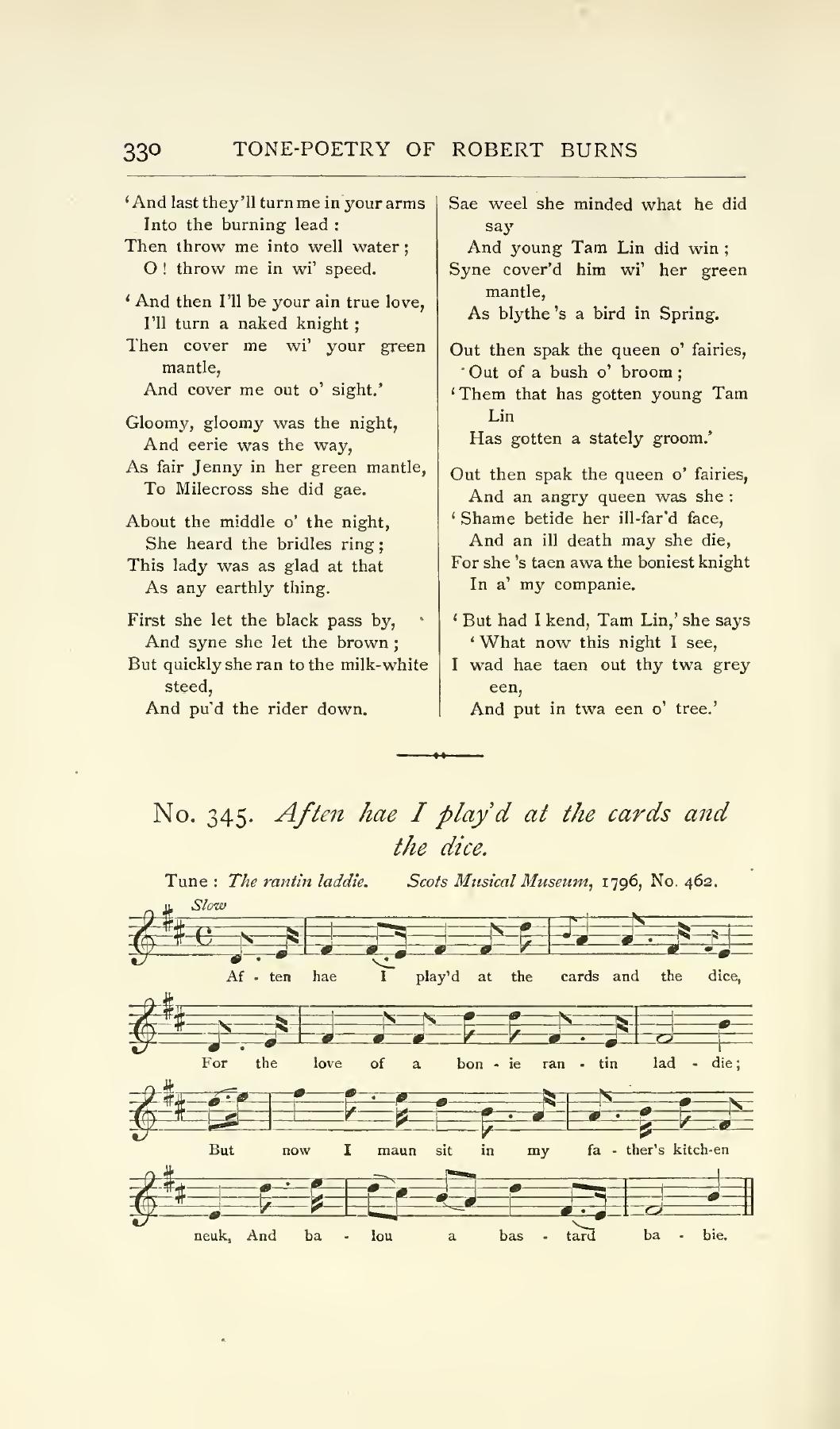 View score Dick’s Songs of Robert Burns (1903)
Lyrics
Dick (1903) · no. 345
Aften hae I play'd at the cards and the dice.
Aften hae I play'd at the cards and the dice,
For the love of a bonie rantin laddie;
But now I maun sit in my father's kitchen neuk,
And balou a bastard babie.

For my father he will not me own,
And my mother she neglects me,
And a' my friends hae lightlied me,
And their servants they do slight me.

But had I a servant at my command—
As aft times I've had many,
That wad rin wi' a letter to bonie Glenswood—
Wi' a letter to my rantin laddie.

'Oh, is he either a laird or a lord,
Or is he but a cadie,
That ye do him ca' sae aften by name,
Your bonie, bonie rantin laddie.'

'Indeed he is baith a laird and a lord,
And he never was a cadie,
For he is the Earl o' bonie Aboyne,
And he is my rantin laddie.'

'O ye'se get a servant at your command,
As aft times ye've had many,
That sall rin wi' a letter to bonie Glenswood—
A letter to your rantin laddie.'

When Lord Aboyne did the letter get,
O, but he blinket bonie;
But or he had read three lines of it,
I think his heart was sorry.

'O, wha is he daur be sae bauld,
Sae cruelly to use my lassie?'
[But I'll tak her to bonie Aboyne
Where oft she did caress me.]

'For her father he will not her know,
And her mother she does slight her;
And a' her friends hae lightlied her,
And their servants they neglect her.'

'Go raise to me my five hundred men,
Make haste and make them ready;
With a milkwhite steed under every ane
For to bring hame my lady.'

As they came in through Buchan-shire,
They were a company bonie,
With a gude claymore in every hand
And O, but they shin'd bonie.
Fragment from Dick’s 1903 edition.
View the source edition · Aften hae I play'd at the cards and the dice.
About this edition
Complete printed fragment from Dick’s 1903 edition.
Scots Musical Museum, vol. V (catalogued 1796) · no. 462
View the source edition · Volume 5, no. 462; pp. 474–475
Music
View historical scores
Dick’s Songs of Robert Burns (1903)
Aften hae I play'd at the cards and the dice.