O, I forbid you maidens a’
Behind the song
The warning is plain: maidens should keep away from Carterhaugh, where Tam Lin exacts a pledge from those who pass. Janet goes there anyway. She claims the place as her own, challenges the stranger’s authority and eventually undertakes a far more dangerous task: rescuing him from the Queen of Fairies. The ballad’s movement from forbidden ground to a Halloween rescue makes Janet’s determination its driving force.[1]
Read the fuller story
Her first answer to Tam Lin is about ownership. Her father has given her Carterhaugh, and she will come and go without asking his permission. The rose she plucks brings him into view beside the waiting horse. Repeated details make the place recognisable when she returns: her green clothing, the well, the steed and the flowers. The landscape becomes a meeting ground between ordinary human claims and fairy power.[1]
Back in her father’s hall, her pregnancy exposes her to scrutiny. Janet rejects the old knight’s attempt to implicate the household and refuses to name any lord there as the father. She accepts the blame herself, while declaring that she would not exchange her own love for any of them. The ballad gives her sharp speech as well as physical courage. Her father’s gentler question briefly changes the tone, but cannot settle the difficulty she faces.[1]
At the second encounter Tam Lin asks whether she is picking roses to end the pregnancy. Janet turns instead to the question of what he is. His answer restores a human history to the frightening figure at the well: he was an earthly knight who fell from his horse and was carried off by the fairy queen. Fairyland is pleasant, he says, but every seven years its people pay a “tiend”, or tithe, to hell. He fears that he will be the next payment. The apparent master of Carterhaugh is himself a captive.[1]
The rescue depends on precise attention. At midnight on Halloween, Janet must wait at Milescross, let the black and brown horses pass, and pull down the rider of the milk-white steed. He gives her further signs by which to know him. Then comes the harder instruction: she must hold him through terrifying changes of shape, including animals and burning metal, until water restores him to human form. The repeated command to hold fast joins love to endurance. She must recognise the person within forms designed to frighten her into letting go.[1]
The telling gives considerable space to these instructions, then compresses their fulfilment. Janet hears the bridles, chooses the right horse and remembers what Tam Lin told her. She wins him and covers him with her green mantle. The fairy queen supplies the final voice, furious at losing her finest knight and wishing she had replaced his eyes with wood. That threat leaves the old danger present even in defeat. Janet’s success has broken a powerful claim upon another person.[1]
Burns’s place in this story is that of a transmitter and contributor within a long ballad tradition. James C. Dick says he collated Burns’s manuscript with “Tam Lin” in the 1796 Scots Musical Museum, and quotes Stenhouse’s report that Burns supplied both ballad and air. Dick describes related material in Herd and the Glenriddell manuscripts, while admitting that he could not establish whether Burns gave the ballad to Robert Riddell or received it from him. He reports two stanzas beginning “Gloomy, gloomy was the night” as new in the Burns text when compared with Glenriddell’s copy. His account associates Burns with a substantial transmitted version whose earlier development remains partly uncertain.[2]
The setting is headed “Tam Lin” and marked “Andante”. Dick distinguishes this air from an earlier tune-name mentioned in the sixteenth-century Complaynt of Scotland, whose melody he says had not been identified. Words, tale and tune have overlapping histories, with different surviving evidence. In this selected version, the sustained narrative rests on recurring places, repeated actions and the commands Janet must remember. Its fullest expression of fidelity is practical: she goes to the appointed place and holds on.[1][2]
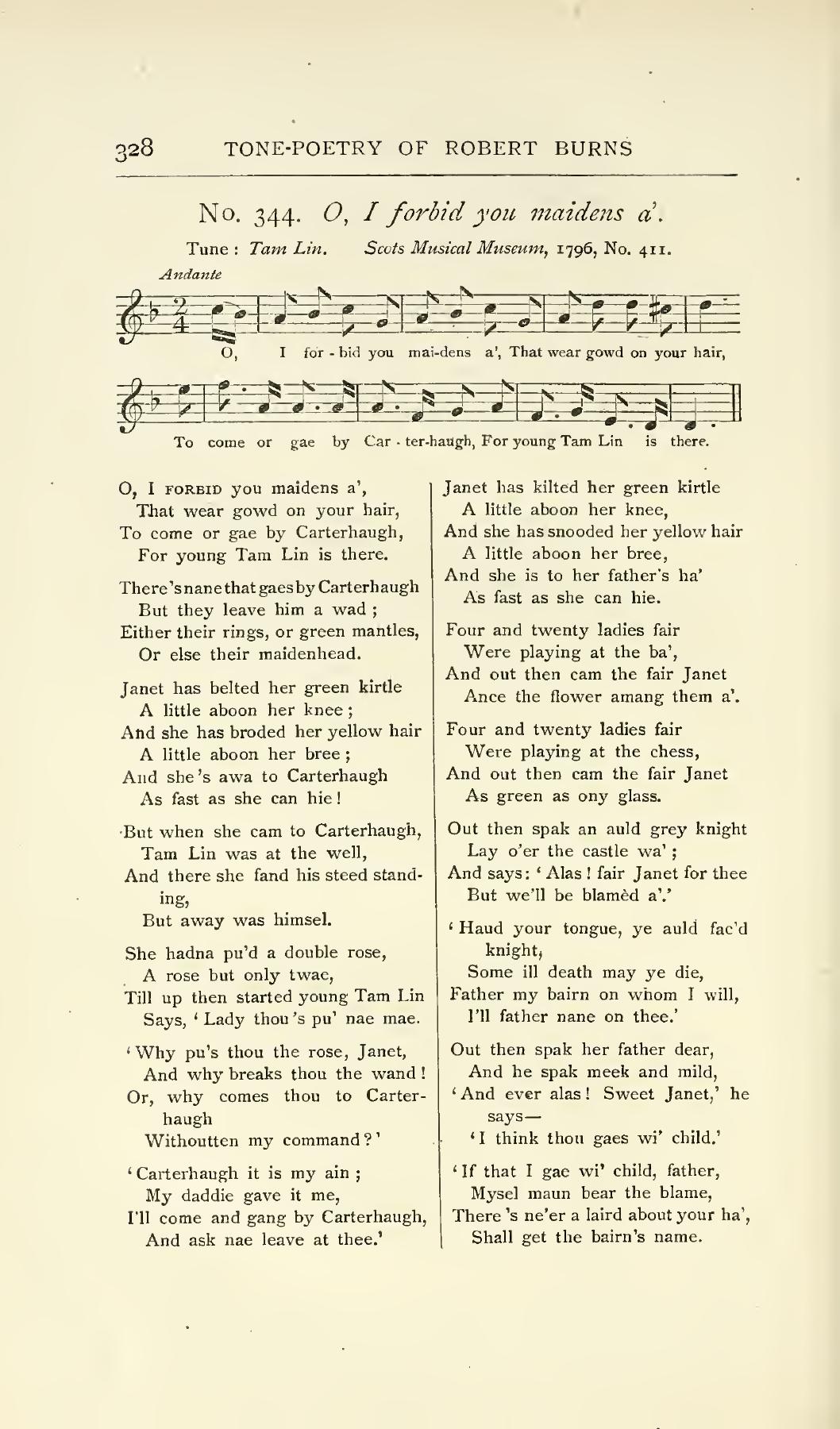 View score Dick’s Songs of Robert Burns (1903)
Lyrics
Version notes
| Dick (1903) · no. 344 | Scots Musical Museum, vol. V (catalogued 1796) · no. 411 |
|---|---|
| fair Janet / ony glass | fair Janet / onie glass |
Dick (1903) · no. 344
O, I forbid you maidens a'.
O, I forbid you maidens a',
That wear gowd on your hair,
To come or gae by Carterhaugh,
For young Tam Lin is there.

There's nane that gaes by Carterhaugh
But they leave him a wad;
Either their rings, or green mantles,
Or else their maidenhead.

Janet has belted her green kirtle
A little aboon her knee;
And she has broded her yellow hair
A little aboon her bree;
And she's awa to Carterhaugh
As fast as she can hie!

But when she cam to Carterhaugh,
Tam Lin was at the well,
And there she fand his steed standing,
But away was himsel.

She hadna pu'd a double rose,
A rose but only twae,
Till up then started young Tam Lin
Says, 'Lady thou's pu' nae mae.

'Why pu's thou the rose, Janet,
And why breaks thou the wand!
Or, why comes thou to Carterhaugh
Withoutten my command?'

'Carterhaugh it is my ain;
My daddie gave it me,
I'll come and gang by Carterhaugh,
And ask nae leave at thee.'

Janet has kilted her green kirtle
A little aboon her knee,
And she has snooded her yellow hair
A little aboon her bree,
And she is to her father's ha'
As fast as she can hie.

Four and twenty ladies fair
Were playing at the ba',
And out then cam the fair Janet
Ance the flower amang them a'.

Four and twenty ladies fair
Were playing at the chess,
And out then cam the fair Janet
As green as ony glass.

Out then spak an auld grey knight
Lay o'er the castle wa';
And says: 'Alas! fair Janet for thee
But we'll be blamed a'.'

'Haud your tongue, ye auld fac'd knight,
Some ill death may ye die,
Father my bairn on whom I will,
I'll father nane on thee.'

Out then spak her father dear,
And he spak meek and mild,
'And ever alas! Sweet Janet,' he says—
'I think thou gaes wi' child.'

'If that I gae wi' child, father,
Mysel maun bear the blame,
There's ne'er a laird about your ha',
Shall get the bairn's name.

'If my love were an earthly knight,
As he's an elfin gray,
I wadna gie my ain true-love
For nae lord that ye hae.

'The steed that my true-love rides on
Is lighter than the wind;
Wi' siller he is shod before,
Wi' burning gowd behind.'

Janet has kilted her green kirtle
A little aboon her knee;
And she has snooded her yellow hair
A little aboon her bree;
And she's awa to Carterhaugh
As fast as she can hie.

When she cam to Carterhaugh,
Tam Lin was at the well;
And there she fand his steed standing,
But away was himsel.

She hadna pu'd a double rose,
A rose but only twae;
Till up then started young Tam Lin
Says, 'Lady thou's pu' nae mae.

'Why pu's thou the rose, Janet,
Amang the groves sae green,
And a' to kill the bonie babe
That we gat us between?'

'O, tell me tell me, Tam Lin,' she says,
'For 's sake that died on tree,
If e'er ye was in holy chapel,
Or Christendom did see.'

'Roxbrugh he was my grandfather
Took me with him to bide,
And ance it fell upon a day,
That wae did me betide.

'And ance it fell upon a day,
A cauld day and a snell,
When we were frae the hunting come
That frae my horse I fell.

'The Queen o' Fairies she caught me
In yon green hill to dwell,
And pleasant is the fairy-land:—
But, an eerie tale to tell!

'Ay, at the end o' seven years
We pay a tiend to hell!
I am sae fair and fu' o' flesh
I'm fear'd it be mysel.

'But the night is Hallowe'en, lady,
The morn is Hallowday;
Then win me, win me, an ye will,
For weel I wat ye may.

'Just at the mirk and midnight hour
The fairy folk will ride;
And they that wad their true-love win
At Milecross they maun bide.'

'But how shall I thee ken, Tam Lin,
Or how my true-love know,
Amang sae mony unco knights
The like I never saw.'

'O first let pass the black, lady,
And syne let pass the brown;
But quickly run to the milk-white steed,
Pu' ye his rider down.

'For I'll ride on the milk-white steed,
And ay nearest the town,
Because I was an earthly knight
They gie me that renown.

'My right hand will be glov'd, lady,
My left hand will be bare,
Cockt up shall my bonnet be
And kaim'd down shall my hair;
And thae's the tokens I gie thee—
Nae doubt I will be there:

'They'll turn me in your arms, lady,
Into an esk and adder,
But hold me fast and fear me not—
I am your bairn's father.

'They'll turn me to a bear sae grim,
And then a lion bold;
But hold me fast and fear me not,
As ye shall love your child.

'Again they'll turn me in your arms
To a red het gaud of airn;
But hold me fast and fear me not,
I'll do to you nae harm.

'And last they'll turn me in your arms
Into the burning lead:
Then throw me into well water;
O! throw me in wi' speed.

'And then I'll be your ain true love,
I'll turn a naked knight;
Then cover me wi' your green mantle,
And cover me out o' sight.'

Gloomy, gloomy was the night,
And eerie was the way,
As fair Jenny in her green mantle,
To Milecross she did gae.

About the middle o' the night,
She heard the bridles ring;
This lady was as glad at that
As any earthly thing.

First she let the black pass by,
And syne she let the brown;
But quickly she ran to the milk-white steed,
And pu'd the rider down.

Sae weel she minded what he did say
And young Tam Lin did win;
Syne cover'd him wi' her green mantle,
As blythe's a bird in Spring.

Out then spak the queen o' fairies,
Out of a bush o' broom;
'Them that has gotten young Tam Lin
Has gotten a stately groom.'

Out then spak the queen o' fairies,
And an angry queen was she:
'Shame betide her ill-far'd face,
And an ill death may she die,
For she's taen awa the boniest knight
In a' my companie.

'But had I kend, Tam Lin,' she says
'What now this night I see,
I wad hae taen out thy twa grey een,
And put in twa een o' tree.'
View the source edition · O, I forbid you maidens a'.
Scots Musical Museum, vol. V (catalogued 1796) · no. 411
View the source edition · Volume 5, no. 411; pp. 423–425
Music
View historical scores
Dick’s Songs of Robert Burns (1903)
O, I forbid you maidens a'.