There was a battle in the north
Behind the song
Geordie’s youngest son has never seen his father. His lady tells the king so as she kneels before him in Edinburgh, where Geordie stands in irons beside the block and axe. She set out from home at his letter and refused to stop for food or drink. When pleading fails she offers all she owns, then raises the money to bring him home. [1]
Read the fuller story
The letter changes her before she has read more than a few words. Her rosy appearance gives way to the pallor of a lily, and she calls for her grey horse and her followers. The repeated account of the journey makes her resolve plain: she promises to travel without food or drink, and the next stanza says that she does so. The story carries her swiftly from receiving the message to confronting its consequences. [1]
The execution block and axe appear before Geordie himself comes down the stair in irons. He remains, in the singer’s eyes, the finest-looking man in the court. His lady kneels and asks for pardon, telling the king that she has borne seven sons and that the youngest has never seen his father. The appeal brings a family’s future into a scene organised around punishment. When the king orders the executioner to hurry, she answers by offering all she has. [1]
The Gordons gather and tell one another to be ready. Their appearance adds the possibility of force to her pleading. An aged lord then proposes a payment of five thousand pounds. Contributions in several kinds of money allow her to count out the sum and recover Geordie. Her final words make clear how far she was prepared to go: blood would have been shed before she lost him. The embrace which ends the ballad celebrates her determination as well as their reunion. [1]
The Scots makes several actions especially compact. “Wyte” is blame, “menzie” a company of followers and “tell down” means count out the money. The movement from blame, through the gathering of supporters, to counted payment gives the tale a clear sequence. Across fifteen quatrains, the lady repeatedly changes what might happen next, while Geordie’s release remains the aim. [1]
Dick presents the song as the old ballad Geordie and quotes a note by Burns asking Johnson to place it after “A country lass”, because it used the same tune. Burns called it long and pretty, adding that he knew of no earlier printing. Dick compares later versions and discusses competing attempts to identify Geordie with historical members of the Gordon family. Those identifications remain proposals within his editorial account; the selected ballad gives its own names and events without settling which historical life lies behind them. [2]
The tune heading is “A country lass”. Dick also describes the air as recovered by Burns and points to a close musical copy called “Oscar’s ghost”. The connection with another song explains the requested placement in the Museum, while the present setting gives the narrative a repeated musical frame. Each new stanza advances the rescue, until the threatened public execution gives way to the couple’s embrace. [1][2]
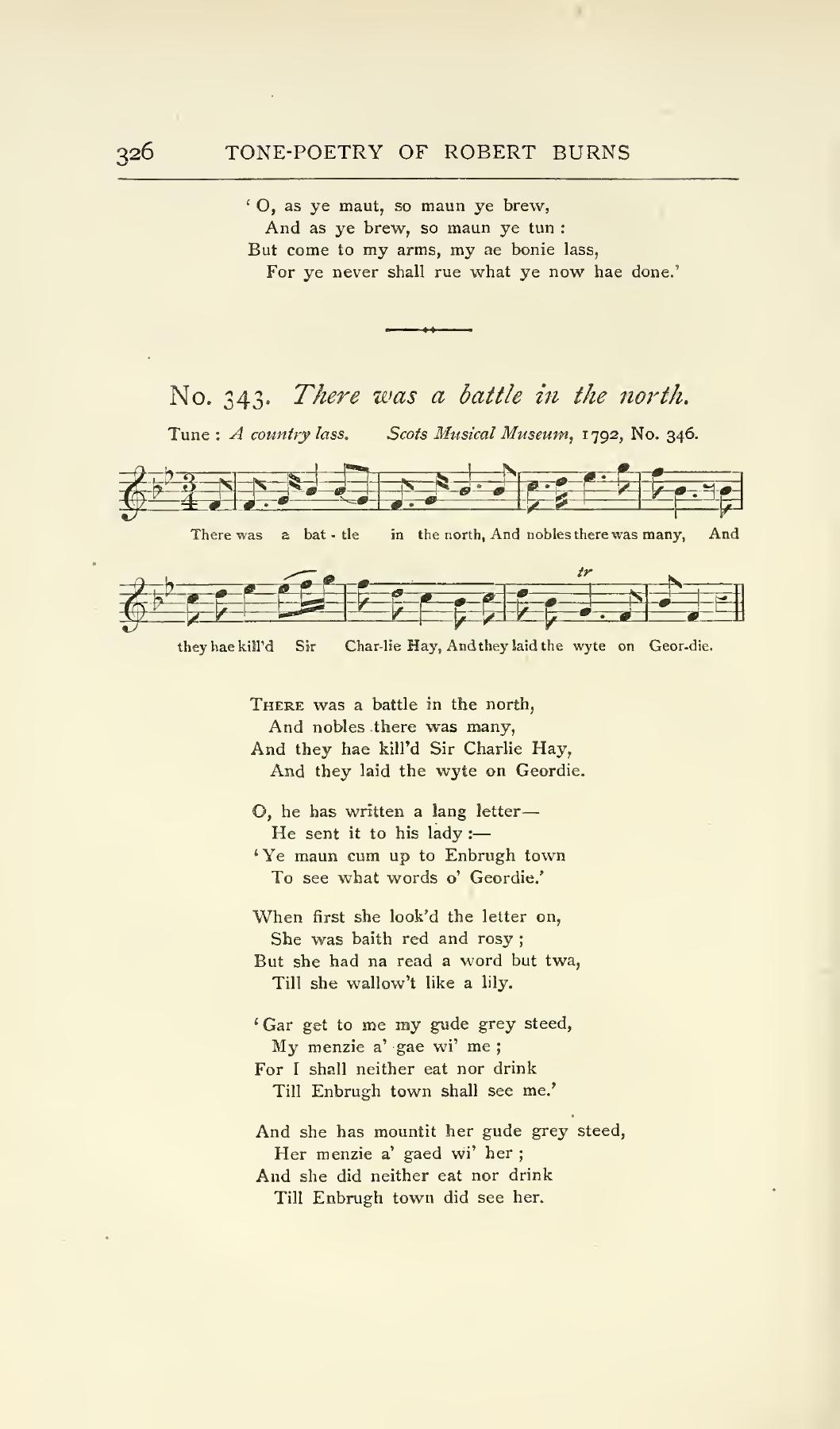 View score Dick’s Songs of Robert Burns (1903)
Lyrics
Dick (1903) · no. 343
There was a battle in the north.
There was a battle in the north,
And nobles there was many,
And they hae kill'd Sir Charlie Hay,
And they laid the wyte on Geordie.

O, he has written a lang letter—
He sent it to his lady:—
'Ye maun cum up to Enbrugh town
To see what words o' Geordie.'

When first she look'd the letter on,
She was baith red and rosy;
But she had na read a word but twa,
Till she wallow't like a lily.

'Gar get to me my gude grey steed,
My menzie a' gae wi' me;
For I shall neither eat nor drink
Till Enbrugh town shall see me.'

And she has mountit her gude grey steed,
Her menzie a' gaed wi' her;
And she did neither eat nor drink
Till Enbrugh town did see her.

And first appear'd the fatal block,
And syne the aix to head him,
And Geordie comin down the stair
And bands o' airn upon him.

But tho' he was chain'd in fetters strang
O' airn and steel sae heavy,
There was na ane in a' the court
Sae bra' a man as Geordie.

O, she's down on her bended knee,
I wat she 's pale and weary;
'O pardon, pardon, noble king
And gie me back my Dearie!

'I hae born seven sons to my Geordie dear
The seventh ne'er saw his daddie :
O, pardon, pardon, noble king,
Pity a waefu' lady!'

'Gar bid the headin-man mak haste!'
Our king reply'd fu' lordly :
'O noble king, tak a' that 's mine
But gie me back my Geordie.'

The Gordons cam and the Gordons ran
And they were stark and steady;
And ay the word amang them a',
Was, 'Gordons keep you ready.'

An aged lord at the king's right hand
Says: 'Noble king, but hear me:—
Gar her tell down five thousand pound,
And gie her back her Dearie.'

Some gae her marks, some gae her crowns,
Some gae her dollars many;
And she 's tell'd down five thousand pound,
And she 's gotten again her Dearie.

She blinkit blythe in her Geordie's face,
Says : 'Dear I've bought thee, Geordie,
But there sud been bluidy bouks on the green
Or I had tint my laddie.'

He claspit her by the middle sma,'
And he kist her lips sae rosy,
'The fairest flower o' woman-kind
Is my sweet bonie Lady.'
View the source edition · There was a battle in the north.
Music
View historical scores
Dick’s Songs of Robert Burns (1903)
There was a battle in the north.